

Military service is a transformative experience, no less today than it was during the American Revolution. What follows is a narrative journey tracing the experiences of men and women who answered the call to duty, from their enlistment to their return home. Excerpts from diaries, memoirs, and postwar depositions tell veterans’ and others’ stories in their own words, while historical sidebars provide context. We think you’ll agree that, while America 250 years ago was profoundly different from today’s world, the continuities of serving in the Armed Forces and living through war then and now are unmistakable. Across the centuries, the voices of veterans sound more familiar than we might imagine.
Joseph Plumb Martin 1774-6
A Teenager Joins the Connecticut Militia
In 1776, 15-year-old Joseph Plumb Martin signed up with the Connecticut Militia and was assigned duty in New York City, arriving just before the opening of the British Long Island Campaign. His first tour of duty ended in December 1776. The next spring, the 16-year-old veteran enlisted in the Continental Army for the duration of the War of Independence. Martin wrote his memoir in 1830, concerned that veterans’ stories were being forgotten. His book, A Narrative of a Revolutionary Soldier, is one of the rare enlisted-man accounts from the Revolution and chronicles hunger, cold, boredom, terror and the strange mix of humor, pride, and hardship that binds soldiers together.
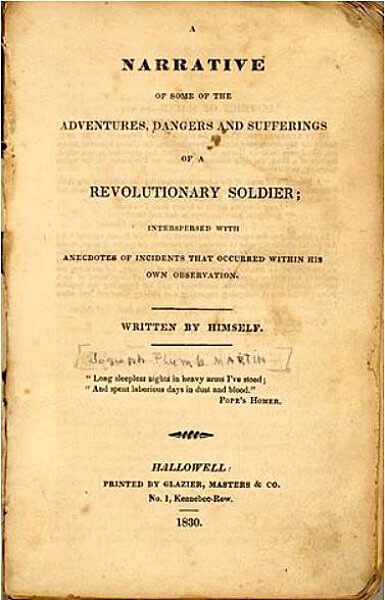
Narrative of a Revolutionary Soldier by Joseph Plumb Martin. (Public Domain)
I remember the stir in the country occasioned by the Stamp Act [the first direct British tax on colonists] but I was so young that I did not understand the meaning of it. I likewise remember the destruction of the tea at Boston and elsewhere. I was then thirteen or fourteen years old and began to understand something of the works going on. I used, about this time, to inquire a deal about the French war, as it was called, which had not been long ended; my grandsire [grandfather] would talk with me about it while working in the fields, perhaps as much to beguile his own time as to gratify my curiosity. I thought then, nothing should induce me to get caught in the toils of an army— “I am well, so I’ll keep,” was my motto then.
Time passed smoothly on with me till the year 1774 arrived, the smell of war began to be pretty strong, but I was determined to have no hand in it. I felt myself to be a real coward. What—venture my carcass where bullets fly! That will never do for me. Stay at home out of harm’s way, thought I, it will be as much to your health as credit to do so.
The spring of 1775 arrived. Expectation of some fatal event seemed to fill the minds of most of the considerate people throughout the country. I was ploughing in the field about half a mile from home, about the twenty-first day of April, when all of a sudden, the bells fell to ringing, and three guns were repeatedly fired in succession down in the village. I had some fearful forebodings.
I found most of the male kind of the people together; soldiers for Boston were in requisition. A dollar deposited upon the drum head was taken up by someone as soon as placed there, and the holder’s name taken, and he enrolled, with orders to equip himself as quick as possible. My spirits began to revive at the sight of the money offered; the seeds of courage began to sprout; but they had not as yet germinated. O, thought I, if I were but old enough to put myself forward, I would be the possessor of one dollar, the dangers of war to the contrary notwithstanding.
This year there were troops raised both for Boston and New-York. Some from the back towns were billeted at my grandsire’s. Their company and conversation began to warm my courage.
During the winter of 1775–6, by hearing the conversation and disputes of [the farmers], I collected pretty correct ideas of the contest between this country and the mother country. I thought I was as warm a patriot as the best of them. I felt more anxious than ever, if possible, to be called a defender of my country.
In the month of June, orders came out for enlisting men for six months. The troops were to go to New-York; and, notwithstanding I was told that the British army at that place was reinforced by fifteen thousand men, it made no alteration in my mind; I did not care if there had been fifteen times fifteen thousand, I should have gone just as soon as if there had been but fifteen hundred. I never spent a thought about numbers, the Americans were invincible, in my opinion.
I one evening went off with a full determination to enlist at all hazards. When I arrived at the place of rendezvous, I found a number of young men of my acquaintance there. The old bantering began.
“Come, if you will enlist I will,” says one.
“You have long been talking about it,” says another. “Come, now is the time.”
Seating myself at the table, enlisting orders were immediately presented to me; I took up the pen, loaded it with the fatal charge, made several mimic imitations of writing my name, but took especial care not to touch the paper with the pen. [At last], I wrote my name fairly upon the indentures. And now I was a soldier, in name at least, if not in practice.
But I had now to go home, after performing this, my heroic action. How shall I be received there? But the report of my adventure had reached there before I did. In the morning when I first saw my grandparents, I felt considerably of the sheepish order. The old gentleman first accosted me with, “Well, you are going a soldiering then, are you?”
I had nothing to answer; I would much rather he had not asked me the question. I saw that the circumstance hurt him and the old lady too; but it was too late now to repent. The old gentleman proceeded, — “I suppose you must be fitted out for the expedition, since it is so.”
Accordingly, they did fit me out in order, with arms and accoutrements, clothing, and cake, and cheese in plenty, not forgetting to put my pocket Bible into my knapsack. —Good old people!
I was now, what I had long wished to be, a soldier; I had obtained my heart’s desire; it was now my business to prove myself equal to my profession. I went, with several others of the company, on board a sloop, bound to New-York; had a pleasant, though protracted passage; passed through the strait called Hellgate; arrived at New-York; marched up into the city, and joined the rest of the regiment that were already there.
And now I had left my good old grandsire’s house, as a constant resident, forever.
Ebenezer Fox 1789
A Teenager Joins the Massachusetts Navy
Ebenezer Fox was born in Roxbury, Massachusetts in 1763 and grew up amid the political upheaval of the American Revolution. He was bound out as an apprentice at the age of seven and spent his youth in servitude at various trades, including a stint as a cabin boy on a voyage to the French colony of St. Domingue and later as a wigmaker’s apprentice in Boston.
As revolutionary ideas filled the streets and workshops of Massachusetts, the young Fox began to see his own apprenticeship as a kind of bondage. At seventeen, swept up in the excitement of the war, he enlisted aboard the Massachusetts warship Protector in 1780. Writing late in life, Fox recalled his teenage state of mind and described the rowdy spectacle of naval recruiting in Revolutionary Boston.
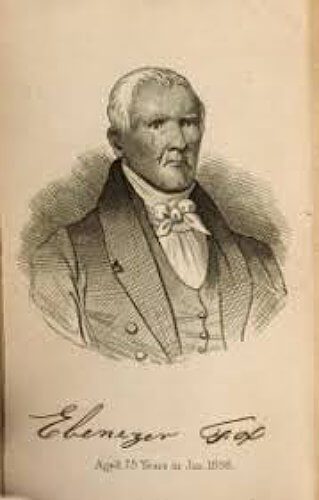
Ebenezer Fox (Public Domain)
I had for some time been dissatisfied with my situation and was desirous of some change. I had made frequent complaints of a grievous nature to my father, but he paid no attention to them, supposing that I had no just cause for them and that they arose merely from a spirit of discontent which would soon subside.
Expressions of exasperated feeling against the government of Great Britain, which had for a long time been indulged and pretty freely expressed, were now continually heard from the mouths of all classes—from father and son, from mother and daughter, from master and slave. A spirit of disaffection pervaded the land; groans and complaints, injustice and wrongs were heard on all sides. Violence and tumult soon followed.
Almost all the conversation that came to my ears related to the injustice of England and the tyranny of government.
It is perfectly natural that the spirit of insubordination that prevailed should spread among the younger members of the community; that they, who were continually hearing complaints, should themselves become complainants. I, and other boys situated similarly to myself, thought we had wrongs to be redressed and rights to be maintained; and, as no one appeared disposed to act the part of a redresser, it was our duty and our privilege to assert our own rights.
We made a direct application of the doctrines we daily heard, in relation to the oppression of the mother country, to our own circumstances, and thought that we were more oppressed than our fathers were.
I thought that I was doing myself great injustice by remaining in bondage when I ought to go free, and that the time was come when I should liberate myself from the thraldom of others and set up a government of my own—or, in other words, do what was right in the sight of my own eyes.
* * *
I continued to perform my duties in the shop until I was about seventeen years of age, when a spirit of roving once more got possession of me, and I expressed a desire to go to sea. The [economic] condition of the country was at this time distressing; and, my master had not more business than he and one apprentice could perform.
Our coast was lined with British cruisers, which had almost annihilated our commerce; and the state of Massachusetts judged it expedient to build a government vessel, rated as a twenty-gun ship, named the Protector, commanded by Captain John Foster Williams. She was to be fitted out for service as soon as possible to protect our commerce and to annoy the enemy.
A rendezvous was established for recruits at the head of Hancock’s Wharf, where the national flag, then bearing thirteen stripes and stars, was hoisted. All means were resorted to which ingenuity could devise to induce men to enlist. A recruiting officer, bearing a flag and attended by a band of martial music, paraded the streets to excite a thirst for glory and a spirit of military ambition.
The recruiting officer possessed the qualifications requisite to make the service appear alluring, especially to the young. He was a jovial, good-natured fellow, of ready wit and much broad humor. Crowds followed in his wake when he marched the streets, and he occasionally stopped at the corners to harangue the multitude in order to excite their patriotism and zeal for the cause of liberty.
When he espied any large boys among the idle crowd around him, he would attract their attention by singing in a comical manner the following doggerel:
All you that have bad masters
And cannot get your due,
Come, come, my brave boys,
And join with our ship’s crew.
My excitable feelings were roused. I repaired to the rendezvous, signed the ship’s papers, mounted a cockade, and was, in my own estimation, already more than half of a sailor.
About the last of February, the ship was ready to receive her crew and was hauled off into the channel, that the sailors might have no opportunity to run away after they were got on board. Upwards of three hundred and thirty men were carried, dragged, and driven on board—of all kinds, ages, and descriptions, in all the various stages of intoxication, from that of “sober tipsiness” to beastly drunkenness, with the uproar and clamor that may be more easily imagined than described. Such a motley group has never been seen since Falstaff’s ragged regiment paraded the streets of Coventry.
Joseph Plumb Martin 1776
In New York, a New Recruit Gets a Taste of Army Life and Madeira Wine: “I expected to be hanged.”
The soldiers at New-York had an idea that the enemy, when they took possession of the town, would make a general seizure of all property that could be of use to them as military or commissary stores, hence they imagined that it was no injury to supply themselves when they thought they could do so with impunity. I was stationed in Stone-street, near the southwest angle of the city; directly opposite to my quarters was a wine cellar, and in it at this time were several pipes of Madeira wine.
By some means the soldiers had smelt it out. Some of them had taken the iron grating from a window in the back yard, and one had entered the cellar, and by means of a powder-horn divested of its bottom, had supplied himself with wine, and was helping his comrades through the window with a delicious draught.
I concluded I would take a flask amongst the rest, which I accordingly did, and conveyed it in safety to my room, and went back into the street to see the end. The owner of the wine soon found out what was going forward on his premises, and, finding that he could affect nothing with them, went to Gen. [Israel] Putnam’s quarters.
The General immediately repaired in person to the field of action, mounting himself upon the doorsteps of my quarters, began haranguing the multitude, threatening to hang every mother’s son of them.
I took every word he said for gospel and expected nothing else but to be hanged before the morrow night.
I got home as soon as the General had left the coast clear, took a draught of the wine, and then flung the flask and the remainder of the wine out of my window.
However, I might have kept it, if I had not been in too much haste to free myself from being hanged by General Putnam. I never heard any thing further about the wine or being hanged about it.
Ezra Tilden 1776
The Things He Carried: From the Revolutionary War Diary of Ezra Tilden
Ezra Tilden was a militia man during the American Revolution who was drafted to serve on July 20th, 1776. Tilden traveled along with Captain Endicott’s Company from Stoughton, Massachusetts, joining Colonel Ephraim Wheelock’s Militia Regiment at Ticonderoga. Before leaving for Ticonderoga, he wrote an account of what he carried in his knapsack.
August 5, 1776
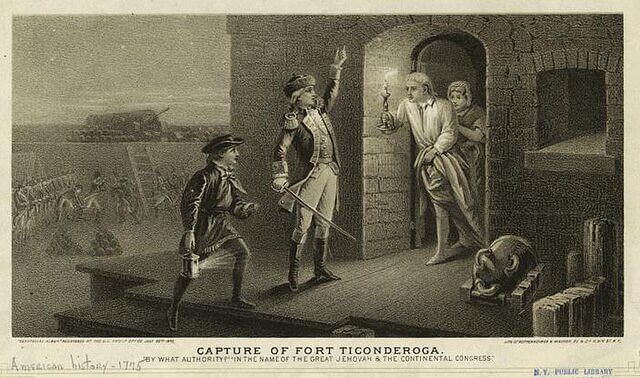
The Capture of Fort Ticonderoga, May 10, 1775. (New York Public Library)
An Account of some things I carried into the Army in my Pack:
A woolen Shirt with a snuff bottle full of ground coffee in it, and one and a half of chocolate in it too, wrapt up in a piece of brown paper and a new cotton and linen shirt and a new milk cheese wrapt up in it which weighed five pounds, a pair of white stockings, a pair of blue stockings, a bag of plumbs, a bag with three pounds and half of sugar in it, a pair of boots, a cap, a powder horn, four sheets of paper wrapt up in a piece of brown paper and four quills in it, a brown paper with two pieces of soap in it, one great pin, four small ones, one brown thread needle, and one worsted darning needle, one ball of white yarn, one ball of blue yarn, some strings, some thread, some sealing wax, a snuff box full of snuff, a pewter bason, a wooden plate, a spoon, a fork, a Jack-knife, a pen-knife, a pair of knee buckles, a pocket book and case to it, a small toothed comb, a pocket looking glass, an under-jacket, a short coat, a great coat, a pair of grey stockings, two pair shoes, a striped shirt, a pair of long trowsers, a hat, two handkerchiefs, a pair of shoe buckles, a pair of garters, a pack to carry my things in, some bread, a pair of arm strings, a pair of leather breeches, a pair of cloth breeches, a leather strap, a cod line, a frock, some tow.
N.B. I have here set down, not only my pack and things in it, but even my clothes and things that I wear, besides the things in my pockets that I carry & other things.
Joseph Plumb Martin 1776
First Taste of Battle
In August and September 1776, as British forces closed in on New York, seventeen-year-old Continental soldier Joseph Plumb Martin saw the wounded from the battle on Long Island and shortly thereafter came under heavy fire himself at Kips Bay on Manhattan. He describes the mixed feelings of a young soldier: dread, confusion, hunger, exhaustion, and relief at finding his regiment again.
I saw our sergeant-major directing his course up Broadway, towards us, in rather an unusual step for him. He soon informed us that he had orders to take our regiment to Long-Island, the British having landed in force there.
Although this was not unexpected to me, yet it gave me rather a disagreeable feeling. However, I kept my cogitations to myself, went to my quarters, packed up my clothes, and got myself in readiness for the expedition as soon as possible.
I then went to the top of the house where I had a full view of that part of the Island. I distinctly saw the smoke of the field-artillery. The horrors of battle then presented themselves to my mind in all their hideousness. I must come to it now, thought I. I will endeavour to do my duty as well as I am able and leave the event with Providence.
We soon landed at Brooklyn, upon the Island, marched up the ascent from the ferry, to the plain.
We now began to meet the wounded men, another sight I was unacquainted with, some with broken arms, some with broken legs, and some with broken heads.
The sight of these a little daunted me and made me think of home.
I saw a Lieutenant who appeared to have feelings not very enviable. He ran round among the men of his company, snivelling and blubbering. Had he been at the gallows with a halter about his neck, he could not have shown more fear. I would have then suffered anything short of death rather than have made such an exhibition of myself.
It was on a Sabbath morning, the day in which the British were always employed about their deviltry, if possible. We lay very quiet in our ditch, waiting their motions, till the sun was an hour or two high. We heard a cannonade at the city, but our attention was drawn toward our own guests.
They being a little dilatory in their operations, I stepped into an old warehouse which stood close by me and sat down upon a stool. All of a sudden, there came such a peal of thunder from the British ships that I thought my head would go with the sound.
I made a frog’s leap for the ditch and lay as still as I possibly could and began to consider which part of my carcass was to go first.
The British played their parts well. Indeed, they had nothing to hinder them. We kept the lines till they were almost levelled upon us, when our officers, seeing we could make no resistance and that we must soon be entirely exposed to the rake of their guns, gave the order to leave the lines.
In retreating we had to cross a level, clear spot of ground, forty or fifty rods wide, exposed to the whole of the enemy’s fire; and they gave it to us in prime order. The grape shot and langrage (cannon ammunition composed of scrap metal—such as bolts, nails, and broken glass) — flew merrily, which served to quicken our motions.
When I had gotten a little out of the reach of their combustibles, I found myself in company with one who was a neighbour of mine at home, and another belonging to our regiment. Where the rest of them were I knew not. We went into a house by the highway, where two women and some small children were crying bitterly. We asked the women if they had any spirits in the house. They placed a case bottle of rum upon the table and bade us help ourselves. We each drank a glass, and bidding them goodbye, betook ourselves to the highway again.
We had not gone far before we saw a party of men hurrying in the same direction with ourselves; we endeavoured to overtake them, but upon approaching found that they were not of our way of thinking—they were Hessians. We immediately altered our course and took the main road leading to King’s Bridge.
Before long we saw another party ahead whom we knew to be Americans; but just as we overtook them, they were fired upon by a party of British from a cornfield, and all was immediately in confusion again. I believe the enemy’s party was small, but our people were all militia, and the demons of fear and disorder seemed to take full possession of everything on that day.
When I came to the spot where the militia were fired upon, the ground was literally covered with arms, knapsacks, staves, coats, hats, and old oil flasks thrown away in the hurry.
By this time only the neighbour whom I mentioned remained with me. He had been unwell for some time and was now so overcome by heat, hunger, and fatigue that he became violently sick. I took his musket and endeavoured to encourage him on, for I was loath to leave him behind.
We had not gone far before we found our retreat cut off by a party of the enemy stretched across the island. I immediately quitted the road and ran into a small boggy spot covered with low bushes and weeds. Into these I crept and squatted down to conceal myself. Several of the British came so near that I could plainly see the buttons upon their coats. They soon withdrew, however, and left the coast clear again.
I then came out of my covert and went on, still carrying my sick friend’s musket. I was faint from hunger, having eaten nothing for more than twenty-four hours, and had slept but little the night before.
Soon I came to a brook where several soldiers had stopped to drink. One man had lain down to drink and did not rise again. Someone said he would kill himself by drinking so much water; another replied that he had already done so—which proved to be the case.
Going on again, I soon found a number of men resting under the fences and bushes. Almost the first I saw was my sick neighbour, sitting with his head between his knees. I was exceedingly glad to find him, for I had little hope of ever seeing him again.
“Come,” said I, “get up and go on with me.”
“No,” said he, looking very pitiful, “I must die here.”
I told him he should not die there if I could help it; and after much persuasion, and some force, I succeeded in getting him upon his feet again.
A shower of rain soon came on and wet us through to the skin, but we still moved slowly forward. After proceeding about half a mile, we came to a place where two or three hundred of our men had begun to make a stand with a few field-pieces, expecting the enemy every moment.
A sentinel stopped us from going farther. I told the officer that our regiment was just ahead and that my sick companion would die if exposed all night to the damp cold air.
“Well,” said he, “if he dies the country will be rid of one who can do it no good.”
A very compassionate gentleman, thought I.
Seeing little chance of escaping by fair means, I watched the sentinel closely. Soon an acquaintance of his came up with a canteen of spirits. After drinking, they fell into conversation. I gave my comrades a wink, and we slipped quietly past the sentinel without his perceiving us.
We soon came up with the regiment resting upon the cold ground after the fatigues of the day. Our company seemed glad to see us, thinking we had been killed or taken prisoners. I was sincerely glad to see them also, for I was once more among friends.
Several of the regiment were missing, among them our Major, a fine man whose loss was much regretted. We were the last who came up; all the others who were missing were either killed or taken prisoners.
James Thacher 1777
An Army Surgeon Treats the Wounded
James Thacher, a Massachusetts physician and Continental Army surgeon, left one of the most vivid medical records of the Revolutionary War. He wrote this passage in October 1777, after the hard fighting around Philadelphia, when American hospitals were crowded with wounded and sick from Brandywine, Germantown, and the fall campaign, and army surgeons worked from morning until night amputating limbs, dressing terrible wounds, and trying to comfort dying men far from home.
October 24, 1777. — This hospital is now crowded with officers and soldiers from the field of battle; those belonging to the British and Hessian troops are accommodated in the same hospital with our own men and receive equal care and attention. The English surgeons perform with skill and dexterity, but the Germans, with a few exceptions, do no credit to their profession; some of them are the most uncouth and clumsy operators I ever witnessed, and appear to be destitute of all sympathy and tenderness towards the suffering patient.
Not less than one thousand wounded and sick are now in this city; the Dutch church, and several private houses, are occupied as hospitals. We have about thirty surgeons and mates, and all are constantly employed. I am obliged to devote the whole of my time, from eight o’clock in the morning to a late hour in the evening, to the care of our patients. Here is a fine field for professional improvement.
Amputating limbs, trepanning fractured skulls, and dressing the most formidable wounds, have familiarized my mind to scenes of woe. A military hospital is peculiarly calculated to afford examples for profitable contemplation, and to interest our sympathy and commiseration. If I turn from beholding mutilated bodies, mangled limbs, and bleeding, incurable wounds, a spectacle no less revolting is presented: miserable objects languishing under afflicting diseases of every description, with emaciated bodies and ghastly visage.
No parent, wife, or sister is there to wipe the tear of anguish from their eyes, or to soothe the pillow of death. They look up to the physician as their only earthly friend and comforter and trust the hands of a stranger to perform the last mournful duties. Frequently have I remarked their confidence in my friendship, as though I were endeared to them by brotherly ties. Viewing these unfortunate men as the faithful defenders of the liberties of our country, far separated from their dearest friends, who would be so lost to the duties of humanity, patriotism, and benevolence, as not to minister to their comfort, and pour into their wounds the healing balm of consolation?
It is my lot to have twenty wounded men committed to my care. One of them, a young man, received a musket ball through his cheeks, cutting its way through the teeth on each side, and through the substance of the tongue; his sufferings have been great, but he now begins to articulate tolerably well. Another had the whole side of his face torn off by a cannon ball, laying his mouth and throat open to view.
Joseph Plumb Martin 1777
“We Were Now in a Truly Forlorn Condition”: The Army at Valley Forge
In December 1777, after defeats around Philadelphia, George Washington’s army marched into winter quarters at Valley Forge, where teenage Continental soldier Joseph Plumb Martin wrote about the hunger, cold, and desperation that nearly destroyed the army.
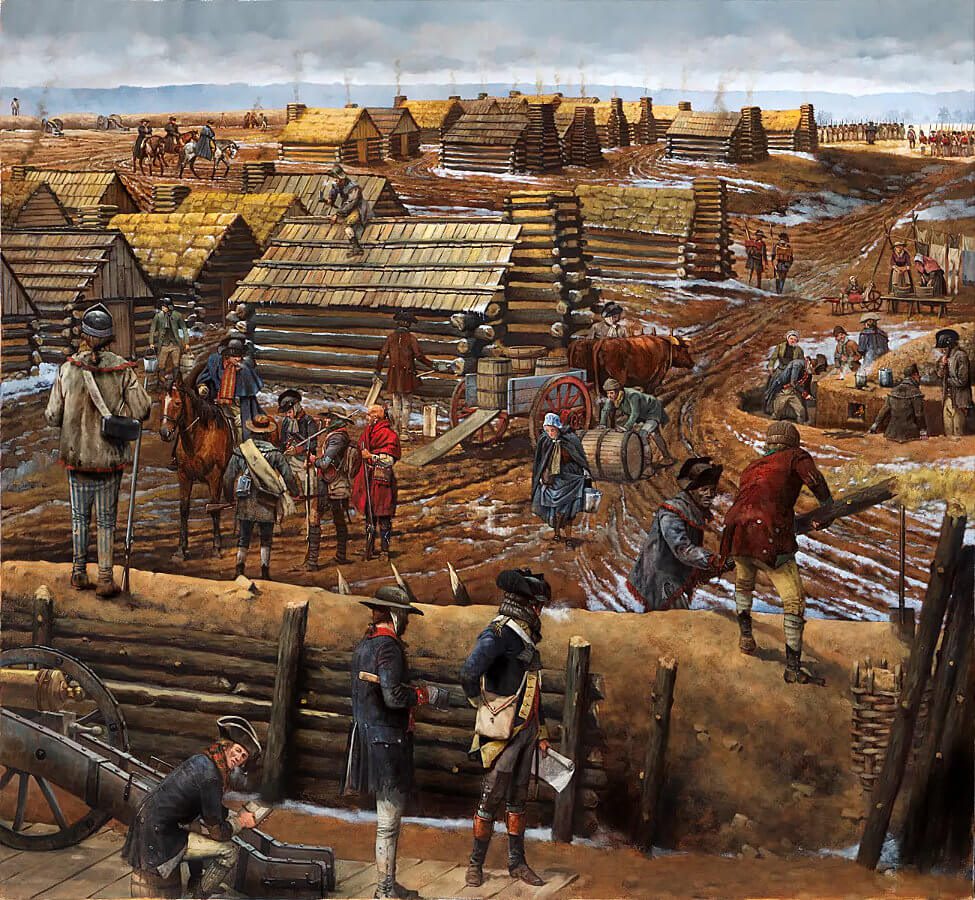
The Encampment at Valley Forge. (National Park Service: Rocco)
We marched for the Valley Forge in order to take up our winter-quarters. We were now in a truly forlorn condition—no clothing, no provisions and as disheartened as need be. We arrived at our destination a few days before Christmas. Our prospect was indeed dreary.
However, there was no alternative but desertion. But we had engaged in the defence of our injured country and were willing, nay, we were determined to persevere as long as such hardships were not altogether intolerable.
I had experienced what I thought sufficient of the hardships of a military life the year before. But we were now absolutely in danger of perishing. We then had but little, and often nothing to eat for days together. Had there fallen deep snows or even heavy and long rainstorms, the whole army must inevitably have perished. Or had the enemy, strong and well provided as he then was, thought fit to pursue us, our poor emaciated carcasses must have ‘strewed the plain.’ But a kind and holy Providence took more notice and better care of us than did the country in whose service we were wearing away our lives by piecemeal.”
We arrived at the Valley Forge in the evening; it was dark; there was no water to be found, and I was perishing with thirst. I searched for water till I was weary and came to my tent without finding any—fatigue and thirst, joined with hunger, almost made me desperate. I felt at that instant as if I would have taken victuals or drink from the best friend I had on earth by force. I am not writing fiction, all are sober realities. Just after I arrived at my tent, two soldiers, whom I did not know, passed by; they had some water in their canteens which they told me they had found a good distance off, but could not direct me to the place as it was very dark. I tried to beg a draught of water from them but they were as rigid as Arabs. At length I persuaded them to sell me a drink for three pence, Pennsylvania currency, which was every cent of property I could then call my own; so great was the necessity I was then reduced to.
I lay here two nights and one day, and had not a morsel of anything to eat all the time, save half of a small pumpkin, which I cooked by placing it upon a rock, the skin side uppermost, and making a fire upon it; by the time it was heat through I devoured it with as keen an appetite as I should a pie made of it at some other time.
Ebenezer Fox 1780
Hell Afloat: On the Prison Ship Jersey
While serving aboard the warship Protector in 1780, Ebenezer Fox was captured by the British and held on the notorious prison ship Jersey, anchored in New York’s East River.
The rotting hulk held more than a thousand American prisoners of war under horrific conditions of hunger, disease, and overcrowding. Thousands died there during the Revolution. Writing late in life, Fox recalled the experience with a mixture of grim humor and vivid detail. His account remains one of the most powerful firsthand descriptions of the suffering endured by American prisoners during the war.
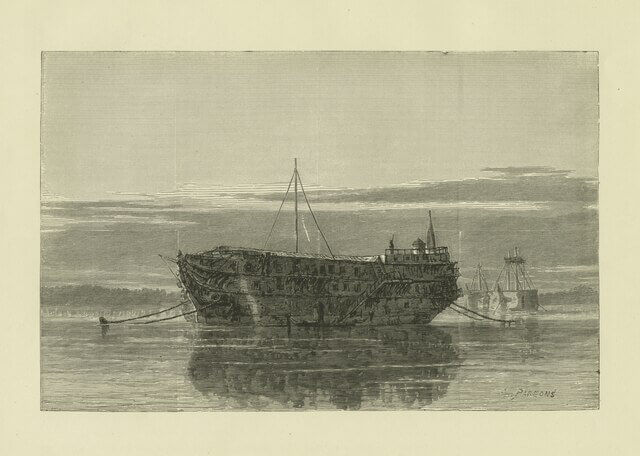
Jersey, a British prison ship. (Public Domain)
We continued merrily on our course, without seeing friend or foe, during the next day; but, the following morning, the man at the masthead cried out, “Two sail to the leeward.” Mr. Little ascended to the main top With his glass, and soon ascertained that they were two large ships, closely hauled upon the wind, in full chase of us.
Our captain, calling all the hands aft on the quarter deck, expressed his opinion, that the ships in pursuit of us were English, and that we should be captured.
We found that the two ships had got up with us. They proved to be the Roe-Buck, a forty-gun ship with a double deck, and the mayday, of twenty-eight guns.
To attempt resistance against a force so much our superior would have been unjustifiable; and the flag of thirteen stars and stripes, under which we had sailed with much satisfaction and success, was reluctantly pulled down; and this was the unfortunate end of our second cruise.
The boats of the enemy were manned and sent alongside of our ship. [Soon], the enemy had ascended the deck.
Their first exploit was to strike or kick every sailor that came in their way, bestowing a variety of opprobrious epithets, among which “damned rebels” was of the most frequent recurrence; then they commenced searching in every part of the ship for articles of value.
* * *
Shortly after, we anchored off Sandy Hook, and preparations were made to examine the prisoners, to ascertain what part of them were Englishmen; or rather, who among them would carry the appearance of able-bodied seamen.
About a third part of our ship’s crew were taken on board of their vessels, to serve in the capacity of sailors. The remainder of us were put on board of a wood coaster, to be conveyed on board the noted prison ship called the Jersey.
The idea of being incarcerated in this floating Pandemonium filled us with horror; but the idea we had formed of its horrors fell far short of the realities which we afterwards experienced.
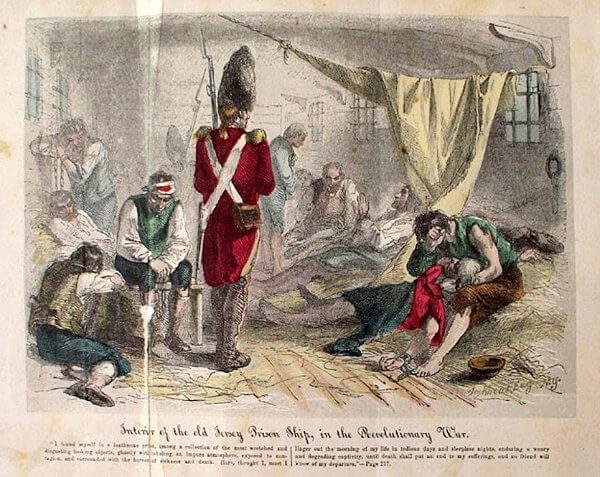
A British Army guard watches over American prisoners on the Jersey prison ship. (Library of Congress)
We proceeded slowly up the river towards our much-dreaded place of confinement, and at doubling a point we came in sight of the gloomy-looking hulk of the old Jersey, aptly named by the sailors, “The hell afloat.” The Jersey was originally a seventy-four gun ship. She was converted into a prison ship, and continued to be used for that purpose during the remainder of the war.
The idea of being a prisoner in such a place was sufficient to fill the mind with grief and distress. The heart sickened, the cheek grew pale with the thought. Our destiny was before us, and there was no alternative but to submit.
I now found myself in a loathsome prison, among a collection of the most wretched and disgusting looking objects that I ever beheld in human form.
Here was a motley crew, covered with rags and filth; visages palled with disease, emaciated with hunger and anxiety, and retaining hardly a trace of their original appearance.
Our keepers were no respecters of persons. We were all “rebels.” The quantity and quality of our fare [food] was the same for all. Each prisoner received two thirds as much as was allowed to a seaman in the British navy.
The bread was mouldy and filled with worms. It required considerable rapping upon the deck before the worms could be dislodged. As for the pork, one would have judged from its motley hues, exhibiting the consistence and appearance of variegated fancy soap, that it was an inhabitant of the ocean rather than of the sty.
But whatever doubts might arise respecting the general species of the beast, the flavor of the flesh was so unsavory that it would have been rejected as unfit for the stuffing even of Bologna sausages.
The flour and the oat-meal were often sour . . . it might be nosed [smelled] half the length of the ship.
The first view of our beef would excite an idea of veneration for its antiquity, and not a little curiosity to ascertain to what kind of an animal it originally belonged. It required more skill than we possessed to determine whether the flesh had once covered the bones of some luckless bull that had died from starvation or of some worn-out horse that had been killed for the crime of having outlived his usefulness.
The manner in which [our food] was cooked was more injurious to our health, than the quality of the food; and, in many cases, laid the foundation of diseases, that brought many a sufferer to his grave, years after his liberation.
The Jersey, from her size and lying near the shore, was imbedded in the mud. All the filth that accumulated among upwards of a thousand men was daily thrown overboard and would remain there till carried away by the tide. The impurity of the water may be easily conceived; and in this water our meat was boiled.
It will be recollected, too, that the water was salt, which caused the inside of the copper to become corroded. Meat thus cooked must in some degree be poisoned; and the effects of it were manifest in the cadaverous countenances of the emaciated beings, who had remained on board for any length of time.
No vegetables were allowed us. Many times since, when I have seen in the country, a large kettle of potatoes and pumpkins steaming over the fire to satisfy the appetites of a farmer’s swine, I have thought of our destitute and starved condition, and what a luxury we should have considered the contents of that kettle on board the Jersey.
When any of the prisoners died in the night, their bodies were brought to the upper deck in the morning and placed upon the gratings. If the deceased had owned a blanket, any prisoner might sew it around the corpse, and then it was lowered with a cope, tied round the middle, down the side of the ship into a boat.
The fate of many of these unhappy victims must have remained forever unknown to their friends; for, so large a number, no exact account could be kept of those who died, and they rested in a nameless grave.
The miseries of our condition were continually increasing: the pestilence on board spread rapidly, and every day added to our bill of mortality. The young, in a particular manner, were its most frequent victims. The number of the prisoners was continually increasing, notwithstanding the frequent and successful attempts to escape. The officers of the ship endeavored to make amends for [the escapes] by increasing the rigor of our confinement and depriving us of all hope of adopting any of the means for liberating ourselves from our cruel thralldom, so successfully practiced by many of our comrades.
Of all the prisons, on land or water, for the confinement of the Americans during the Revolutionary war, the “Old Jersey” was acknowledged to be the worst.
