

By Todd DePastino
As a historian drawn to veterans’ stories, I sometimes indulge a private daydream. One morning at a Veterans Breakfast Club gathering, just as the coffee is being poured and the conversations begin, the door opens and in walks a small, weathered old man in a dusty colonial militia uniform.
He’s bent with age and leans on a cane. A scar across his forehead hints at old battles. There’s a sparkle in his eye and a wry half-smile on his lips. He takes a seat with a cup of coffee and begins talking the way veterans do—plainly, but proudly—about fighting the Redcoats and later sailing the seas as a Patriot privateer.
As it happens, he is the last surviving veteran of the American Revolution, and he’s stumbled into the Veterans Breakfast Club.
The man in my daydream was real. His name was George Robert Twelves Hewes, and he was a humble shoemaker. He possessed a sharp wit, an uncanny memory, and storytelling prowess that would have made him a star at our VBC gatherings. If he walked into the VBC today, he’d fit right in.

Joseph Greenleaf Cole portrait of George Robert Twelves Hewes now hanging in the Old State House in Boston. (Boston Tea Party Ships & Museum)
How George Hewes Entered the History Books
History isn’t made to record the stories of people like George Hewes. He was born into a poor family in Boston, lived a hard-scrabble life, and died in poverty. Nothing about him advertised heroism. He stood barely five-feet-tall, and after the Revolution, he returned to his quiet life as a shoemaker.
The only reason we know George’s story is because late in his life, people around him started listening. They took an interest in George because they knew the original “Greatest Generation,” those who had fought in 1776, was rapidly passing away.
On July 4, 1833, George was living at his son’s house in Richfield Springs, New York. Without income or savings, he depended on his fifteen children for support. They took turns hosting the old man before shuttling him off to the next sibling.
On this Independence Day 1833, the town poured out to the village green for speeches and a parade, ceremonial gunfire and the reading of the Declaration of Independence. Standard July 4th celebrations also included thirteen toasts, one for each original state, plus an extra for George Washington.
Among the crowd that day was a tiny old man, resplendent in his ancient Massachusetts militia uniform. In prior years, he’d probably been overlooked. But by 1833, Americans knew that the generation that had fought the Revolution and founded the country was fading. There’d been an outpouring of interest in the old-timers in 1826 for the 50th anniversary of 1776. That fascination hadn’t abated, and anyone old enough to have served in the War of Independence was considered someone to be celebrated and listened to.
George didn’t shy away from the attention. He allowed people to gather round him and began making extravagant and, frankly, unbelievable claims. He said he was the last living veteran who had been there when the war broke out in 1775. That was false. He also said he was 100 years old. In truth, he was nearly 91.
When the good people of Richfield Springs learned George was from Boston, they began peppering him with questions.
“Were you there for the Boston Massacre?”
“Why, of course!” George answered. He relayed how he’d rushed out to the Boston Custom House on King Street on March 5, 1770, to throw snowballs at the British soldiers who’d been harassing a fellow apprentice. A Redcoat smashed his shoulder with a Brown Bess musket. He watched in horror as British soldiers fired into the crowd and five young Americans fell.
“What about the Boston Tea Party? Were you part of that?”
“Of course, I was part of it,” George responded. He waxed nostalgic about dressing up as a Mohawk Indian and joining a group that snuck aboard three ships—the Dartmouth, the Eleanor, and the Beaver—the night of December 16, 1773. He explained that he was assigned to the Dartmouth and given leadership of his vigilante squad by virtue of his unusual talent for whistling commands. After confronting the ship’s captain and demanding keys to the tea chests, he and his squad spent the next three hours dumping the tea into the harbor.
These stories were only the beginning. George told all kinds of far-fetched tales about fighting in land battles as a militiaman and even serving at sea as a pirate (politely referred to as a “privateer”) stealing cargo from British ships. He talked about knowing all the Boston bigwigs: Samuel Adams and John Adams, John Hancock and Joseph Warren—the very leaders of the American Revolution. He even claimed to have had dinner with George Washington himself.
It turns out that, apart from his age and status as the last Revolutionary survivor, every other detail George shared about his life was true. Every last story. It all checked out. He had been part of the Boston Massacre mob. He had been a member of the Sons of Liberty and had thrown British tea in Boston Harbor. And he had fought in the Battle of Rhode Island in 1778 and had helped to capture seven enemy ships while serving as a privateer sailor. He’d even met Washington.
The citizens of Richfield Springs were held spellbound by George on July 4, 1833.
One of those fascinated listeners was a writer, James Hawkes, who turned the stories George told that day into a book published the following year, A Retrospect of the Boston Tea-Party, With a Memoir of George R. T. Hewes, A Survivor of the Little Band of Patriots Who Drowned the Tea in Boston Harbour in 1773.
Hawkes’ book was a sensation at a time when the nation was paying its final public tribute to the Heroes of 1776.
A Retrospect of the Boston Tea-Party made Hewes a celebrity. He was invited to Boston to sit for a formal portrait to hang in the Massachusetts State House (it’s still there). He became the subject of a second biography by Benjamin Thatcher that reached even more readers. And he was feted by dignitaries and crowds of admirers for the next seven years.
George Robert Twelves Hewes might have made it to 100 years old, if he hadn’t fallen while boarding a carriage on July 4, 1840. He never recovered after breaking his hip and died four months later at age 98.
The two old biographies of George capture his life experiences, his colorful character, and warm sense of humor. They also address what I would have tried to get George to talk about at my imagined Veterans Breakfast Club event.
A VBC Question for George
“George,” I would ask, “what was your life like before the Revolution?” The story George shared and which I now share with you, is one he told countless times.
At twenty-one, George, a shoemaker’s apprentice in Boston, repaired a shoe for a wealthy merchant named John Hancock. At the time, Hancock worked in the countinghouse of his uncle Thomas Hancock, the richest merchant in Boston. Hancock was so pleased with the repair he sent a message inviting the young apprentice to pay him a visit on New Year’s Day.
In colonial Boston, where the gap between a grandee like Hancock and a lowly apprentice like George was vast, the prospect of paying Hancock a social visit was terrifying. Every movement, every word would have to follow script. George would have to make sure he paid Hancock the honor, respect, and deference he was due.
On New Year’s Day, young George washed his face, put on his best jacket, and walked trembling to the great Hancock mansion on Beacon Hill.
He knocked on the front door.
A servant answered.
“Is ’Squire Hancock at home, sir?” George asked, bowing and removing his hat.
The servant ordered him to sit in the kitchen while word was sent upstairs. A few minutes later the man returned, suddenly much more polite than before, and ushered George into Hancock’s sitting room.
George later admitted he was “almost scared to death.”
Hancock greeted him kindly. George tried to deliver the speech he had prepared—something polite and respectful that would announce his visit and allow him to leave as quickly as possible.
Hancock interrupted.
“Well, my lad,” he said, “take a chair.”
Then Hancock reached into his pocket and placed a crown coin in George’s hand. He thanked him for the New Year’s greeting and invited him to drink a toast. Wine was poured and glasses were clinked, a ritual that was unknown to George.
As soon as he could, George bowed again and escaped.
What George’s Meeting with John Hancock Reveals
This simple story reveals something important about the world George grew up in. Colonial society ran on deference. Poor men bowed. They removed their hats. They stepped out of the way when a superior approached. They spoke carefully and never looked an aristocrat in the eye. They knew their place.
And it wasn’t just about manners. Ordinary craftsmen and farmers didn’t hold office or make decisions for the colony. They mostly didn’t vote. They deferred to, that is, they accepted the rule of their social betters.
What we call the American Revolution shattered this old deferential world, and you can trace the transformation, the birth of a new American society, in George’s stories about the Boston Massacre in 1770, the Boston Tea Party in 1773, and what was, for George, his most painful encounter with colonial authority: his clash with British customs officer John Malcolm on January 25, 1774.
George had just finished his dinner and was walking back to his shoemaking shop along Fore Street when he saw a disturbing scene unfolding ahead of him. Malcolm was cursing at a small boy who was pushing a toy sled through the street. The customs officer shook his heavy cane threateningly, offended that the boy had not moved out of his way fast enough.
George watched for a moment, then stepped forward.
“Mr. Malcolm,” he said, “I hope you are not going to strike that boy with that stick.”
It was a bold thing for a poor shoemaker to say to a man like Malcolm. Malcolm was no ordinary bully. He was a fierce defender of royal authority and proud enforcer of imperial law—the Stamp Act, the Townshend Acts, the Tea Act, and all the other regulations odious to the people of Boston.
Malcolm turned on Hewes immediately.
“You are an impertinent rascal,” he barked. “It is none of your business. And a vagabond like you has no place to speak to a gentleman in such a way.”
George held his ground.
“I’m not a vagabond, and you should not strike a boy with such a heavy stick.”
That was all it took for Malcolm to explode in rage. He lifted his cane and struck a blow squarely on the shoemaker’s forehead. The cane’s metal tip carved a gully in George’s skull, and he collapsed to the ground unconscious.
Friends rushed him to Dr. Joseph Warren, the patriot physician who would later die at Bunker Hill. Warren treated the wound, which left a visible scar on George’s forehead for the rest of his life.
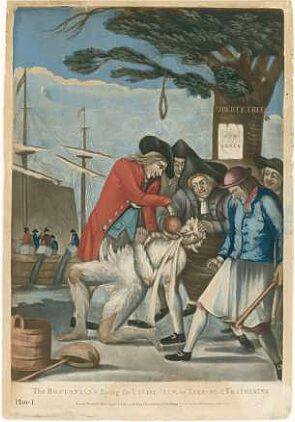
Philip Dawe’s The Bostonians Paying the Excise-man or Tarring and Feathering 1774 depicts the fate of the infamous John Malcolm. (Public Domain)
The Sons of Liberty, made up mostly of artisans like George, took matters in their own hands.
That evening, they stormed Malcolm’s house, dragged the official out, placed him on a sled, and hauled him through the streets with thousands of Bostonians jeering.
What followed became the most famous tarring and feathering of the American Revolution.
Malcolm was stripped to the waist, coated in hot tar and feathers, paraded through Boston, and taken to Liberty Tree, an old elm on Orange Street near Boston Common. There the crowd demanded he renounce his royal office or be hanged.
Meanwhile, back at Dr. Warren’s house, George Hewes came to, heard what was happening, and, his head swathed in bloody bandages, rushed to the Liberty Tree.
The tender-hearted George brought a blanket with him and tried to throw it protectively over Malcolm’s shoulders. He pleaded with the vigilantes to let the humiliated man go.
The crowd did, eventually, release Malcolm, but not before forcing tea down his throat and making him give mocking toasts to King George III. Malcolm soon left Boston, never to return.
Another VBC Breakfast Question for George
In my daydream, I can’t resist asking George Robert Twelves Hewes my standard question I ask all veterans: “Why did you join the military?”
His answer, no doubt, would be manifold, having several different components. George joined, in part, to further the work of the Revolution, to do away with royal bullies like John Malcolm, and to bring into being the new world that George had first glimpsed in the Boston Massacre and the Tea Party. But he had other motives.
One was the search for adventure. All his life George had been a shoemaker, an occupation he’d never liked and had kept him bent over a bench from morning to night stitching leather for other people’s feet.
The war offered something different.
The first opportunity came in 1776 when George signed on to a privateering vessel out of Providence. Privateering was the eighteenth-century version of legalized piracy. The government issued a “letter of marque” authorizing privately owned ships to hunt enemy vessels and seize their cargo. The captured goods were sold and the proceeds divided among the owners, the officers, and the crew.
For a poor craftsman like Hewes, the promise was intoxicating. Prize money might mean a house, a new shop, apprentices of his own, maybe even a chance to rise in the world.
His first cruise went well. He sailed aboard the Diamond, and the ship captured three enemy vessels. He helped sail one of the enemy ships back into port. It must have felt triumphant, proof that fortune had finally turned his way.
But the sea had its dangers.
On one occasion, off Newfoundland, George and two shipmates nearly drowned when a rope they were standing on snapped and threw them overboard. Sailors rushed to haul them back onto the deck before the freezing Atlantic swallowed them.
There were also long stints of exhausting labor. George described manning the pumps for eight straight days and nights on a leaking ship just to keep it from sinking.
The payoff for all this pain and suffering was more than pirate’s booty. It was the sense of common purpose, camaraderie, and shared mission. Aboard ship, on those privateering voyages, ordinary sailors had a voice. They earned respect. Captains consulted their crews before making decisions. When the crew of the Diamond had gone weeks without sighting an enemy vessel, the captain gathered the men and asked them for one more week. The crew agreed.
Later, aboard another privateer, the Defence, the crew voted whether to extend their cruise in pursuit of enemy ships. George would remember that moment the rest of his life.
For the first time, men like him—poor sailors and craftsmen—had a say in the decisions that governed their lives. They were voting for what they wanted, instead of bowing to superiors who decided for them.
When George wasn’t at sea, he served in the Massachusetts militia. His tours were short—usually one or two months at a time—but they were demanding. There was endless marching, long nights of sentry duty, and weeks spent guarding the coast from British attack.
He saw action during the Battle of Rhode Island in 1778, one of the largest battles fought in New England during the war. He remembered rowing silently through the darkness toward a British fort in a night attack that had to be abandoned when one soldier spoke out of turn and gave away their position.
How Military Service Shaped His Life
George never claimed any great heroism. His stories are full of marching, waiting, guarding, and hard labor, the kind of service most soldiers know well.
But, again, something about that experience stayed with him for the rest of his life.
For the first time, George Robert Twelves Hewes felt himself to be part of something larger than his shoemaker’s bench. He was fighting alongside other ordinary men who shared the same risks and held to the same purpose. It was a brotherhood, and a dignified one at that.
Seventy years later, as an old man sitting on the village green at Richfield Springs on the 4th of July, George recalled one small incident that illustrated just how much the Revolution had changed him.
Sometime around 1778 or 1779, George was in Boston looking to ship out again. War service had become part of his life now. He had already sailed on one privateer and served in the militia, and he was eager for another cruise.
He signed up to serve aboard a twenty-gun warship called the Hancock.
One day, while George was walking through the streets of Boston, a lieutenant from the ship encountered him and ordered him to remove his hat.
In the old-world George had grown up in, this would have been routine. A poor workingman took his hat off when addressed by a social superior. It was automatic.
But, now, after what he’d endured, George refused.
“I do not remove my hat for any man,” he told the lieutenant, and walked away.
Instead of joining the Hancock, George voted with his feet and transferred his enlistment to another ship.
The frightened apprentice who had once stood speechless before John Hancock was gone. The Revolution had remade him. In his place stood a proud veteran of the Boston Massacre crowds, the Boston Tea Party, the clash with John Malcolm, and several years of war on land and sea.
I think if you multiply the experience of George Robert Twelves Hewes by the two-million or so free Americans who lived in the thirteen colonies in 1776, you can begin to see what made the American Revolution revolutionary. The Revolution wasn’t just a change in government or the rules governing taxation and representation. It was a deeply personal transformation in how Americans thought about themselves and their place in the world. It was the birth of what we might call American citizenship.
The Revolution didn’t make George rich or even lift him out of poverty. After the war he went back to his shoemaker’s bench and struggled the rest of his life to support his family. But it changed how he saw himself and others. And that new consciousness is summed up well in the famous words we celebrate every July 4th: “All men are created equal.”
And so I come back to my daydream.
Imagine, again, George Robert Twelves Hewes wandering into one of our Veterans Breakfast Club events, steadied by a cane, twinkle in his eye. We immediately recognize him. Not because of his threadbare uniform or his Revolutionary War celebrity, but because he sounds exactly like the veterans we know today. He’s one of us, and we are merely the inheritors and stewards of the heritage he and his original Greatest Generation won for our country.
When George stands to speak, our veterans see themselves in him. They hear their own voices echoed back through time as George describes digging a foxhole, manning a gun, and eating lousy rations. He’s not that different from our veterans today. He carries our history in his stories, showing us that history is not just made by generals and presidents, but by ordinary people who find themselves living through extraordinary times.
That is why the citizens of Richfield Springs gathered around George Hewes on that Fourth of July in 1833. They sensed that the living memory of the American Revolution was slipping away, and they wanted to hear it while they still could.
We feel that same urgency today.
At the Veterans Breakfast Club we gather to listen, to remember, and to understand. When our veterans speak, they bring the past to life and teach us lessons you can only learn from those who were there.
If you’d like to learn more about George Robert Twelves Hewes, the best modern account of his life is historian Alfred F. Young’s remarkable book The Shoemaker and the Tea Party: Memory and the American Revolution (Beacon Press, 1999). Young rediscovered Hewes in the 1980s and showed how this humble Boston shoemaker helps us understand the American Revolution from the perspective of ordinary people who lived it. You can also learn more of George’s story at the Boston Tea Party Ships & Museum, which interprets the famous protest of December 16, 1773. A portrait of Hewes painted in 1835 can be seen at the Old State House Museum in Boston.
