
By Todd DePastino
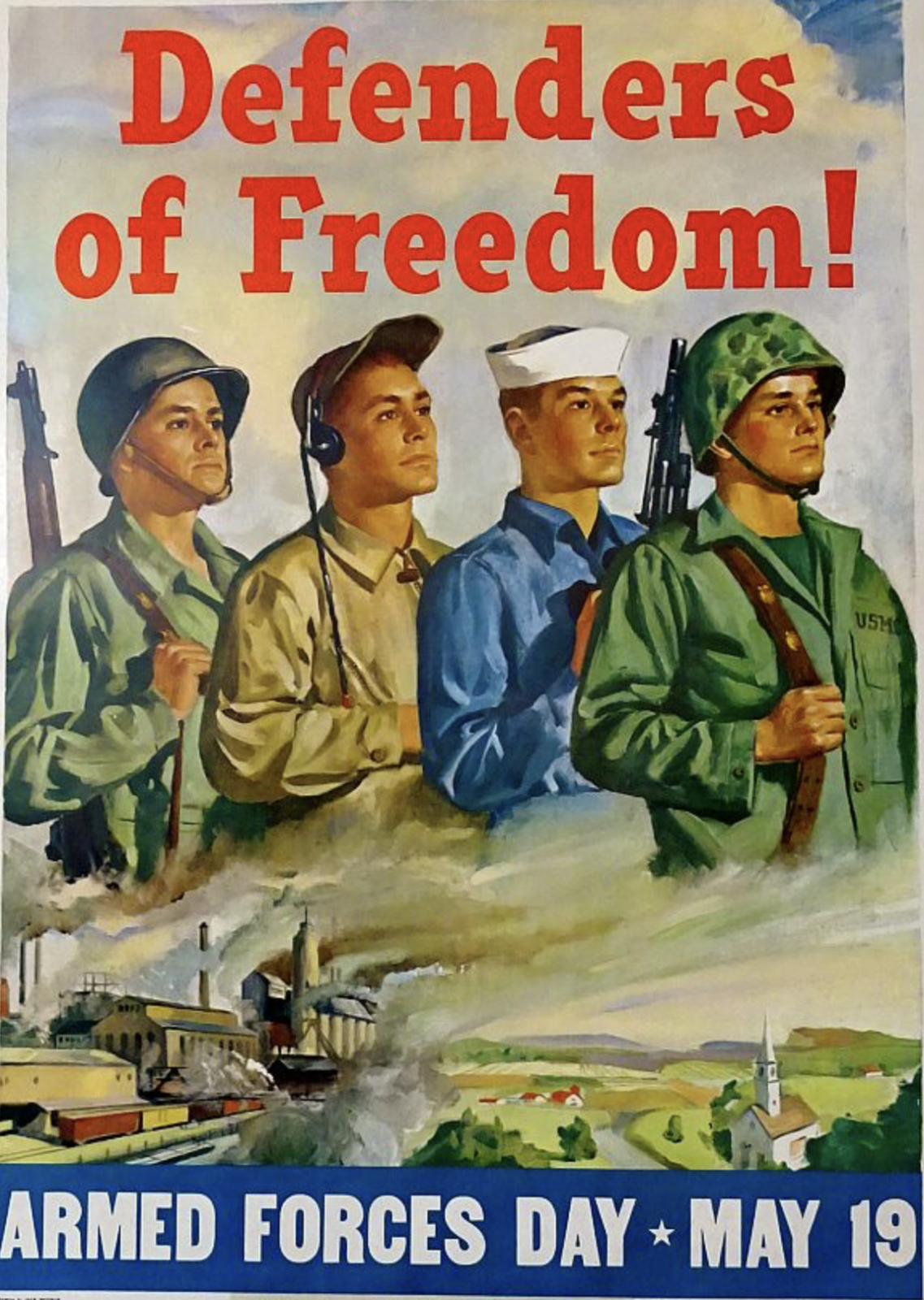
On May 20, 1950, Americans celebrated the first official Armed Forces Day with parades, air shows, and military base open houses. President Harry Truman wanted to give Americans an occasion to thank Service Members for their defense of the country. Administration officials emphasized unity, teamwork, and the permanent need for a strong national defense.
But beneath the surface of this united front churned fierce rivalries born of victory in World War II. The first Armed Forces Day was part of a larger struggle to quell the divisions and unify the armed services for the burgeoning Cold War. Before Armed Forces Day, each branch had their own birthday celebrations. The idea was to consolidate them all into one.
It didn’t work. Not entirely, at least.
The triumph of World War II made the strengths of the American military system visible to everyone. The Army, Navy, Marine Corps, Coast Guard, and newly independent Air Force had all fought brilliantly in different theaters. But they had also competed with each other. The more each branch could demonstrate its indispensable contribution to Victory, the more it would secure in resources, prestige, and influence.
Generals and admirals clashed over strategy and control. Which branch should command air power? Did amphibious warfare fall under the purview of the Marine Corps or the Army or both? Would aircraft carriers replace battleships? Would future wars be won by strategic bombing ? Had the atomic bomb made armies and navies obsolete?
These arguments intensified after 1945, when military budgets suddenly shrank, and each service fought to protect its role in the emerging fight with the Soviet Union.
Army veteran President Harry S Truman believed the rivalry had become dangerous. He had seen firsthand the confusion, duplication, and waste that could result when the services operated like semi-independent kingdoms. Truman wanted a unified national defense structure under stronger civilian control.
The result was the landmark National Security Act of 1947.
The law created the National Military Establishment as we know it today, unified under a single Secretary of Defense, established the United States Air Force as an independent branch, and created the policy-setting National Security Council and the Central Intelligence Agency.
But the law did not end the infighting. In some ways, it made things worse.
Truman tried to impose some order on the chaos with a special meeting at his “Little White House” in Key West, Florida. In March 1948, the new Defense Secretary James Forrestal gathered the Joint Chiefs there to hammer out the roles and missions of the Army, Navy, Marines, and newly independent United States Air Force.
The resulting agreement, published as Functions of the Armed Forces and the Joint Chiefs of Staff, gave each side some of what it wanted:
- The Air Force got primary responsibility for strategic air warfare, including long-range bombing and the nation’s nuclear strike capability.
- The Navy was permitted to maintain its own naval aviation arm, including aircraft carriers and carrier-based combat aircraft.
- The Navy was also promised an eventual role in nuclear warfare once it had acquired a large 65,000-ton “supercarrier” which could launch long-range bombers capable of delivering nuclear weapons from the sea.
- The Marine Corps retained its separate identity and its mission as an amphibious and expeditionary force supporting naval operations.
- The Army kept primary responsibility for ground warfare and land-based military operations.
The agreement established the idea of “primary” and “collateral” missions: one service might hold chief responsibility for a mission, while another could still perform related supporting functions.
The compromise didn’t settle unresolved arguments about money, prestige, and the future of warfare. In April 1949, these tensions burst into public view with the famous “Revolt of the Admirals.”
The immediate spark for the Revolt came when the new Defense Secretary Louis A. Johnson abruptly canceled construction of the much-anticipated “supercarrier” USS United States, just five days after its keel had been laid. To many naval officers, the cancellation looked like a deliberate attempt to hand strategic warfare almost entirely to the United States Air Force and reduce the Navy to a secondary role. The decision, combined with deep budget cuts and growing faith in the Air Force’s B-36 bomber as the nation’s primary nuclear deterrent, convinced many admirals that the Navy itself was under threat.
Senior naval officers openly challenged Defense Secretary Louis Johnson and, indirectly, Truman himself. Congressional hearings turned ugly. Admirals criticized military policy in public, and accusations of favoritism, politics, and dangerously flawed strategy filled the newspapers.
The United States was just starting to present itself as the leader of the free world, and its military leadership looked fractured and dysfunctional.
All this internal feuding inspired the creation of Armed Forces Day as a way to soothe the turmoil.
In the midst of contentious Congressional hearings, Secretary Johnson announced the creation of a single national Armed Forces Day to replace the separate Army, Navy, and Air Force days that had previously existed.
The language surrounding the new holiday was unmistakable: the US had one single defense establishment, not rival fiefdoms competing for appropriations and prestige.
On May 20, 1950, Truman rang in the holiday as “the first combined demonstration by America’s defense team.” He described the armed services as “a unified team of land, sea, and air forces.” Truman wanted Americans to think of the military as integrated, modern, and coordinated under the new Department of Defense structure created in 1949.
And the talk of unity and togetherness wasn’t just for appearances’ sake.
At 7:00am on August 29, 1949, the Soviet Union successfully detonated a plutonium implosion device, its first Atomic Bomb. The United States no longer had a monopoly on nuclear weapons, guaranteeing that World War III would see the trade of nuclear strikes.
Soon after, China would fall to the Communists, and NATO would get off the ground. The Cold War, as we know it, was on.
The United States needed military strength and unity more than ever.
Armed Forces Day became a kind of civic theater, a public relations campaign for military unification.
Instead of separate branch celebrations, all Sevice Members would march together beneath one national command structure. The United States military would face the Cold War as one force.
Service rivalry never disappeared. But the swift work of the Truman administration, Armed Forces Day included, contained that rivalry within a larger national framework.
The holiday reflected a major historical shift. Before WWII, Americans often thought of the Army and Navy almost as separate institutions. By 1950, the United States was building something new: a permanent national security state centered around the Department of Defense, joint planning, unified commands, and Cold War readiness.
Armed Forces Day was the public face of that transformation. Despite all the arguments, all branches of service were now supposed to be on the same team.
