

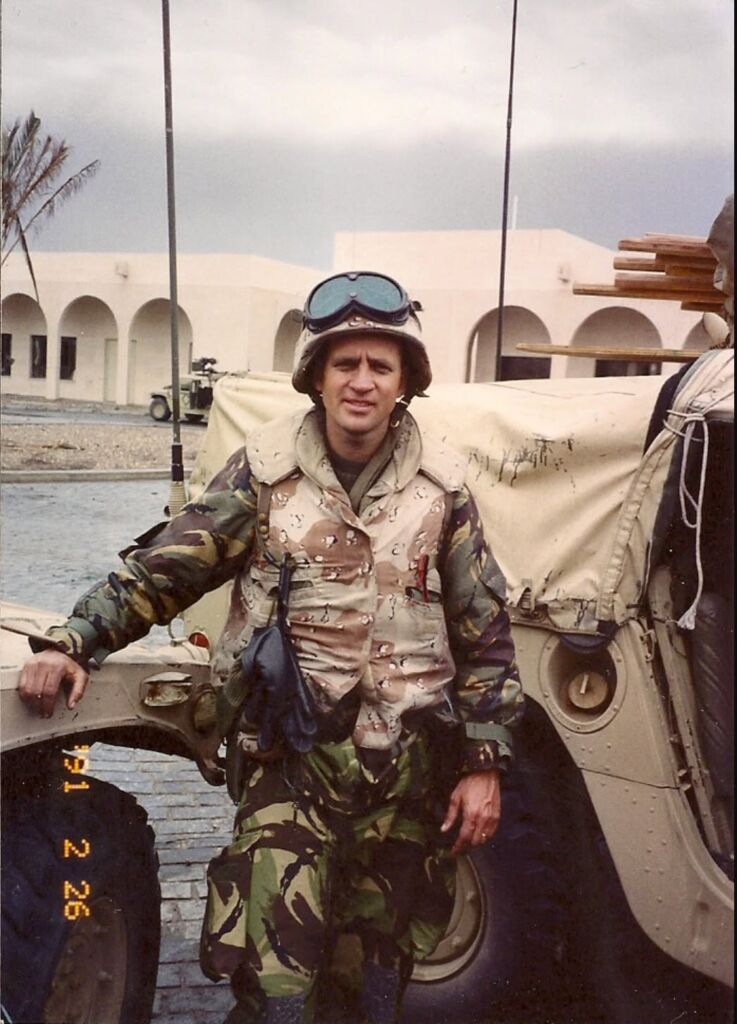
By Brad Washabaugh
Few problems of modern warfare are more agonizing than friendly fire. Getting wounded or killed by the enemy is one thing. But receiving fire from your own side has historically carried a hint of shame, and sometimes has been covered up by military authorities. But friendly fire is a perennial problem in war. Estimates of friendly fire rates across time are all over the map, from 2% to over 40% of all casualties. Only in the late 20th century did the US military begin systematic study of the phenomenon.
In the wake of Operation Desert Storm, the problem of friendly fire weighed heavily on our own VBC Board Member and retired Marine Corps Colonel Brad Washabaugh.
During a distinguished 29-year career, Brad served around the world in command and staff assignments. During Operation Desert Storm, then-Major Washabaugh served as operations officer for 3rd Battalion, 7th Marines, helping plan and execute the battalion’s role in the famous coalition “left hook” that broke Iraqi defenses and liberated Kuwait.
But amid that overwhelming victory, tragedy struck.
One of Washabaugh’s Marines, Lance Corporal Christian Jay Porter of Springfield, Illinois, was killed by friendly fire during the opening day of the ground offensive. His death profoundly affected the Marines who served with him and remained with Washabaugh long after the war ended.
Assigned to Marine Corps Command and Staff College after Desert Storm, Washabaugh chose friendly fire as the subject of a major research paper. His 1992 report, “Friendly Fire: Time for Action,” examined why nearly one-quarter of U.S. combat deaths during Desert Storm resulted from friendly fire and urged the military to improve training, doctrine, battlefield awareness, and technology.
More than three decades later, the report remains remarkably relevant. As drones, artificial intelligence, precision-guided weapons, and digital battlefield networks transform warfare, the question Washabaugh posed in 1992 remains with us: Can technology eliminate friendly fire, or does the human dimension of war ensure it will always be with us?
We recently asked Col. Washabaugh to reflect on the report he wrote shortly after Desert Storm and how his thinking has evolved over the past 34 years.
Q&A with Col. Brad Washabaugh
In a recent email, you mentioned Lance Corporal Christian Porter and said his memory was with you as you wrote this report. Can you tell us about Porter and the role he played in your thinking?
Lance Corporal Christian Jay Porter (1970-1991) of Springfield, Illinois, was a member of my unit. I was a major at the time and assigned as the battalion’s operations officer. We were one of two maneuver battalions within Task Force Grizzly of the 1st Marine Division. Our mission was to conduct an infiltration attack through two Iraqi minefields to open up a gap through which a mechanized task force, task Force Ripper, could rapidly advance to secure assigned objectives within Kuwait.
LCpl Porter was assigned to Headquarters and Service Company as a motor transport driver. I got to know LCpl Porter while we were in Okinawa in the months leading up to our deployment from there to Saudi Arabia in Jan 1991. He often served as my driver as I attended meetings at various bases on Okinawa.
During our drives together we shared small talk about hometowns, sports and just about anything that came to mind. LCpl Porter was a well-liked Marine and was always cheerful and quick with a smile. I thought he was a good Marine, very dependable and one who took pride in his job. Driving in Okinawa is not easy–often narrow roads, traffic circles, international traffic signs, and traveling on the left side of the road. There were no worries from me when traveling with LCpl Porter.
During the war LCpl Porter was assigned to drive a 5-ton truck as part of our logistics train carrying food, ammunition and other supplies. Tragically, he was killed on 24 February by friendly fire from a mechanized unit that was advancing though our positions from our rear. During those chaotic moments, Marines throughout our unit sought cover from incoming main tank rounds and machinegun fire. I desperately tried to contact the unit firing to immediately cease fire as the sand kicked up around us with incoming rounds.
The firing from the mechanized unit seemed to last for much too long, but it was only a few minutes before it stopped. Shortly thereafter we received a radio report of a casualty—a Marine was dead.
My battalion commander went to the scene and returned pale and shaken. That was when I learned that LCpl Porter was killed. I had expected more casualties from the intense gunfire, but LCpl Porter was the only one. His death hit us all especially hard.
To have one of your Marines killed by friendly fire is a gut punch—something that none of us were expected. We became wary of units operating near us and also the use of supporting arms as a result.
After the war and our return to 29 Palms, CA, I was assigned to Command and Staff College in Quantico, VA.
One of our assignments was to write a paper regarding a relevant military topic. I choose to write on friendly fire. With the memory of LCpl Portaro as a driving force for my research and writing, I sought to raise awareness and to prompt action within the military to find ways to reduce the occurrence of friendly fire.
I was determined not to have LCpl Porter’s death be in vain.
You write that nearly one-quarter of U.S. combat deaths in Desert Storm were caused by friendly fire. Why was that the case?
There were a number of critical factors that had a role. The terrain was nearly featureless that made visual reference for unit boundaries and navigation difficult, visibility was reduced by dust, oil fires and weather conditions, units relied on fast maneuver with overwhelming firepower that challenged coordination and command & control procedures, identification of targets and engagement with high velocity weapons were often done at long ranges without positive visual identification, technology that identified friend or foe was essentially limited to aircraft, leaving air to ground engagements dependent on visual identification, we fought with coalition forces that had similar vehicles and equipment to enemy forces, and then most importantly, there was the human dimension and the fog of war.
Fear, uncertainty, fatigue, and inexperience affected the individuals doing the fighting. Mistakes were made; tragic events from friendly fire resulted.
Your report argues that advances in technology can actually increase the risk of friendly fire. That seems counterintuitive. Can you explain what you meant? Does that paradox still exist?
Technology has its limitations and vulnerabilities. Overreliance on technical solutions can lead to a false sense of battlefield situational awareness. Not every person, piece of equipment, or non-combatant can be identified and tracked with technology. Technology can be degraded and defeated with countermeasures. GPS signals used in identification, tracking and navigation can be disrupted. Core battlefield skills such as navigation with a map and compass should not be discarded because of technological advances. I recognize that tuman involvement can both be an asset and a liability, but we must balance it properly with technology. And we must not lessen the importance of training and doctrine in execution of our warfighting capabilities.
Looking back 34 years later, what did you get right? What did you get wrong? Has technology solved the problem?
I believe I got it mostly right. My experience from Desert Storm heightened my understanding for the difficulties in addressing this is age-old problem—and also the tremendous human cost involved. There is no quick fix; friendly fire can never be completely eliminated but we can reduce its occurrence by taking needed action within the human and technological dimensions of warfighting. I think that I failed in not stating the absolute requirement for a universal, accepted definition of friendly fire and the need to accurately report and study instances of friendly fire. Not only would this increase awareness, but the data collection would help target possible solutions.
If you were writing this report today, in an era of drones and artificial intelligence, what would concern you most?
I would be most concerned about using AI for instances where human judgement is needed for making decisions that have strategic and operational implications.
Modern warfare is characterized with increased lethality and heightened sensitivity to unnecessary casualties. One mistake can have grave consequences, both militarily and politically. Humans must be the final decisionmakers.
Drones have changed the nature of today’s warfare, giving the advantage to those who can rapidly adapt and use this technology to their advantage. I believe that drones can reduce the risk of friendly fire when properly used in surveillance and targeting. But I also believe they can increase the chance of friendly fire if air defenses misidentify responding to a drone threat with friendly aircraft in the area.
I believe this might have been the case in the recent Iranian war. Three U.S. F‑15Es were shot down by Kuwaiti friendly fire during a time when their air defenses were reportedly responding to Iranian Shahed drones. Even when an air‑defense system correctly engages a hostile drone target, the intercept can create collateral effects with falling debris, missed intercepts, and detonation near their target that sprays shrapnel that can hit friendly aircraft flying nearby.
Read Col. Washabaugh’s Original Report
Although written shortly after Operation Desert Storm, it raises questions that remain central to military operations today. As Washabaugh concludes, friendly fire can never be eliminated entirely. But by studying it honestly rather than treating it as an embarrassment, military organizations can reduce its occurrence—and honor those, like Lance Corporal Christian Porter, whose deaths continue to teach difficult but necessary lessons.
