

By Todd DePastino
You may have heard the legend of Molly Pitcher, which first appeared in the 1830s as the nation was celebrating the last of the Revolutionary War generation.
The nickname “Molly Pitcher” is perfect. “Molly” was 18th century slang for a woman and “Pitcher” conveyed the critical role of water in wartime. During the American Revolution, the hard work of supplying water for cooking, washing, drinking, cleaning wounds, and mopping gun barrels for the next firing fell largely to the thousands of women who served in the Continental Army and state militias at any one time.
Molly Pitcher, then, was not one woman, but many. As historian Emily J. Teipe at the National Archives astutely puts it, Molly Pitcher was to the American Revolution what “G.I. Joe” was to World War II, a collective generic term encompassing masses of anonymous people who served and sacrificed in the cause of our nation.
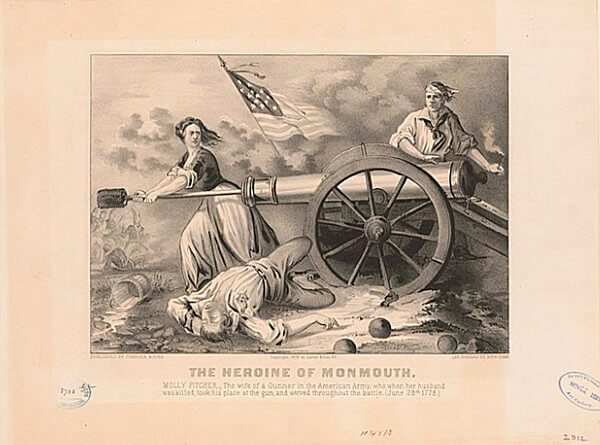
A Molly Pitcher heroine at the 1778 Battle of Monmouth as imagined by Currier & Ives, circa 1876. (Public Domain)
Given the large numbers of women in the Army during the War of Independence, it’s puzzling that we don’t have many vivid first-hand accounts—diaries, letters, memoirs—written by them. That’s why we fall back on composite characters like Molly Pitcher to embody their experiences.
Part of the reason for this thin historical record traces back to General George Washington’s deep ambivalence about these so-called “camp followers.” On the one hand, he needed them to wash clothes, cook meals, and nurse the sick. His Army never had enough men to handle all this work. He also knew that women were good for morale. Many of his soldiers would only serve if their wives could be with them. If Washington kicked the women out, the men would follow.
On the other hand, Washington often regarded these women as a problem to be managed. They consumed scarce rations and slowed his Army down, especially if they were pregnant or traveling with children. They also might have a harmful effect on morale by encouraging “disorder,” a euphemism for drinking and prostitution.
His solution was to allow “humane and industrious women” in camp but to cap their numbers. Some worked in unofficial capacities supporting family and friends. Others were paid members of the military, due rations and subject to military discipline.
Wars tend to upset social order and draw into public life people who had been kept at the margins—women, the poor, the displaced, the very young and the very old. But when the fighting ends, there is often a powerful urge to restore the old order. Women who had fought the Revolution, like women who filled factories in World War II, were urged to step back into domestic and private roles after the peace.
This postwar backlash, in addition to lower literacy rates among women, helps explain the paucity of war memoirs written by women after 1783. It was also considered the height of indignity for a woman even to speak in public. The prohibition against women lecturing or sharing their stories would last until almost the Civil War, after the Revolutionary generation had vanished.
Still, researchers have labored to put flesh-and-bones on Molly Pitcher, to give her a real name and identity to help us understand better the role of women in the American Revolution.
The best claimant to the title is one Mary Ludwig Hays McCauley of Carlisle, Pennsylvania. It’s taken decades of research to assemble her story. Mary served with her husband William Hays at the Battle of Monmouth in June 1778. She carried water to exhausted and wounded men under murderous heat. When her husband collapsed, perhaps from heatstroke or a wound, Mary took his place at the cannon and worked it through the battle. We’re fairly certain Mary Hays is the woman described by Joseph Plumb Martin:
A woman whose husband belonged to the Artillery, and who was then attached to a piece in the engagement, attended with her husband at the piece the whole time. While in the act of reaching a cartridge and having one of her feet as far before the other as she could step, a cannon shot from the enemy passed directly between her legs without doing any other damage than carrying away all the lower part of her petticoat. Looking at it with apparent unconcern, she observed, that it was lucky it did not pass a little higher, for in that case it might have carried away something else, and continued her occupation.
Pennsylvania later granted Mary a small annual pension, and nineteenth-century commemorators increasingly identified her as the “real” Molly Pitcher.
Another woman, Margaret Corbin, has an equally strong claim. At Fort Washington in November 1776, Margaret Corbin stood with her husband John at an artillery piece in Captain Francis Proctor’s company. When he was killed, she took his place and continued firing until she herself was badly wounded in the arm, chest, and jaw. She earned a place on the Continental Army’s official list of the Invalid Corps.
Congress later granted her half a soldier’s monthly pay and a suit of clothes, making her the first woman in American history to receive a military pension from Congress.
The legend of Molly Pitcher survives because she fills a hole in our memory and stands in for the many women whose labor, endurance, and occasional acts of battlefield courage were essential to the Revolutionary cause. In that sense, Molly Pitcher is less a finished story than an invitation to keep listening for the voices that otherwise would be lost to history.
Sarah Osborn Benjamin at Yorktown 1781
One of the rare accounts by a woman who lived and labored with the Continental Army—washing, baking, mending, and carrying food into the trenches – comes from Sarah Osborn Benjamin who was at Yorktown in 1781.
In 1837, she gave a pension deposition to prove her husband Aaron Osborn’s Revolutionary War service. In doing so, she also created a first-person account of the Battle of Yorktown by a woman. Because her testimony was recorded in the third person by a clerk, we have restored it here as nearly as possible to Sarah’s own voice.
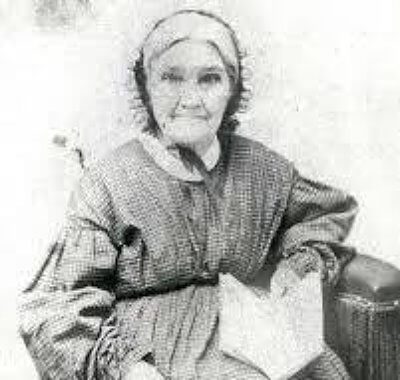
Sarah Benjamin Osborn lived to be over 100 years old. (National Park Service)
We continued our march to Philadelphia, I riding on horseback through the streets, and came at length to a place toward the Schuylkill where the British had burned some houses. There we encamped for the afternoon and night. We were out of bread, so I was employed in baking all that afternoon and evening. I recollect no females there but Sergeant Lamberson’s wife, Lieutenant Forman’s wife, and a colored woman by the name of Letta. The Quaker ladies who came around urged me to stay behind, but my husband said no, he could not leave me.
So the next day we went on again, marching from day to day until we reached Baltimore. There my husband and I, with the forces under General Clinton, Captain Gregg, and several other officers whose names I do not now remember, embarked on board a vessel and sailed down the Chesapeake. There were several vessels in company, and I was in the foremost. General Washington was not in the vessel with me, and I do not know where he was until he arrived at Yorktown, where I saw him again. He may have embarked somewhere else, but I am certain that I embarked at Baltimore, and that General Clinton was in the same vessel with me. Some of the troops went down by land.
We sailed until we had gone up the James River as far as the tide would carry us, about twelve miles from the mouth, and there we landed. The tide being spent, we had a fine time catching sea lobsters, which we ate. We marched immediately for a place I think was Williamsburg, I going alternately on horseback and on foot. When we got there, we remained two days until all the army that had come by land had arrived, and then we marched for Yorktown, or Little York as it was then called.
The York troops were posted on the right, the Connecticut troops next, and the French to the left. In about a day, or less than a day, we reached our encampment about a mile from Yorktown. I was then on foot, and the other females were there also, and my husband was still on the Commissary’s guard. What first struck my eye was a large plain between us and Yorktown, and an entrenchment thrown up there. I also saw a number of dead negroes lying around the encampment, whom I understood the British had driven out of the town and left to starve, or else had first starved and then thrown out.
I took my place just back of the American tents, about a mile from the town, and busied myself washing, mending, and cooking for the soldiers, in which I was helped by the other women. Some of the men washed their own clothes. For a number of days I heard the roar of the artillery. The last night the Americans threw up entrenchments, it was misty and foggy, rather wet, though not rainy. Every soldier, as I understood it, threw up for himself, and afterward I saw those entrenchments and went into them myself. My husband was there at work, throwing up entrenchments, and I cooked and carried in beef and bread and coffee, in a gallon pot, to the soldiers there.
Once, while I was carrying in provisions, I met General Washington. He asked me if I was not afraid of the cannon balls. I answered no, the bullets would not cheat the gallows, and besides, it would not do for the men to fight and starve too.
They dug their entrenchments nearer and nearer to Yorktown every night, or every two nights, until the last. While they were digging that last one, the enemy fired very heavily until about nine o’clock the next morning. Then they stopped, and the enemy’s drums beat exceedingly. I was a little way off in Colonel Van Schaick’s, or in the officers’, marquee, and there were a number of officers present, among them Captain Gregg, who, because of infirmities, did not go out much on duty. The drums kept on beating, and all at once the officers hurried out and swung their hats. I asked, “What is the matter now?” One of them said, “Are not you soldier enough to know what it means?” I answered, “No.” Then they told me, “The British have surrendered.”
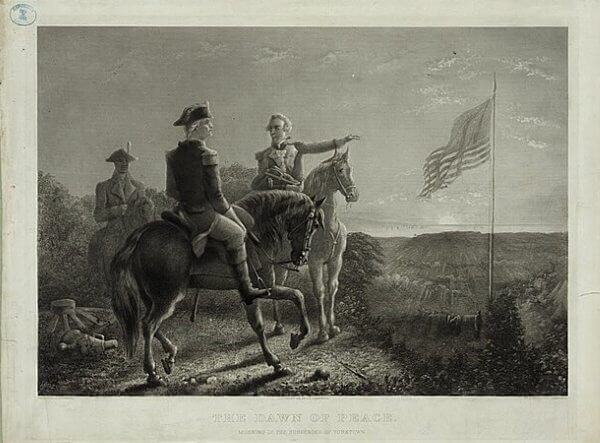
The Morning of the Surrender of Yorktown, Octorber 19, 1781. (Public Domain)
That morning I had provisions ready, and I carried them down to the entrenchments. Four of the soldiers for whom I commonly cooked ate their breakfasts there. I stood on one side of the road and the American officers upon the other, when the British officers came out of the town and rode up to the American officers and delivered what I understood to be the tokens of surrender. I think those were returned again, and the British officers then rode on before the army, who marched out beating and playing a melancholy tune, their drums covered with black handkerchiefs and their fifes tied round with black ribbons. They marched into an old field, grounded their arms there, and then returned into town again to await their destiny.
I recollect seeing many American officers, some on horseback and some on foot, though I cannot now call them all by name. Washington, LaFayette, and Clinton were among them. The British general at the head of the army was a large, portly man, full-faced, and the tears rolled down his cheeks as he passed. I do not recollect his name, but it was not Cornwallis. I saw Cornwallis afterward and noticed that he was a small man and cross-eyed.
When I went into the town, I noticed two dead negroes lying by the musket house. Out of curiosity I went into a large building nearby, and there I saw cupboards smashed to pieces and china dishes and other wares strewn all over the floor. Among them was a pewter cover to a hot basin with a handle upon it. I picked it up, supposing it had belonged to the British, but the governor came in and claimed it as his. Still, he said he would have the name of giving it away, for it was the last one out of twelve that he could see, and so he presented it to me. I afterward brought it home with me to Orange County and sold it for old pewter, which I have regretted a hundred times.
After two or three days my husband and I sailed back up the Chesapeake to the Head of Elk. We afterward went into winter quarters at Pompton Plains, then to West Point, and later to New Windsor. I continued, as usual, cooking and serving, while my husband remained on duty as a corporal until the army was finally discharged.
