
Courtesy VVA Veteran (https://vvaveteran.org/32-5/felton.html)
By Todd DePastino
A few days ago, I received an email from Suzanne Sigona, who has been a volunteer at the Vietnam Veterans Memorial, The Wall, in Washington, DC, for over 30 years. She wanted me to know about the recent death of Duery Felton Jr., the longtime curator of the objects left at the Vietnam Veterans Memorial.
“Duery cannot just ‘die,’” she wrote.
I had never heard of Duery Felton before Suzanne’s email. But the more I read about him and his extraordinary life’s work, the more convinced I became that Suzanne was right. He deserved special recognition, especially from the veteran community that unknowingly entrusted him with some of its most sacred possessions and memories.
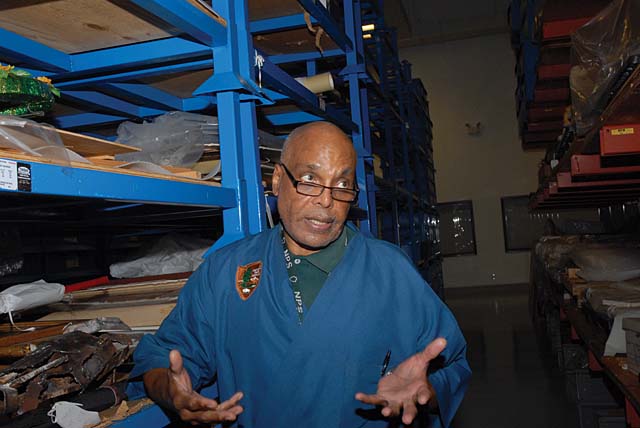
Felton, who died recently at age 78, was a Vietnam veteran and the first full-time curator of the Vietnam Veterans Memorial Collection, the enormous archive of personal objects left at The Wall since its dedication in 1982. Those objects now number more than 400,000 and include letters, photographs, medals, boots, Bibles, dog tags, stuffed animals, POW bracelets, whiskey bottles, unit patches, flowers, flags, and handwritten notes to the dead.
Every item carried a story, and Duery was the person who cataloged and preserved those stories.
According to an excellent profile in VVA Veteran magazine, Felton served with the 1st Infantry Division in Vietnam and was severely wounded in combat in 1967 near the Cambodian border. After years of surgeries and rehabilitation at Walter Reed, he eventually found his way to The Wall.
He started as a volunteer, and then realized that many of the objects left at The Wall were pieces of military equipment unfamiliar to civilian archivists. Hospital pajamas, web gear, trinkets, personal effects: these were things that needed to be identified and then interpreted for what they signified.
Over time, he defined a job for himself that the National Park Service didn’t even know it needed. As Duery puts it in a StoryCorps interview with fellow Vietnam veteran Rick Weidman, the job “chose me. I really do think that it chose me.”
“People come to the Vietnam Veterans Memorial to apologize, to communicate, to eulogize and to commemorate,” Duery explained. And each of the items left holds meaning.
Suzanne Sigona understood Duery Felton’s importance as well as anyone. In her tribute posted to Duery’s online obituary, she describes him not simply as an archivist, but as “an archivist, a caretaker, a detective and a student.” She remembers his relentless attention to detail and his devotion to honoring the trust of grieving families and veterans who left personal offerings at The Wall.
Her tribute deserves to be preserved in full:
Duery was my friend from my early days of working at the Wall. I wrote this so veterans and loved ones throughout our country know the name of Duery Felton.
Honoring Service recognizes the dedication of Duery C Felton Jr. Many veterans and their loved ones recently lost one of their heroes. They may not have known his name but they placed their faith and trust in his work.
Duery, a Vietnam veteran (1st Infantry Division aka the Big Red 1) died recently. He was the curator of the collection of artifacts left at the Vietnam Veterans Memorial in Washington, DC.
In my early days of working at the Wall I met Duery. He was the employee of the National Park Service who took your precious offerings and gave them the respect and care to be maintained as part of the collection. It was explained to me by David Guynes (NPS) that the intent of the collection was to record the contemporary history of the Vietnam war. When you left an item, you believed that the item would be given care and Duery was committed to honoring your trust.
Duery was an archivist, a caretaker, a detective and a student. He often went down a trail to be certain that something was correctly identified and stored properly. Considering the volume of offerings in the early days, it was quite the challenge. He owned the responsibility every day. He had passion and integrity.
Hearts hurt that we lost him so soon. He had more stories to tell from his rich life as the “Keeper” of your personal offerings.
On a lighter side of this message, I was at the Wall on Memorial Day weekend when the group from Wisconsin rolled in a Harley and left it at the apex. I called Duery immediately to tell him. Without hesitation he said, “I guess I better quit joking about someone possibly leaving me a Huey.”
His devotion to his position with the National Park Service is legendary and his work lives on.
The Harley-Davidson motorcycle Suzanne mentioned became one of the most famous objects ever left at The Wall. But there were countless other offerings: fading snapshots, unopened letters, wedding bands, children’s drawings, field jackets still carrying the smell of smoke and canvas.
Felton treated all of them with equal care.
“It’s the only collection I know of that removes bias in the selection process,” Duery observed. “Anybody can contribute. And every offering is accorded the same degree of care and respect.”
That idea seems especially important now.
Most museums decide what deserves preservation. The Wall does not. Veterans and families decide. Grief decides. Love decides.
Felton simply made sure those offerings—and the people behind them—would not disappear.
If you would like to learn more about Duery Felton and the remarkable collection he helped build and preserve, I strongly encourage you to read the full VVA Veteran profile on Felton and the Vietnam Veterans Memorial Collection and explore the extraordinary Vietnam Veterans Memorial Fund archive of items left at The Wall.
Duery Felton spent decades protecting the memories other people left behind. Let us honor and remember him, in turn.
