

By Jay Lacklen
By 1976, Air Force pilot Jay Lacklen had spent years flying one of the largest and most demanding aircraft in the U.S. inventory, the Boeing B-52 Stratofortress. In the excerpt below from his memoir Flying the Line: An Air Force Pilot’s Journey, he recalls two flights that nearly ended in disaster. One moment of danger occurred during takeoff from Loring Air Force Base in Maine, the other during a nighttime low-level training mission over South Carolina.
We’ve added a few brief explanations for readers unfamiliar with Air Force terminology.
Around the time my two pilot training instructor pilots (IPs) died in separate aircraft crashes, I nearly did, too—twice.
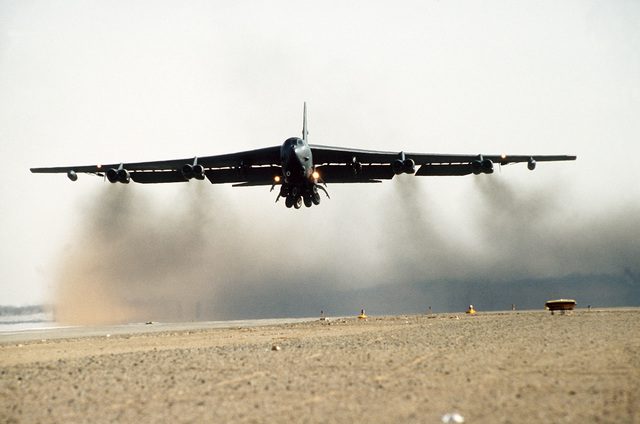
The first episode took place on a routine takeoff from Loring and proved frighteningly similar to an earlier B-52 accident. As we rolled down the runway, we barely made our acceleration check—a required speed that must be reached within a specified time or the takeoff must be aborted while enough runway remains to stop safely.
This alarmed me because we usually beat the time easily. After eating up 8,000 feet of the 11,000-foot runway, we remained thirty knots below rotation speed and were barely accelerating. Something was terribly wrong. I had pulled several of the throttles back slightly to match the prescribed takeoff power setting, but I now shoved all of them to the firewall. At least they’d know we gave it everything we had if we didn’t make it.
I looked down the remaining runway at the pine forest off the end, where it seemed we were about to meet a fiery and apocalyptic end.
At this point, my mind began going haywire. Viewing the remaining 3,000 feet of runway, I thought, in rising panic, that I could easily stop my car in this distance and perhaps I should try to abort on the runway. Fortunately, I also recalled an imperative John, my Castle IP, had impressed on me:
“When in doubt, continue the takeoff.”
John’s advice saved us, because if I had as much as touched the brakes, we’d have died horribly in that pine forest.
As the end of the runway approached, I experienced my life flashing before my eyes—in an odd form. I pictured my family members and Boonie Bill’s dogs for some crazy reason and marveled, almost serenely, that I now knew where I would die—right off the end of this runway.
At the last possible second, I pulled the yoke back hard into my stomach, not knowing if the airplane had enough airspeed to respond.
It did.
We blew all the dust off the overrun and limped into the air barely above the treetops.
I briefly considered ordering the crew to bail out since I still didn’t know what was wrong or if we could gain airspeed and stay airborne. But I realized the navigators, seated in the lower deck on downward-firing ejection seats, did not have enough altitude for a successful escape. No, we would all make it or not, unless we approached a stall. At that point, I’d have to try to save the four of us upstairs, at least, and order the bailout.
When we turned onto the departure course, we were only 2,500 feet above the terrain. We should have been at 10,000.
The copilot’s eyes were wide as saucers when I dared to look at him. We had both thought we were dead.
I aborted the mission, burned down my fuel to the maximum landing weight, and put it on the deck with a demand that maintenance meet us at the parking spot.
Upon later inspection, it turned out maintenance had mistakenly trimmed the four outboard engines to produce about five percent less than full power. We might have caught this, but we normally concentrated on the two center-engine instruments, which showed proper settings. The reduced outboard engine thrust was just sufficient to make our acceleration check but not enough to reach rotation speed before the end of the runway.
Fortunately, the engines provided just enough power to save our skins.
That night, I visited the pizza restaurant not quite a mile off the end of the runway and just off the extended centerline. I sat down at the bar in my flight suit, but before I could speak, the owner exclaimed loudly that some idiot pilot almost tore the roof off the place that morning.
I told him, yes, I know, and I knew exactly who that idiot was.
The second episode happened during a nighttime low-level training mission over South Carolina.
Things started on a shaky note. As the crew bus pulled up to the aircraft, I noticed the Deputy Commander for Maintenance (DCM) standing in front of the plane. This meant he would probably try to talk me into taking an airplane with some maintenance problem they couldn’t fix.
Sure enough, that is what he did.
He explained the plane had experienced runaway nose-up trim on its previous mission, causing the aircraft to pitch sharply upward without pilot input while flying at low altitude. They had replaced every part they could think of but never discovered what had caused the problem—a classic CN&D (“Could Not Duplicate”) maintenance write-up.
At any rate, would I take the airplane?
I thought a pitch-up would not be catastrophic, even at low level. Besides, they had probably fixed the problem, since they couldn’t duplicate it.
Sure, I said. We’ll take it.
The B-52 has a large striped trim wheel beside the aircraft commander’s right knee, making it obvious when the trim system is moving. Having been warned about the previous problem, I watched that wheel throughout the thirty-minute low-level run and our first simulated bomb run. Nothing unusual happened.
I mentally declared the problem solved.
I gave the copilot the airplane for a climbing turn to the racetrack pattern used to set up for a second bomb run.
As the aircraft climbed from 500 to 800 feet above the ground, I later vaguely recalled the trim wheel moving steadily. This wasn’t unusual since we were slowing and climbing, which required a trim change.
I did not notice that the trim was running in the wrong direction.
As the copilot leveled off at 800 feet, and I was busy reviewing my low-level chart, the aircraft suddenly snapped nose-down ten degrees—a horrendous, panic-inducing loss of control that promised to kill us all in about ten seconds as the moonlit pine forest below filled the windscreen and rushed toward us.
Reflexively, I grabbed the yoke and pulled.
Nothing happened.
It felt as if someone had poured concrete on it.
The yoke wouldn’t budge because the copilot had already pulled it all the way back. The low-level autopilot mode had tried to compensate for the runaway trim until it could no longer do so. When it disconnected, the airplane instantly pitched down under the full force of the out-of-trim condition.
From the lower deck, the navigators fairly screamed over the interphone, demanding to know what was wrong. They needed about 400 feet above the ground and level flight just to have one swing beneath their parachutes before impact.
We were rapidly approaching that altitude.
By my command, or not, they would soon have to eject to save themselves.
I tried to get my index finger to the interphone switch on the yoke but couldn’t manage it because I was pulling so hard on the immovable controls. Even if I had been able to transmit, I couldn’t have told them anything because I didn’t yet know what was wrong.
Within seconds, I’d have to give the bailout command.
Fortunately, the copilot recognized that the trim was probably the problem since he had been flying when it happened. He immediately began trimming nose-up against the runaway nose-down command. Slowly, he overcame the erroneous input and raised the trim to a slight nose-up position.
As the aircraft’s nose rose above the horizon, I disconnected the automatic trim system for the remainder of the flight.
From then on, I would trim manually with the wheel beside my knee.
Fool me once, shame on you.
The copilot, having saved our bacon, now hit the panic button and started shouting, “Mayday! Mayday! Mayday!” on the air traffic control frequency.
I tried to stop him because I now, a few seconds belatedly, realized what had happened and knew we were safe once I disconnected the trim system.
Unfortunately, every aircraft and air traffic controller for a hundred miles started asking our situation.
I couldn’t exactly answer, “Oh, never mind.”
So I explained that we’d suffered a runaway trim situation at low level but had regained control after disconnecting the system. Several aircraft continued questioning us, apparently wondering why we had declared a Mayday if we didn’t need help.
I explained that the call had been justified—but we had regained control, and no assistance would be required.
It would be the only Mayday call I heard in thirty-three years of flying, and it was my aircraft that made it.
I called Loring on HF radio and told the command post that the airplane had stood us on our nose during a low-level mission, but we seemed to have it under control and were returning to base (RTB).
The DCM met us at 4:00 that morning to apologize for the aircraft he’d given us.
I’m sure he had the wing commander’s footprint on his ass.
