

By Todd DePastino
This account is drawn largely from the memories and research of Norman Silverman, a veteran of the Army Security Agency who served in West Berlin during the height of the Cold War. Norman later helped create the remarkable West Berlin Archive, an extensive online collection of photographs, documents, recollections, and historical narratives from ASA veterans and others who lived and worked in divided Berlin. The site is far more than a nostalgia project. It is one of the richest firsthand archives anywhere on the experience of Cold War Berlin from the perspective of the Americans who listened, watched, worked, and lived there every day.
Readers should especially explore the site’s sections on the Berlin Wall, Teufelsberg, ASA operations, and the many personal memoirs contributed by veterans over the years. The photographs alone are extraordinary.
You can also watch Norman Silverman’s Veterans Breakfast Club interview with VBC volunteer Ray Brendel here:
Watch the VBC Interview with Norman Silverman
And visit the archive itself here:
Explore the West Berlin Archive
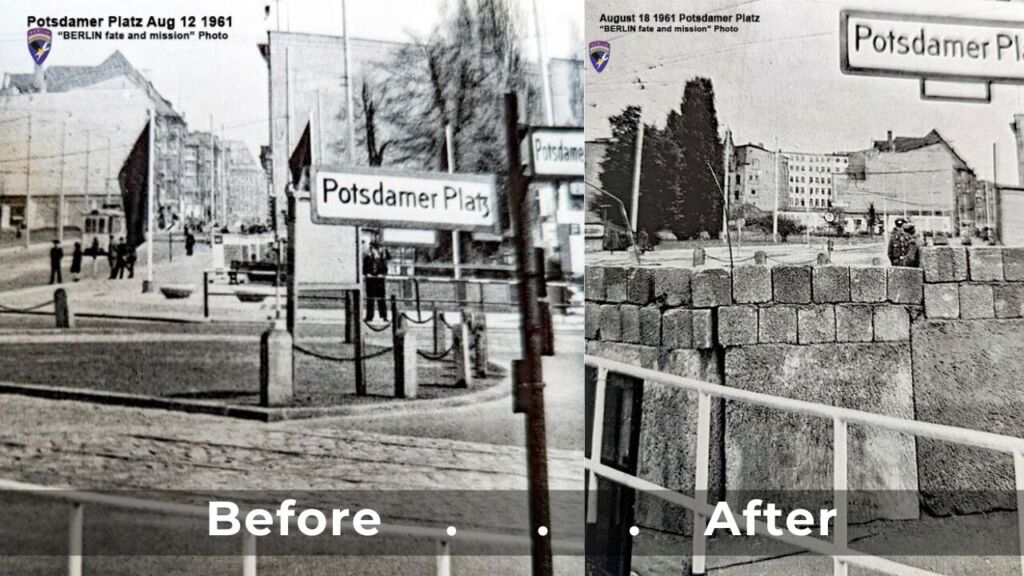
The Berlin Wall began with barbed wire, roadblocks, and confusion in the middle of the night.
Around 10 p.m. on August 12, 1961, East German police and soldiers began sealing the border between East and West Berlin. Streets were dug up. Train and subway lines were cut. Telephone connections were interrupted. Workers ripped apart pavement while armed guards rolled out wire barricades through neighborhoods where people had crossed freely only hours earlier.
Many Berliners slept through it.
When they woke the next morning, the city had changed.
Families were suddenly separated. Some people found themselves cut off from jobs on the other side of the city. Others realized they would not see parents, fiancées, children, or friends again except at a distance across wire and concrete.
For the people living in West Berlin, the Wall did not feel temporary. Even in those first hours, many sensed something enormous had happened.
The soldiers and intelligence specialists of the Army Security Agency understood that too.
“We knew what was going on,” recalled Norman Silverman years later. “The poor Berliners didn’t know it until they woke up the next morning.”
Silverman arrived in Berlin in 1963, not long after the Wall went up, but the city was still living in the immediate aftermath of those days. The wire barriers were already becoming something more permanent. Concrete sections appeared. Watchtowers multiplied. Guard dogs, floodlights, anti-vehicle trenches, and firing zones stretched across the center of Berlin and eventually along the entire border between East and West Germany.
The East Germans called it an “anti-fascist protective barrier.” Almost nobody else did.
To Berliners it was simply the Wall.
Before August 1961, East Germany had a problem that Soviet leaders and East German authorities could no longer ignore: people kept leaving.
Hundreds of thousands crossed through Berlin into the West every year. Workers. Students. Professionals. Young people especially. Berlin was the weak spot in the Iron Curtain because, unlike the rest of the East-West border, movement inside the city had remained relatively open after World War II. Someone could ride a subway train from East Berlin into West Berlin and simply not go back.
The East German government was bleeding people and credibility.
The Soviets had already tried once to force the Western Allies out of Berlin during the Berlin Blockade of 1948–49. That crisis ended with the Berlin Airlift. American, British, and French aircraft flew food and coal into the isolated city around the clock until the blockade failed. West Berlin survived, but it remained a western island surrounded by Soviet-controlled territory.
By 1961, tensions were rising again.
The Cold War seemed to accelerate month by month. Yuri Gagarin became the first man in space in August 1961. The Bay of Pigs invasion had failed earlier that year. American U-2 pilot Gary Powers had been shot down over the Soviet Union. The Cuban Missile Crisis was still ahead. Berlin sat directly in the middle of that confrontation.
The ASA men listened to it every day.
Silverman had grown up in the Bronx. He was a Giants fan, a Civil Air Patrol kid, and part of the Pershing Rifles drill team at Fordham University. He attended several colleges without settling anywhere permanently.
“In 1962, I was in a retail management training program and decided that this would be my business future,” he later wrote. “I had already quit Fordham U., Cornell U., and had some courses at NYU and Hunter College.”
Like many young men of his generation, he knew the draft was waiting.
The company he worked for suggested that volunteering for two years might be better than being drafted later. So he volunteered and reported to Fort Dix in March 1962.
After basic training he was sent to Fort Devens and ASA electronic intelligence school.
He still did not really know where he was headed.
“Eight of our class of over 20 were sent to Europe,” he recalled. “I was the only one sent to Germany.”
Then came Frankfurt. A brief interview. A train ride east.
“The day after arriving in Frankfurt and a short interview, I was on my way to Berlin and was engulfed in what became, and still is, the most emotionally and unforgettable time of my life.”
The ASA facilities were scattered around West Berlin—in the Grunewald forest, at Tempelhof Airport, in Rudow, and eventually at Teufelsberg, the artificial hill built from millions of tons of wartime rubble.
“It was all made of rubble,” Silverman said of Teufelsberg. “They picked up the rubble from World War II.”
That rubble was the physical remains of Hitler’s destroyed capital. Berlin still carried visible scars from the war everywhere you looked. Empty lots. Broken churches. Bullet marks. Buildings missing entire walls.
Yet the city also felt alive.
“Berlin was one of the cultural cities of the world,” Silverman said.
The ASA men listened to Soviet and Eastern Bloc communications from stations hidden in the woods or high above the city. Some intercepted Morse code traffic. Others monitored voice communications or radar signals. The work was classified and compartmentalized. Many veterans later joked that they learned more after discharge than they knew while serving.
“Our guys in the Grunewald were primarily for code interception,” Silverman explained. “We picked up some verbal sometimes… but basically we intercepted code, high-speed code from spies.”
The work schedule rotated constantly. Days. Swings. Midnights. Six days on, two days off. Then the cycle changed again.
But when they were off duty, the ASA men went into the city.
That mattered.
These were not soldiers living on isolated bases cut off from local life. They mixed constantly with Berliners. They dated German women. Went to theaters and jazz clubs. Sat in cafés along the Kurfürstendamm. Some volunteered with orphanages and youth groups. Others traveled all over Europe while stationed there.
“We socialized and laughed with Berliners,” Silverman wrote years later.
Many veterans remembered feeling less like occupiers than participants in the rebuilding of West Berlin itself.
“We were Berliners,” Silverman said simply.
The Wall was impossible to ignore.
At first there had been wire and temporary barriers. Then came concrete pipes, cinderblocks, fencing, guard towers, dogs, and eventually the broad “death strip” designed to leave escapees completely exposed. Some apartment buildings along the border had windows bricked over because they opened into West Berlin. In places like Bernauer Straße, people escaped by jumping from windows before those buildings were sealed or demolished.
The ASA men witnessed escape attempts constantly.
One day Silverman heard shots near the French sector and stopped his car near the Wall.
“I looked to the right and there was the fences and then the big field maybe almost a quarter mile across and the tower with a watchtower,” he remembered. “And I looked up at the fence right next to me and at the top of that wire was the guy’s gloves.”
Another memory stayed with him for decades: Peter Fechter, the 18-year-old East Berliner shot trying to escape in 1962.
Fechter fell into the exposed strip between East and West Berlin. Crowds gathered. West Berlin police and Americans could hear him crying for help. East German guards kept everyone back.
“They let him lay there until he died,” Silverman said.
Those moments burned themselves into the memories of people who lived there.
“You want to know what freedom is…” he said years later, trailing off.
The city lived with tension constantly. Soviet and American tanks faced each other at Checkpoint Charlie during the crisis of October 1961. Berliners crowded nearby watching the standoff. Some handed flowers or food to the American crews.
“It’s amazing nobody ever pulled the trigger,” Silverman said. “It would have gone crazy.”
The ASA veterans understood how dangerous the situation really was because they were hearing Soviet military communications themselves. During the Cuban Missile Crisis, Berlin felt even more exposed.
Then, in June 1963, John F. Kennedy came to West Berlin.
Hundreds of thousands of Berliners packed the streets around Rathaus Schöneberg to hear him. West Berliners feared abandonment. Kennedy’s “Ich bin ein Berliner” speech reassured them the United States would remain committed to the city.
“We felt their emotions of freedom and democracy when Pres. Kennedy made his ‘Ich Bin Ein Berliner’ speech,” Silverman wrote, “and we felt the deep sorrow they felt when he was killed.”
The Wall stood for 28 years.
It changed shape repeatedly during that time. What began as wire and crude barriers became a layered border system designed to prevent escape entirely. Yet people kept trying. Some tunneled beneath it. Some rammed through checkpoints. Some crossed hidden in vehicles. Some flew over in homemade aircraft. Many died trying.
When the Wall finally fell in November 1989, crowds climbed on top of it with hammers and chisels. Berliners crossed freely again for the first time in a generation. Segments of the Wall were later scattered around the world as historical artifacts.
By then Norman Silverman was long out of the Army and living in California.
But Berlin never left him.
“After 60 years of keeping secrets,” he wrote, “I still remember every minute that I was part of the democratic and cultural resurrection of the people of Berlin.”
And when he heard the Wall had fallen, he cried driving home in his car.
