

By Todd DePastino
Baron von Steuben and the Making of a Real Army
America has a long tradition of the “citizen-soldier.” The concept is like an equation: they need to balance each other out for it to work. Too much the citizen, then soldiering suffers. Too much the soldier, then the object of the service, upholding the Republic, gets lost.
When the Revolution began, the Americans were overweighted with citizen zeal. The men who answered the call at Lexington and Concord were mostly local militiamen who drilled now and then, elected many of their own officers, and expected to go home when the immediate emergency had passed.
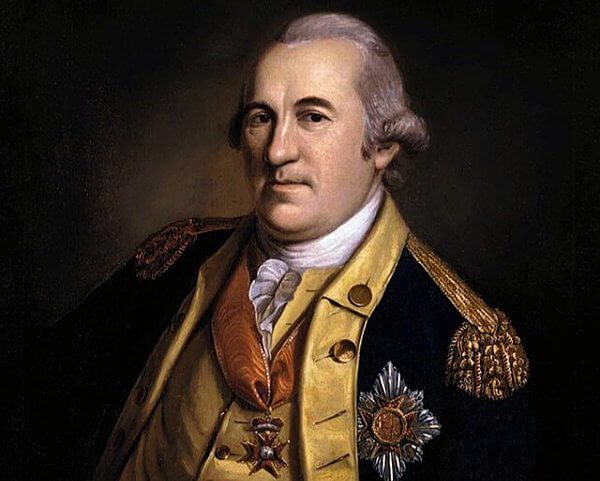
Baron von Steuben by Charles Wilson Peale, 1780. (Public Domain)
The Continental Army, created in 1775, was a step toward something more permanent. Eventually, General George Washington convinced the Continental Congress to create unprecedentedly long enlistments–three years or the duration of the war—so that he could have men long enough to train and fight.
Assisting Washington in forming something like a professional army was a colorful Prussian immigrant who called himself Baron von Steuben. Von Steuben arrived at Valley Forge on February 23, 1778, and was horrified by what he saw. This Patriot army was seasoned by hardship and had shown unquestioned courage on the battlefield. But it remained poorly trained, haphazardly equipped, and still guided too much by the “citizen” side of the soldierly equation. This was a war, argued von Steuben, that demanded discipline, coordination, and steadiness under fire.
Von Steuben wasn’t really a Baron. Nor was he a general in the Prussian army, as Benjamin Franklin had mistakenly claimed in his letter of introduction to George Washington. But he was a Prussian officer and had risen to captain, though his gaudy uniform with a jeweled medallion suggested something grander. Von Steuben made an unforgettable entrance at Valley Forge, attended by a secretary and servant, and accompanied everywhere by his spoiled Italian greyhound, Azor. For all his theatrical flourish, von Steuben’s real magic was his gift for turning a ragged, hungry army into a force that could march, drill, and fight together.
Von Steuben was smart enough not to try to turn these Patriot farmers into little Prussians. At Valley Forge he created a model company—about 120 men drawn from Washington’s guard and the different state lines—and drilled them personally in German and French (his English was never adequate). He taught them just the basics.
Those men then returned to their regiments and taught the others. Von Steuben simplified commands, standardized movements, and insisted on regularity in camp. It wasn’t just about marching and musket drill but the daily habits that made an army function: sanitation, camp arrangement, inspections, and accountability. He wrote drills by night and taught them by day, staying only a few steps ahead of the army he was remaking.
Sixteen-year-old Joseph Plumb Martin, having served in the more relaxed Connecticut militia, got a rude awakening when he entered von Steuben’s Continental Army at Valley Forge. “After I had joined my regiment I was kept constantly, when off other duty, engaged in learning the Baron de Steuben’s new Prussian exercise,” he recalled. “It was a continual drill.”
The transformation von Steuben wrought did not happen in an instant, and it did not erase hunger or create boots for those who needed them. But the Prussian helped make the Continental Army something it had not fully been before: a force that could move efficiently and stand in the field with a confidence born of practice.
His larger legacy was the Blue Book—Regulations for the Order and Discipline of the Troops of the United States—which standardized drill, administration, camp order, and military conduct and remained the army’s core manual into the War of 1812.
Steuben’s manual was not only about how to wheel platoons and fire muskets. It also tried to bring order and hygiene to the daily life of camp.
“The officer of the police is to make a general inspection into the cleanliness of the camp,” the book says, ”and not suffer fire to be made anywhere but in the kitchens, and cause all dirt to be immediately removed.”
The regulations deliberately stifled individual initiative and relegated even the fetching of water and wood, again, to a rigid process.
“When any of the men want water, they must apply to the officer of the police . . . all who want water must immediately parade with their canteens before the colours,” and be sent off under two noncommissioned officers. Even a thirsty soldier, in von Steuben’s ideal army, did not simply wander off with a bucket.
This is how far Steuben wanted order to reach: not just onto the parade ground, but into the routines of a soldier’s everyday life.
Bill Mauldin Lampoons the “Prussian spirit” in the Continental Army

Mud & Guts – A Look at the common soldier of the American Revolution, 1978. (Public Domain)
In 1976, the National Park Service commissioned World War II GI cartoonist Bill Mauldin to create a book about the common soldier in the American Revolution. The result was brilliant little pamphlet titled Mud & Guts (1978).
As he reviewed the historical record, Mauldin found himself no more a fan of George Washington and Baron Von Steuben than he had been of George Patton back in 1944.
In Mud & Guts, Mauldin directs his satirical ire at what he saw as the old military habit valuing “show” over “go,” preferring the soldier who looks right on parade over the one who fights well in the field.
In Mauldin’s telling, von Steuben had planted a harmful “Prussian spirit” in the Continental Army with an overemphasis on drills, geometry, inspections, and obedience. Mauldin does not deny that this worked. He simply dislikes what it cost in spontaneity, equality, and common-soldier independence. Ever the citizen, Mauldin couldn’t help but side with the “unlettered, unshaven, sardonic riflemen” over von Steuben, the polished martinet.
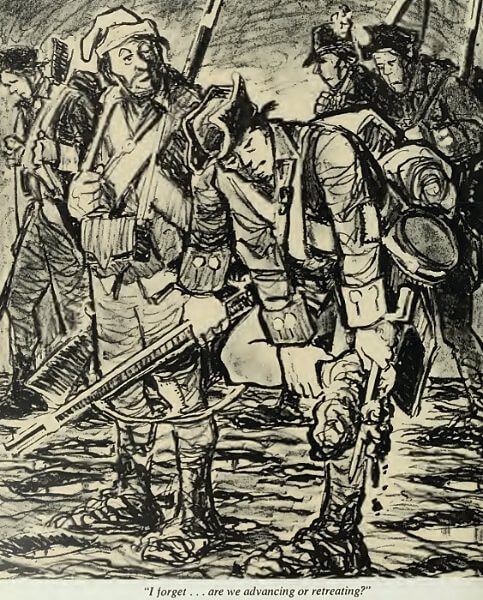
Cartoon from Bill Mauldin’s Mud & Guts, 1978. (Public Domain)
His most direct shot at von Steuben shows the Prussian general glaring at an ill-shod soldier with the caption: “… Und ven I yell ‘achtung!’ I vant to hear dose rags click.”
In another cartoon, a rough-clad frontiersman is at rest in a makeshift tree stand. He responds to his commander, “I’m a disgrace to what uniform, sir?”
It is classic Mauldin: irreverent and funny but also capturing a real tension at work in the Revolution: half-starved, poorly-clothed, and fiercely independent troops chafing against commanders who knew that victory could only be won with order, precision, and uniform standards.
