

By John DeBarber
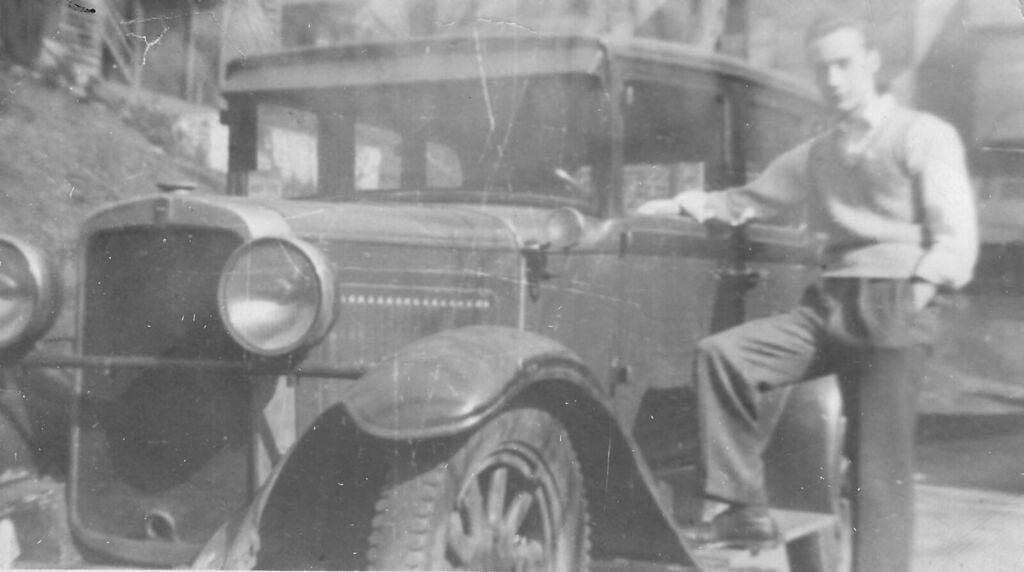
Peter DeBarber recently sent us this brief memoir of his WWII Navy veteran father, John DeBarber. Like many veterans of World War II, John left behind only a modest written account of his service. The few pages capture his journey from a high school student worried about being drafted to a Navy fire controlman in the Pacific, before serving aboard a destroyer in postwar China. John did the unglamorous but essential work aboard an attack transport that made the Pacific war possible. You’ll read of seasickness off the Columbia River, long convoy voyages across the Pacific, the tension of kamikaze attacks, and the opportunities the GI Bill opened after the war. Thank you, Peter, sharing both the photograph (with his 1928 Model A Ford pre-war) and these recollections.
I think the best place for me to start is right after Pearl Harbor. I was in high school, and my fondest ambition was to be a fighter pilot. I tried for an Army program in which youngsters were tested to see if they were qualified to be aviation cadets. If one was qualified, he was given a little badge (blue enamel wings) and was assured that when he reached age eighteen he would become an Army Air Corps Aviation Cadet. I failed. My eyes were not strong enough.
So now I faced the possibility of being drafted into the Army when I turned eighteen. I didn’t like that idea, so I volunteered for the Navy. When I graduated from high school in 1943, I went off to Great Lakes Naval Training Center in Illinois for boot camp. While in boot camp, we were tested to determine what billets were most suitable. I did well in math and physics. As a consequence, I was assigned to basic fire control service school. I wasn’t too happy until I learned that fire control was not putting out fires but was the control of naval gunfire. In early fall 1943, and out of boot camp, I entered fire control school at Great Lakes.
I was fascinated by the subject, did well, and upon graduation was assigned to advanced fire control school at San Diego. I started there in early spring 1944. The school was at a destroyer base and consequently concentrated on the fire control systems found aboard a destroyer. When I graduated in late spring 1944, I was assigned to the USS Pondera (APA-191), an attack transport that had not yet been commissioned. I was disappointed that I was not assigned to a destroyer. Destroyers were glamorous. Attack transports were not.
An attack transport is equipped to deliver assault troops to landing beaches and carries all sorts of landing craft and cranes to load them. It also carries many antiaircraft guns equipped with computing sights and power drives—sophisticated equipment for the time. Maintenance and operation of this equipment occupied the fire controlmen. There were two rated petty officer fire controlmen assisted by two strikers (apprentices). I was one of the petty officers. We were busy.
The Pondera was commissioned at Astoria, Oregon, in the summer of 1944. We sailed down the Columbia River into the Pacific and headed north to Puget Sound, where we conducted a shakedown cruise and sea trials. The Pacific at the mouth of the Columbia is always rough. Most of the crew, ninety percent of whom had never been to sea, became seasick, including me. When we reached Puget Sound, the ship was covered with vomit and had to be washed down with fire hoses. Most of us were never seasick again, and the trials were conducted without a hitch.
After the trials, we sailed to Long Beach, California, where we served as a training ship for a few months in the early fall of 1944.
Then we began our real duty. We took a load of nurses and other medical personnel to Hawaii. Then we took a contingent of Army assault troops to Kwajalein and Enewetak in the Marshall Islands and returned to Hawaii (Pearl Harbor). There we loaded up with Army troops and headed west to the Philippines, where we landed them on the island of Leyte.
While in Leyte, we collided with another ship. There was not much damage, but it was an embarrassment for our skipper. This was late fall 1944. These missions took a long time because an attack transport’s flank speed is only about fifteen knots, the distances were large (thousands of miles), and we traveled in convoys on a zig-zag course to thwart lurking enemy submarines. The principal threat was air attack. Actually, it was more of a nuisance than a threat because at that time there were few kamikazes and we had air superiority. Later, at Okinawa, the situation was different. There is a period here I can’t recollect, but somehow we ended up back in Pearl Harbor early in 1945.
At Pearl Harbor, we took on a contingent of SeaBees (Navy Construction Battalion) and headed west to Ulithi Atoll in the Caroline Islands. Ulithi was the main staging area for all of the campaigns in the latter part of the Pacific War. It is a large atoll, and its lagoon served as a port for hundreds of ships.
There we joined the fleet that was to support the invasion of Okinawa. The fleet that headed to Okinawa was huge. The sea from horizon to horizon in all directions was filled with ships—transports, aircraft carriers, destroyers, and more. In advance were the battleships, cruisers, and aircraft carriers that were to bombard and soften the Japanese defenses prior to the landings that would take place at the beginning of April 1945.
We arrived at Okinawa shortly after the initial landings and anchored off Hagushi Beach, the site of the first landings, preparing to disembark the SeaBees. It turned out that the area in which the SeaBees were to operate had not been cleared. We then moved to the other side of the island to an area later designated Buckner Bay and again prepared to land the SeaBees. Again there was a delay for some reason, and we were left twiddling our thumbs. Actually, we were biting our fingernails.
While waiting, we had to contend in the daytime with potshots from Japanese artillery on the beach and at night with kamikaze air raids. Although we had antiaircraft guns, we were prohibited from using them. It was determined that indiscriminate firing by all the ships assembled there posed a severe risk of damage from friendly fire. Instead, we hunkered down under a smoke screen and hoped our air cover would protect us.
There were also Japanese suicide boats laden with explosives that came out under cover of darkness and attempted to ram ships anchored off the beaches. We had a close encounter with one that damaged a ship anchored less than a hundred yards from us. Finally, we landed the SeaBees and departed unscathed for Guam with a load of casualties. We had been at Okinawa a couple of weeks, and it was now near the end of April 1945.
From Guam, we went to Seattle, where I was informed that I had been selected for the V-12 Program (officer training for high school graduates). I had been angling for this assignment from the first day I entered the Navy. I went to Farragut Naval Training Station in Idaho for some pre-V-12 exams and refresher courses. I was slated to go to Vanderbilt University in Tennessee for my V-12 education.
This was in the middle of the summer of 1945. While at Farragut, the war ended. We were given a choice. We could remain in the V-12 Program and commit to three years of duty after graduation, or we could resign from V-12 and be reassigned to await discharge. We were informed of the educational provisions of the GI Bill, and most of us decided to forgo V-12.
I was returned to Seattle, where I was assigned to the USS Brush (DD-745)—at last, a destroyer! This was at year’s end, 1945.
The Brush sailed from Seattle to San Diego and from there to Shanghai via Guam. We arrived in Shanghai early in 1946 and spent the next few months sailing around the Yellow Sea, ostensibly to show the flag and discourage increasing Communist activity along the Chinese coast and in Korea.
While there, we delivered mail to occupation troops stationed in Tsingtao, Tientsin, and Keijo. These places are now called Qingdao, Tianjin, and Seoul, respectively. While in the Yellow Sea, we also swept mines, a decidedly spooky activity. We had a lot of territory to cover, and to do so we often sailed at thirty knots. A destroyer at that speed in a heavy sea provides a rough ride. In spite of this, I was never seasick.
Around the first of April 1946, I became eligible for discharge and boarded the USS Monrovia (APA-31) in Shanghai for a trip back to the States. The trip took over a month, the Monrovia being a slow old tub that stopped to pick up passengers everywhere—Hong Kong, Okinawa, Guam, Pearl Harbor. We finally arrived in San Francisco, where I was processed and sent to Bainbridge Naval Training Center in Maryland for separation.
So I eventually got home in early summer 1946, about three years after I initially left for Great Lakes. In the interim, I had a couple of leaves, one at the end of boot camp and one when I left Farragut.
There were things I liked about the Navy—the sea, the ships, my work—and there were things I didn’t like—the regimentation, the scary episodes, and especially the lack of privacy. I think my Navy experience was profitable. I went into the Navy with no interest in additional education and came out enthusiastic about it, and the accrued educational benefits of the GI Bill allowed me to follow up on that enthusiasm.
November 2012
