

By Todd DePastino
On December 17, 1944, hundreds of American bombers crossed Central Europe on a mission against Nazi Germany’s synthetic fuel industry. One of them, a B-24J Liberator known only by the number painted on its fuselage—“White 47”—never returned.
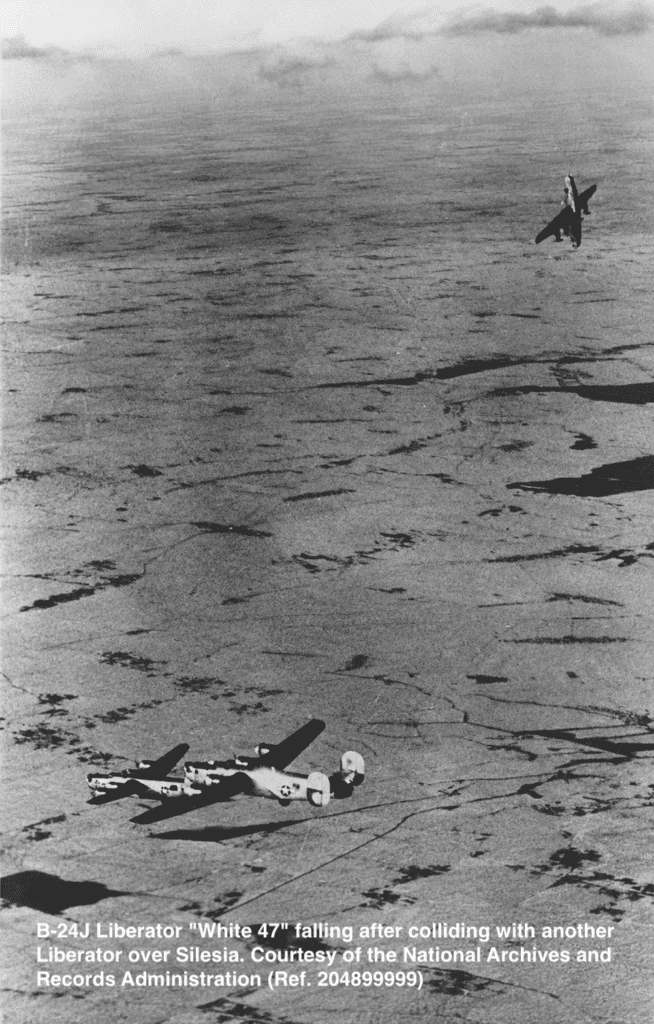
The airplane broke apart nearly five miles above Silesia and fell into a snowy forest near the village then called Ringwitz, today Rzymkowice in southwestern Poland. Ten Americans aboard the bomber were killed. Another American from a second B-24 died after jumping from his damaged airplane.
The crash was witnessed from the ground. Pieces of the airplane remained scattered through the forest. The story survived locally, repeated by people who remembered seeing the flaming bomber fall. But the Americans themselves gradually disappeared from the history. Their names appeared in military reports and on a memorial wall in Belgium, but no marker stood at the place where they died, and no one could say with certainty where their bodies had been buried.
More than eighty years later, Polish historian Daniel Podobiński and a small circle of researchers are trying to recover the stories of the men of “White 47.”
Daniel lives in Wierzbie, only a few miles from the crash site. Until 1945, the village was known as Weidengut and contained a German Luftwaffe airfield. The wreckage of the American bomber—and at least some of the dead—was brought there after the crash.
In 2025, Daniel published a 67-page illustrated study, The Crash of the Liberator Near Rzymkowice, coauthored by Jadwiga Wójciak. It reconstructs the mission, follows decades of attempts to locate the crash and burial sites, and, most importantly, gives life to the crew members who died there.
“I know they were young men,” Daniel wrote when he first contacted the Veterans Breakfast Club. “It would be great to get to know them as people, as sons, brothers, not just as servants in the army.”
The Mission to Odertal
White 47’s December 17, 1944 mission began far away in southern Italy.
The Fifteenth Air Force operated from airfields around Foggia and struck targets across southern and Central Europe. By the summer of 1944, oil refineries and synthetic fuel plants had become a high priority. Germany had little domestic petroleum, and its ability to continue the war depended heavily upon facilities that converted coal into aviation fuel and gasoline.
Among the targets were the vast industrial complexes at Blechhammer, Heydebreck, and Odertal in Silesia.
The December 17 mission involved at least 550 American bombers attacking fuel plants, railroads, and other targets across the region. Twenty-eight B-24s from the 451st Bomb Group were assigned to Odertal, divided into four seven-aircraft formations called Able, Baker, Fox, and Dog Flights.
White 47, serial number 42-51941, flew in Baker Flight. Its pilot was First Lieutenant Theodore C. King. Near him was the flight’s lead airplane, number 42-52045, piloted by Lieutenant William T. Shelton.
The bombers took off from Castelluccio airfield south of Foggia shortly after 8:00 a.m. Their route carried them north over the Adriatic and through the eastern Sudetenland before they entered Silesia. After nearly four hours in the air, the formations approached the Odertal synthetic fuel works.
The ground was covered with snow, and visibility was good. That was helpful for bombing, but it also meant the American formation could be clearly seen by German defenders.
After dropping their bombs sometime between 12:15 and 1:04 p.m., the B-24s began a broad turn for home. German fighters and antiaircraft guns attacked as the formation maneuvered. Ball turret gunner Santo Magliocca, whose story was told by Bob Podurgiel in the VBC Magazine, remembered Messerschmitts and Focke-Wulfs charging through the bomber formations at close range, their cannon and machine-gun fire tearing into the airplanes.
It was a bad day in the air. One veteran of another bomb group later called it “Black Sunday.”
But the destruction of White 47 appears to have come not directly from an enemy shell or fighter, but from the confusion created by the attack.
Shelton’s lead B-24 suffered an electrical failure and began losing speed. He dropped below the formation in a sharp diving turn. King’s airplane apparently moved into the lead position. When Shelton attempted to return to formation, the propeller of his left outboard engine struck White 47 at approximately 25,000 feet.
The propeller cut into the fuselage near the waist gun positions and severed the tail.
From another B-24, Staff Sergeant Henry Chepulis saw the pieces fall past his waist window. He recorded the moment in his diary:
“One [plane] chewed off the tail of another ship. The ship with the tail knocked off went down like a rock. The tail section flew right by my waist window. Saw a chute open from the remains of that tail.”
The parachute may have belonged to Corporal William Dean Fry, the tail gunner. He escaped the severed section but did not survive.
The remaining fuselage went into a spin and fell toward the forest near Rzymkowice, striking the ground nose-first and burning. Joseph Weisler, a photographer flying as an extra crew member that day, managed to get out. He later said that he pushed two men from the waist section before leaving the airplane himself, although he did not know their names. A German soldier captured him after he landed and told him the others were dead.
Weisler was the only survivor from White 47.
Shelton’s B-24 remained in the air despite losing an engine and suffering damage to its tail. Three men in its nose section bailed out immediately. Two survived and were taken prisoner. The third, bombardier Second Lieutenant John L. Sullivan Jr., died near Rzymkowice. Shelton and the remaining crew continued south until reaching Yugoslavia, where they finally abandoned the airplane and were rescued by partisans.
Eleven Americans had died in the collision and its aftermath: ten from King’s bomber and Sullivan from Shelton’s.
Who Were the Men of “White 47”?
The pilot, Theodore King, was 25 years old, from Niagara County, New York. Before entering the Army Air Forces, he attended college and worked as a paymaster.
His copilot, Bernard Schams of La Crosse, Wisconsin, had married Wanda Reahart on May 30, 1944, shortly before going overseas. He died less than a month after his twenty-second birthday.
Navigator Sidney Grapey had been an outstanding student at Northwestern University, where he served as secretary of the Phi Eta Sigma honor society. He later worked as an actor.
Bombardier William Navins, also 22, had attended college and worked as an actor before joining the Army Air Forces.
The gunners came from different corners of the United States and different kinds of civilian lives. Linn Arbogast had driven a taxi. Frank Anderson was married. Nose gunner Howard Miller left behind a wife, Gertrude. James Wood had worked in civilian life before taking his place inside one of the most exposed positions aboard a heavy bomber—the retractable ball turret beneath the airplane.
The youngest was William Dean Fry.
Fry came from Pennsylvania and had worked as a chauffeur. He joined the Army in January 1944. According to his brother Marvin, “Dean,” as the family called him, was not even a regular member of King’s crew. Their assigned tail gunner was sick on December 17, and Fry was sent as a replacement.
It was his first combat mission.
It was also his last.
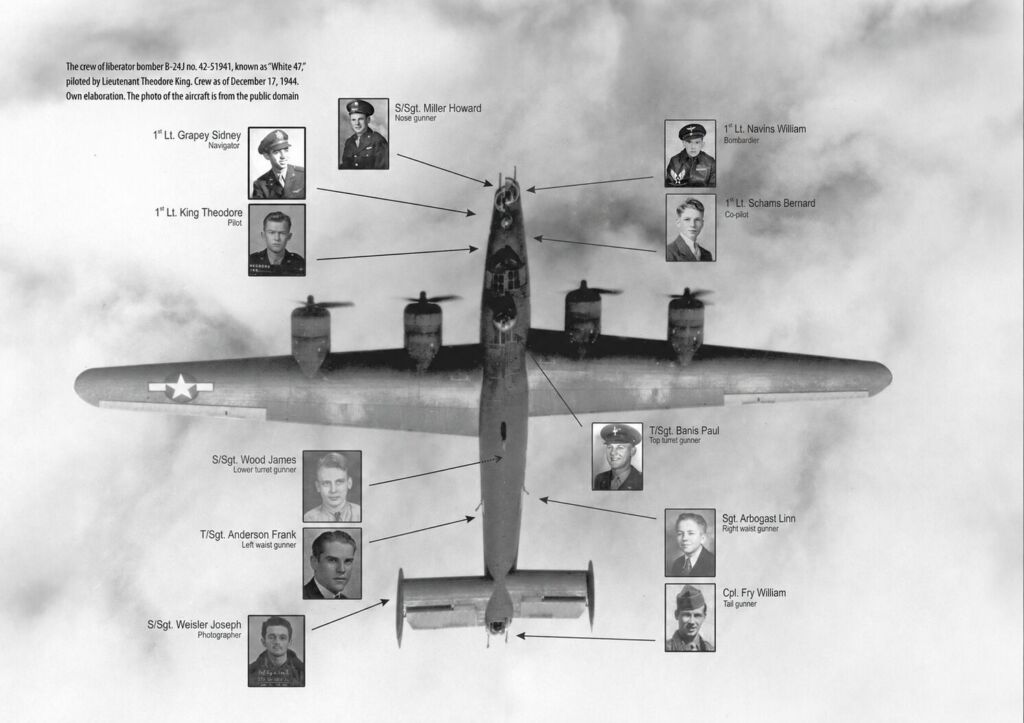
The crew included top turret gunner Paul Banis, as well as Weisler, the photographer who survived. King’s regular bomber crew numbered ten, but eleven men were aboard that day because of the photographic assignment.
The full study includes portraits of nearly all of them arranged around an image of a B-24, with arrows pointing toward the stations where each man worked.
A Crash Remembered, and Misremembered
The people living near Rzymkowice did not forget the falling Liberator. They remembered the wreckage, the bodies, the German soldiers and the pieces of aircraft removed from the forest. But memory changed as witnesses died and nature reclaimed the crash site.
A Warsaw Uprising veteran named Andrzej Smoleński, then a prisoner at the enormous Lamsdorf prisoner-of-war complex, recorded on December 17, 1944, that he had seen an airplane go down toward the camp. Decades later, that brief note helped lead historian Ludwik Uryga of the Central Museum of Prisoners of War into a larger investigation.
Czech aviation historian Miloš Podzimek visited the area in 1991 and again in 1993, interviewing residents and walking the ground. He had long been haunted by a photograph of a B-24 falling without its tail, not yet knowing precisely where the image had been taken or who was aboard the airplane. When he stood in the forest near Rzymkowice in 1991, he was still unsure whether the crash was the one in the photograph. His later research confirmed the connection.
American researchers also made attempts to locate the bodies. Graves Registration teams gathered witness accounts in 1947 and 1948, but the advent of the Cold War closed the area to further American investigation. The suspected burial ground lay within a Polish military training area, and the documentary record remained scattered among American, German and Polish archives.
The crew members are listed on the Wall of the Missing at Henri-Chapelle American Cemetery in Belgium. Sullivan is memorialized at Epinal American Cemetery in France. But a name on a wall is not the same as a known grave.
German records indicate that the bodies of King, Anderson, Miller, Sullivan and two unidentified men were brought to the Wierzbie airfield. One unidentified body was apparently recognized by Weisler as Bernard Schams. The fate of the remaining men is less certain. Researchers believe the Americans were probably buried at the Old Prisoner of War Cemetery at Łambinowice, once part of the Lamsdorf camp system, but the exact location has never been confirmed.
Even the precise crash site became uncertain. Witnesses led earlier researchers to one area, while pieces of the aircraft were later found approximately 700 meters farther west. The forest itself had changed. Trees grew, and roads and property lines shifted.
At a local museum, Daniel found part of a small metal identification bracelet or clasp bearing the name “Howard Miller” and Miller’s military service number. It had reportedly come from the crash area.
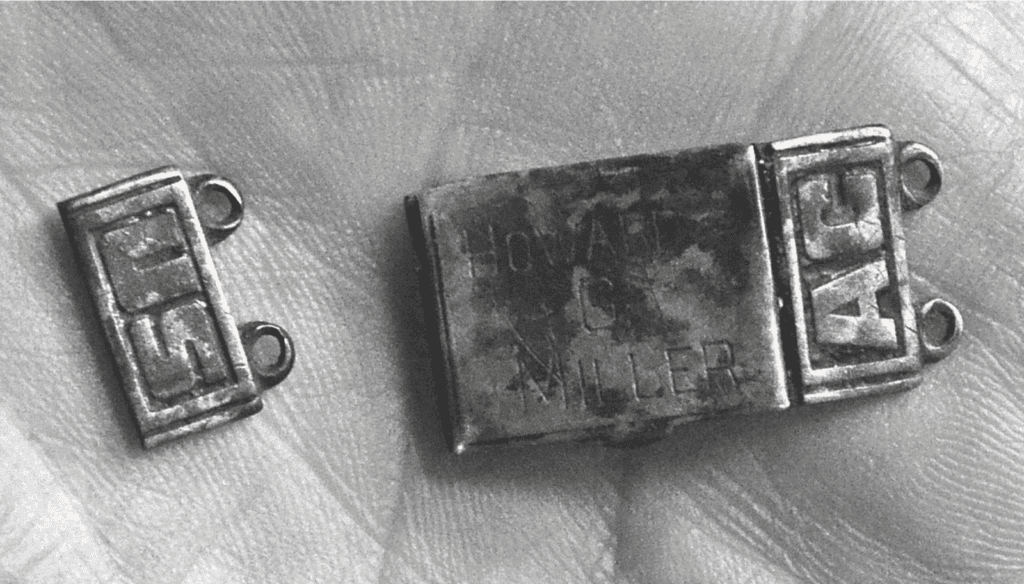
The object had crossed the distance between a young American airman and a Polish historian eighty years later. Miller was no longer only a name in a report. Something he had carried had survived him.
How the Story Reached Pittsburgh
The connection to the Veterans Breakfast Club began with Santo Magliocca, the ball turret gunner who witnessed the attack from another B-24.
Bob Podurgiel’s article about Magliocca in the VBC Magazine and mentioned the collision. Daniel found the story from Poland and contacted us in February 2025. He explained that he lived near the crash site and was trying to learn more about the Americans.
We connected Daniel with Marvin Fry, William Dean Fry’s surviving brother, and Marvin’s son Doug. The Fry family shared military reports, photographs, a crew picture and a moving 1946 letter written by Gertrude Miller, Howard Miller’s widow.
Daniel wrote that he opened their email “with a beating heart” and spent hours reading the documents.
Another connection followed when Miloš Podzimek contacted VBC after seeing the same story. Suddenly, people in Poland, the Czech Republic and the United States—local historians, aviation researchers, journalists and relatives of the dead—were exchanging records and trying to fit the pieces together.
Daniel and Jadwiga brought these fragments together in their study, but the work has not ended.
In September 2025, local residents traveled a 30-kilometer “King’s Route” connecting the crash site, the former Weidengut airfield where the wreckage and bodies were taken, and the cemetery at Lamsdorf where the men may have been buried. Daniel hopes to make the journey an annual commemoration.
The local Forest District, which manages the crash area, has expressed interest in placing a small memorial there. American authorities have also sought permission to conduct archaeological work, while researchers continue trying to identify the crew’s burial place.
Daniel recently wrote that the King’s Route will be organized again and that work on both the memorial and burial question continues.
A Place in the Forest
Near the end of his study, Daniel considers whether the forest itself can serve as a memorial. In one sense, it already does. It holds the last physical traces of the airplane and fragments that have not yet been found. But an unmarked forest covers up its past. Unless someone tells the story, it remains buried with tree roots.
Daniel argues that this is why oral histories, archaeological work, family records and a permanent marker matter.
Joseph Weisler’s daughter, Carol, expressed what the work means to the families:
“You can only imagine how much all of what you are doing means to me. . . . I am honored that you are honoring these good men, more than you will ever know.”
The history of White 47 remains unfinished. We still do not know with certainty where the dead were buried. A permanent memorial has been discussed but not completed.
Still, the men are no longer quite as lost as they were. Daniel Podobiński’s work has been to gather those stories again, one document, photograph, object and family connection at a time.
Editor’s note: This article is based primarily on Daniel Podobiński’s The Crash of the Liberator Near Rzymkowice, coauthored by Jadwiga Wójciak and published in 2025. The complete 67-page illustrated study is available here with the author’s permission.
