

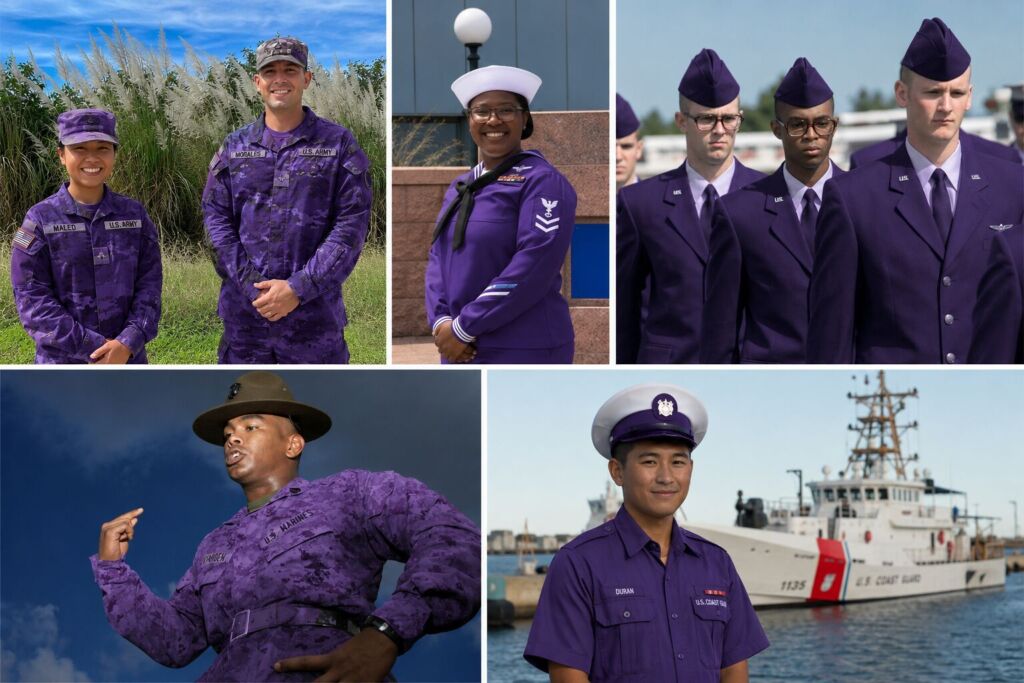
By Bob Von Bargen
Few veterans today remember the phrase “purple suit.” I was reminded of that recently after giving a presentation on the origins of Armed Forces Day. At the end, I asked the audience whether anyone remembered the expression. No one did. That surprised me because, for many of us, “putting on your purple suit” was a familiar reminder to think beyond our own service and work together to accomplish the mission.
The term “purple suit“ was never the name of an actual uniform. It was a lighthearted Department of Defense expression for setting aside service rivalries and working as one military team. The idea rested on a simple joke:
- The Army wears green.
- The Navy wears blue.
- The Air Force wears blue.
- The Marine Corps wears green.
- The Coast Guard wears blue.
Blend those service colors together, and the result is purple.
When someone said, “Put on your purple suit,” the message was clear: stop thinking only as an Army officer, Navy chief, Air Force colonel, Marine captain, or Coast Guardsman, and think instead as a member of the United States Armed Forces. The phrase became shorthand for a joint, mission-first perspective rather than a service-centered one.
Joint operations had long existed in World War II, Korea, and Vietnam, but the services still tended to operate with substantial independence. Each branch maintained its own doctrine, budget priorities, communications systems, and ways of doing business.
The push toward a more “purple” mindset gained momentum after several difficult operations revealed the cost of weakcoordination among the services. The most influential examples included:
- The failed 1980 Operation Eagle Claw mission to rescue S. hostages in Iran.
- Shortcomings identified during the 1983 invasion of Grenada.
- The growing recognition that modern warfare required seamless cooperation across land, sea, air, and later space and cyber forces.
Those lessons led to the landmark Goldwater-Nichols Department of Defense Reorganization Act of 1986. The actreshaped the U.S. military by strengthening unified combatant commanders and making joint assignments important for promotion to senior rank. It also promoted common planning and doctrine, helping reduce service rivalries and teachingofficers to operate effectively beyond their own branches. For many who served in the 1960s and into 1990s, the phrase “wear your purple suit” became a regular reminder that the mission came first.
You might hear remarks such as:
- “Take off your Air Force hat and put on your purple suit.”
- “This is not an Army problem—think purple.”
- “Today, we are all wearing purple suits.”
No one was expected to abandon pride in their own service, but they were expected to look beyond it. Advancement increasingly depended on a “purple suit” mindset: success came not from which service led the effort, but from combining everyone’s capabilities to accomplish the mission. Over time, the term faded from use. Today’s officers have grown up in a military where joint operations are standard practice. After nearly forty years under Goldwater-Nichols, many younger service members have never heard the phrase because joint thinking has always been part of their experience. The culture changed so completely that the old nickname became less necessary—ironically, because the idea behind it succeeded.
Years ago, as we learned to operate as one military team, we joked about putting on our ‘purple suit.’ No such uniformexisted. It simply reminded us that the mission mattered more than the color of any one service’s uniform. Today, joint operations are routine. In many ways, the purple suit has become invisible—not because it disappeared, but because it became part of who we are.
