

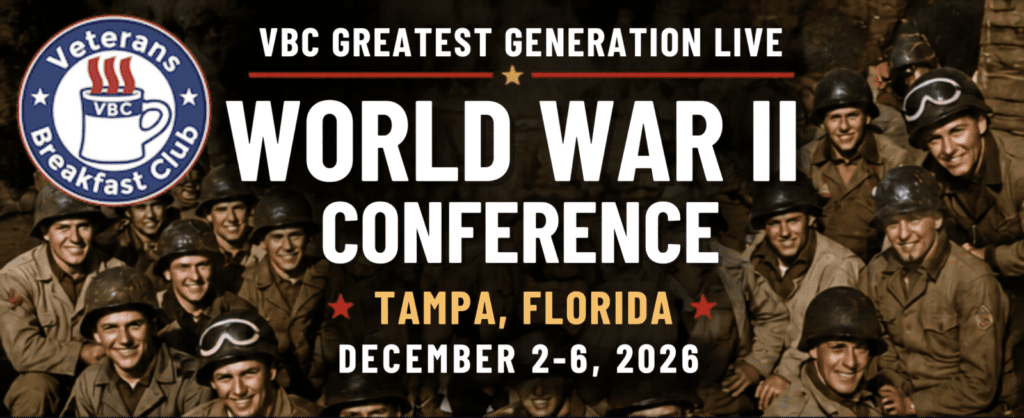
Banner to join World War II Veterans the VBC Greatest Generation Live World War II Conference in Tampa, Florida

Featured Keynote Speaker

Michael S. Bell, PhD
Executive Director, Institute for the Study of War and Democracy
Learn more about Michael:
The National WWII Museum
Speaker Bio
Jenny Craig Institute for the Study of War and Democracy

Featured Speakers

Helen Patton
Granddaughter of General George S. Patton

David Nasaw
Author of The Wounded Generation
Learn more about David: VBC Livestream Events and VBC Blog

James Campbell
Author of Ghost Mountain Boys
Learn more about James: VBC Livestream Event

Michel Paradis
Author of In the Light of Battle
Learn more about Michel: VBC Livestream Event

Michael P. Faley
100th Bomb Group historian
Learn more about Michael: VBC Livestream Events

Rebecca Crosby Hutchinson
Daughter of 100th Bomb Group navigator and author Harry Crosby
Learn more about Rebecca: VBC Livestream Events

Colin Heaton
Luftwaffe historian, author, and consultant to Apple+ TV’s Masters of the Air
Learn more about Colin: VBC Livestream Events

Chris Kolakowski
Director of the Wisconsin Veterans Museum
Learn more about Chris: VBC Livestream Event

Roger Cirillo
Research-author for American Armies and Battlefields in Europe: World War II series

Jeff Ballard
Naval historian and Pacific War author
Learn more about Jeff: VBC Livestream Events and VBC Blog

Dave Holland
Guadalcanal historian, author, and battlefield guide
Learn more about Dave: VBC Livestream Events

Carol Schultz
Author of The Hidden Legacy of World War II
Learn more about Carol: VBC Livestream Event

Rich Sherman
Navy veteran, photographer, and author of Never Home
Learn more about Rich: VBC Livestream Events

Our World War II Veterans Attending

Russ Freeburg

WWII Veteran Russell Freeburg’s 103rd Birthday Celebration

Russ was born on March 4, 1923, in the railroad town of Galesburg, Illinois. He grew up in the Great Depression, came of age as clouds of war gathered, and served his country on the battlefields of Europe.

After graduating high school in 1941, Russ enrolled at Knox College and joined ROTC. In February 1942 he entered the Army Enlisted Reserve Corps and was called to active duty in June 1943. By March 1944 he was assigned to the 8th Armored Division, 49th Armored Infantry Battalion, C Company.

A Staff Sergeant and squad leader, Russ crossed the Atlantic aboard the HMS Samaria and trained on England’s Salisbury Plain before shipping to France as the Battle of the Bulge raged. His division moved across the Metz front, shifted from the 3rd to the 9th Army, and fought through southern Holland.

He crossed the Rhine and the Ruhr, battled through the Ruhr Pocket, and pushed east into Germany and Czechoslovakia, ending the war not far from Soviet lines. Then came the long journey home—through the “cigarette camps” of France, back across the Atlantic, and finally discharge in February 1946.

After the war, Russ built a remarkable career in journalism. He began at the City News Bureau of Chicago, joined the Chicago Tribune in 1950, and moved to Washington in 1958 to cover the Justice Department and the White House. In 1966 he became executive director of the Tribune’s Washington bureau and later served as managing editor.

He co-authored Oil & War with Robert Goralski of NBC News in 1987—a study of the geopolitics of energy long before it became headline shorthand.

Warren Goss

WWII and D-Day Veteran Warren Goss

In 1943, Warren volunteered for the 531st Engineer Shore Regiment, 1st Engineer Amphibian Brigade. Warren trained for much of the next year, and that included the ill-fated training exercise Operation Tiger, where 800 American soldiers lost their lives at Slapton Sands. The training was for D-Day, and Warren crossed the Channel the morning of June 6, headed for Utah Beach. He was one of the first to step foot on Utah Beach that morning. The next few hours were intense: Warren saw terrible sights as he jumped off the landing craft. He made it to the beach and headed inland, in the direction of Ste-Marie-du-Mont. Warren did many patrols in Normandy before the battle ended in August. With the job of the 531st done, Warren was transferred to Company K, 274th Infantry Regiment, 70th Infantry Division, and they set across central France in the direction of Germany, crossing the Saar River and fighting in the Battle of the Bulge during the winter of 1944-45.  Warren’s war ended near Frankfurt; he eventually made his way home and found his way back into civilian life, marrying and raising his own family.

Richard Inlow

WWII Navy SeaBee Richard Inlow

Drafted out of high school and sent to a Seabee battalion, Dick didn’t even know what a Seabee was—just that the Navy put him on a train and sent him where he was needed. Before long, he found himself landing on the first day at Peleliu, supporting the Marines under fire, carrying ammunition through waist-deep water as bullets struck around him.

“I survived by hiding behind the Marines,” he says with characteristic understatement.

Dick served with the 33rd Naval Construction Battalion, helping repair airstrips under combat conditions and supporting frontline operations in some of the Pacific’s most brutal fighting.

After the war, Dick built a full and accomplished life, becoming a teacher, a mathematician, and a man who never lost his passion for learning.

Hilbert Margol

PFC Hilbert Margol, born February 22, 1924 in Jacksonville, Florida, was drafted in 1943 and served with Battery B, 392nd Field Artillery Battalion of the famed 42nd “Rainbow” Infantry Division, alongside his identical twin brother, Howard. In April 1945 his unit became among the first American forces to enter and liberate Dachau concentration camp—Hilbert and Howard were stopped by a stench in the woods and discovered boxcars crammed with the dead, a sight that Hilbert describes as beyond anything he’d imagined. After his honorable discharge in April 1946, Margol dedicated much of his later life to public education, sharing his firsthand testimony to oppose Holocaust denial and ensure the horrors he witnessed are never forgotten.

Neil McCallum

WWII Marine Neal McCallum and the Battle of Okinawa

At just 18 years old, McCallum landed on Okinawa with Fox Company, 29th Marine Regiment, 6th Marine Division, part of the massive U.S. invasion force that stormed the island on Easter Sunday April 1, 1945y.

He served as an infantryman in a mortar section and fought through some of the fiercest combat of the war, including the deadly struggle for Sugar Loaf Hill, where Marines suffered staggering losses. On May 19, 1945, McCallum was seriously wounded by enemy fire, just one day after his close friend was killed in action.

The Battle of Okinawa was the largest amphibious assault in the Pacific Theater and one of the bloodiest. The battle raged over 82 days. Whenit was over, more 12,000 Americans were dead and another 37,000 wounded. Japanese casualties were many times that number. And, perhaps most tragic, 100,000–200,000 Okinawan civilians were dead.

Fought across ridges, caves, and fortified positions, Okinawa became a war of attrition with kamikaze attacks. The scale of the destruction gave a U.S. forces a yardstick for estimating the cost of invading mainland Japan.