


Our World War II Veterans Attending
Sallie Amato
Sallie Amato, who turned 103 in 2026, was a sergeant in the Marine Corps. Her specialty was playing the bugle, providing the ceremonial calls for reveille, chow call and evening taps. She describes her life as full of happiness, dedicated to family and country.
Rita Baumgarten
Rita Baumgarten is the wife of Dr. Hal Baumgarten, one of the few first-wave survivors of the Dog Green Beach landing at Omaha Beach on June 6, 1944. He was part of the platoon in Company B know as the “Bedford Boys,” because most were from Bedford, Virginia. A writer and educator, Dr. Baumgarten carried on the story of the Bedford Boys until his death, including as the principal historical advisor for the Omaha Beach landing scene in Saving Private Ryan. Rita has continued to carry on her late husband’s word and passion in many paces, including the National WWII Museum.
Louis Boria Jr.
Louis Boria Jr., 99, grew up in a Puerto Rican family in Brooklyn. He joined the Marine Corps at age 16 in 1943. His first combat duty was in the invasion of Leyte in 1944. Boria was recalled to active duty for the Korean Conflict. After retiring from the Marines in 1957, Boria held various positions in New York City. His four sons all joined the Marine Corps.
Russ Freeburg

Russ was born on March 4, 1923, in the railroad town of Galesburg, Illinois. He grew up in the Great Depression, came of age as clouds of war gathered, and served his country on the battlefields of Europe.
After graduating high school in 1941, Russ enrolled at Knox College and joined ROTC. In February 1942 he entered the Army Enlisted Reserve Corps and was called to active duty in June 1943. By March 1944 he was assigned to the 8th Armored Division, 49th Armored Infantry Battalion, C Company.
A Staff Sergeant and squad leader, Russ crossed the Atlantic aboard the HMS Samaria and trained on England’s Salisbury Plain before shipping to France as the Battle of the Bulge raged. His division moved across the Metz front, shifted from the 3rd to the 9th Army, and fought through southern Holland.
He crossed the Rhine and the Ruhr, battled through the Ruhr Pocket, and pushed east into Germany and Czechoslovakia, ending the war not far from Soviet lines. Then came the long journey home—through the “cigarette camps” of France, back across the Atlantic, and finally discharge in February 1946.
After the war, Russ built a remarkable career in journalism. He began at the City News Bureau of Chicago, joined the Chicago Tribune in 1950, and moved to Washington in 1958 to cover the Justice Department and the White House. In 1966 he became executive director of the Tribune’s Washington bureau and later served as managing editor.
He co-authored Oil & War with Robert Goralski of NBC News in 1987—a study of the geopolitics of energy long before it became headline shorthand.
Warren Goss
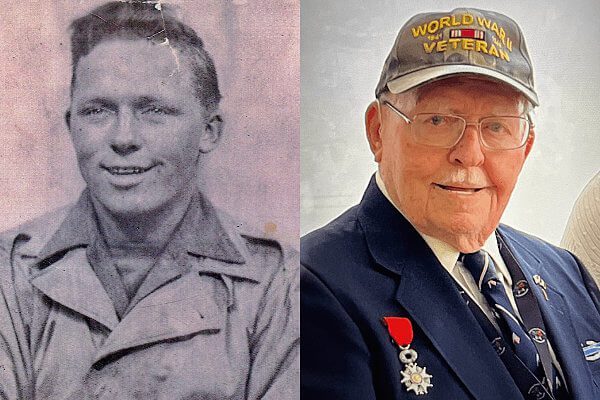
In 1943, Warren volunteered for the 531st Engineer Shore Regiment, 1st Engineer Amphibian Brigade. Warren trained for much of the next year, and that included the ill-fated training exercise Operation Tiger, where 800 American soldiers lost their lives at Slapton Sands. The training was for D-Day, and Warren crossed the Channel the morning of June 6, headed for Utah Beach. He was one of the first to step foot on Utah Beach that morning. The next few hours were intense: Warren saw terrible sights as he jumped off the landing craft. He made it to the beach and headed inland, in the direction of Ste-Marie-du-Mont. Warren did many patrols in Normandy before the battle ended in August. With the job of the 531st done, Warren was transferred to Company K, 274th Infantry Regiment, 70th Infantry Division, and they set across central France in the direction of Germany, crossing the Saar River and fighting in the Battle of the Bulge during the winter of 1944-45. Warren’s war ended near Frankfurt; he eventually made his way home and found his way back into civilian life, marrying and raising his own family.
Richard Inlow

Drafted out of high school and sent to a Seabee battalion, Dick didn’t even know what a Seabee was—just that the Navy put him on a train and sent him where he was needed. Before long, he found himself landing on the first day at Peleliu, supporting the Marines under fire, carrying ammunition through waist-deep water as bullets struck around him.
“I survived by hiding behind the Marines,” he says with characteristic understatement.
Dick served with the 33rd Naval Construction Battalion, helping repair airstrips under combat conditions and supporting frontline operations in some of the Pacific’s most brutal fighting.
After the war, Dick built a full and accomplished life, becoming a teacher, a mathematician, and a man who never lost his passion for learning.
Mel Jenner
Mel Jenner, Chief Master Sergeant, joined the Army Air Corps in 1940 at age 17. He was an aerial gunner on 31 Eighth Air Force missions, including bombing missions to Berlin and reconnaissance on D-Day. In 1947 he reenlisted in the U.S. Air Force and served in Germany during the Berlin Airlift, in Korea and Vietnam.
Hilbert Margol
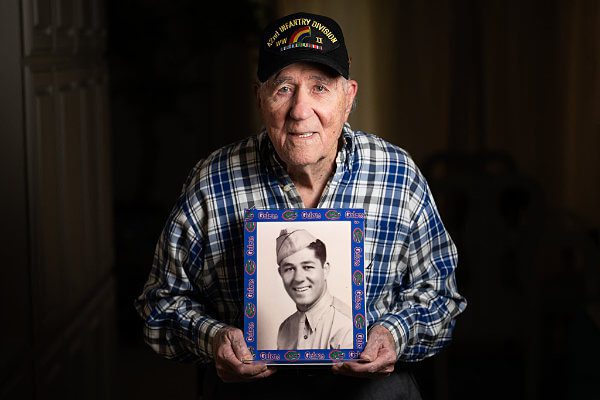
PFC Hilbert Margol, born February 22, 1924 in Jacksonville, Florida, was drafted in 1943 and served with Battery B, 392nd Field Artillery Battalion of the famed 42nd “Rainbow” Infantry Division, alongside his identical twin brother, Howard. In April 1945 his unit became among the first American forces to enter and liberate Dachau concentration camp—Hilbert and Howard were stopped by a stench in the woods and discovered boxcars crammed with the dead, a sight that Hilbert describes as beyond anything he’d imagined. After his honorable discharge in April 1946, Margol dedicated much of his later life to public education, sharing his firsthand testimony to oppose Holocaust denial and ensure the horrors he witnessed are never forgotten.
Irving Locker
Irving Locker, 102, from New Jersey, entered the U. S. Army and served in Europe in a VII Corps anti-aircraft/anti-tank battalion in which he was in charge of several guns. The unit fought across France from Normandy, along the Siegfried Line, during the Battle of the Bulge and in Germany. His unit was one of those that liberated concentration camps.
Neil McCallum
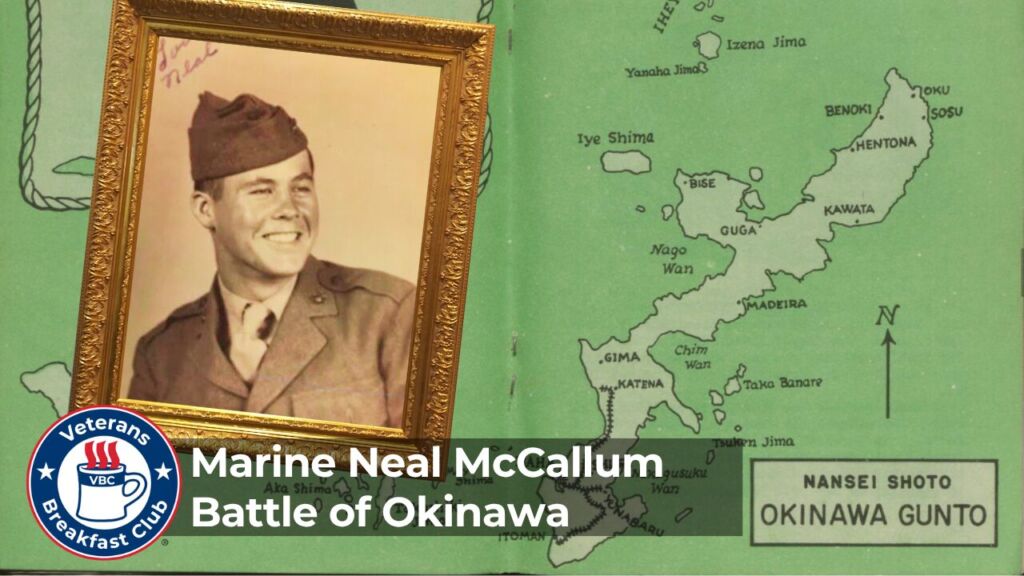
At just 18 years old, McCallum landed on Okinawa with Fox Company, 29th Marine Regiment, 6th Marine Division, part of the massive U.S. invasion force that stormed the island on Easter Sunday April 1, 1945y.
He served as an infantryman in a mortar section and fought through some of the fiercest combat of the war, including the deadly struggle for Sugar Loaf Hill, where Marines suffered staggering losses. On May 19, 1945, McCallum was seriously wounded by enemy fire, just one day after his close friend was killed in action.
The Battle of Okinawa was the largest amphibious assault in the Pacific Theater and one of the bloodiest. The battle raged over 82 days. Whenit was over, more 12,000 Americans were dead and another 37,000 wounded. Japanese casualties were many times that number. And, perhaps most tragic, 100,000–200,000 Okinawan civilians were dead.
Fought across ridges, caves, and fortified positions, Okinawa became a war of attrition with kamikaze attacks. The scale of the destruction gave a U.S. forces a yardstick for estimating the cost of invading mainland Japan.
Dominick Paternoster
Dominick Paternoster, 102, from Utica, New York, grew up in an Italian immigrant family. He served in the U.S. Navy from March 1944 as a Petty Officer 2nd Class fire control-man and engineer aboard USS Picking, a destroyer stationed in the West Pacific. After the war Dominick attended NYU, started a family and became a successful entrepreneur