

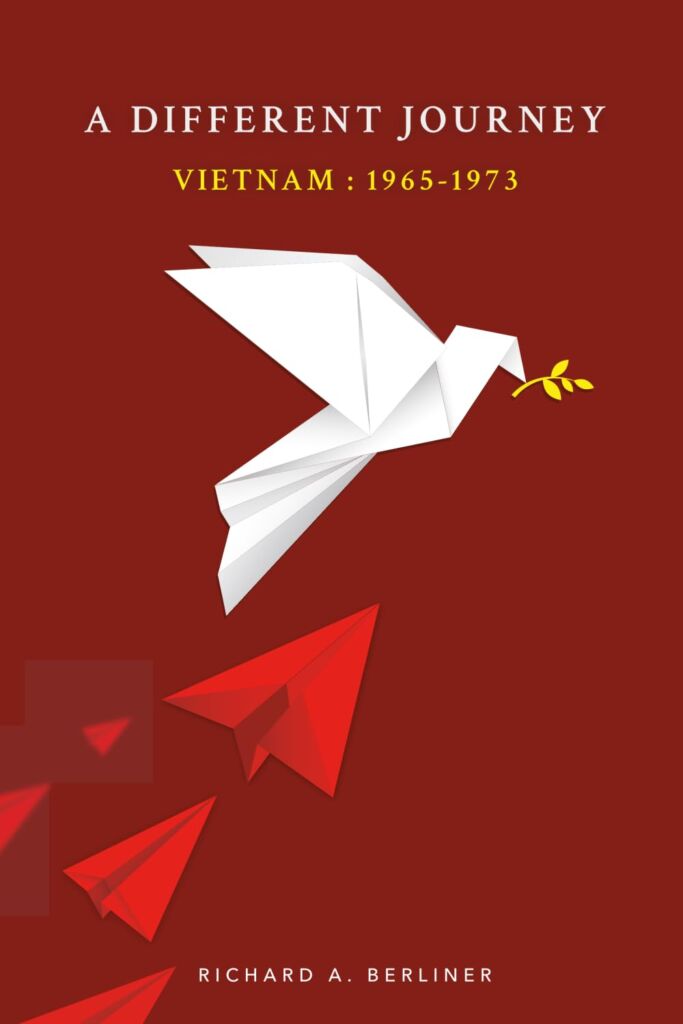
By Richard Berliner
Richard Berliner’s new book, A Different Journey: Vietnam 1965–1973 offers the rare perspective of an American civilian aid worker who lived, traveled, and worked alongside Vietnamese communities during the war. Richard served in Vietnam in 1966–67 as a volunteer with International Voluntary Services (IVS), making him a witness to war as a non-combatant. In the excerpt below, what begins as an ordinary drive through the countryside turns into a harrowing day that might have cost Richard his life. It appears here with the author’s permission.
The USAID jeep slowed as we approached the small roadside village. Suddenly, without warning, a toddler stepped off the sidewalk— colliding with our front fender. My driver, Nam, veered to the left, too late to avoid impact, and stopped the vehicle. He hopped out and went to the boy, now sprawled out on the road. Quickly a crowd gathered. I hung back near the jeep, knowing how volatile a crowd can be when aroused. Suddenly, Nam started running up the road, chased by a man waving a rifle. Shots rang out as Nam rounded the bend. My mind was a blur.
Someone in the crowd shouted, “Người Mỹ ở đây!” (“There is an American here!”)
The crowd turned toward me. Panic set in.
“Hey buddy. Do you need some help?” A voice out of the blue, in English.
Two American soldiers were driving by on their way to the nearby helicopter base. I felt a huge relief and then suddenly remembered the child. I quickly explained what had happened. We crossed the street, picked up the boy, and with his mother headed up the road where Nam had been chased. He had run off into the brush and was nowhere in sight, but there was no time to stop. This had suddenly turned into the worst day of my life.
The American helicopter base was less than two miles up the hill on the left. The child who had been struck by our jeep was taken inside a canvas-clad structure. I told the American soldier—I never knew his name—about what had happened, and without hesitation he said we needed to go back to the village and find my driver. As much as I wanted to help Nam, I dreaded heading back to the village where we might face an angry mob. But halfway down the hill we encountered two men pulling a wagon with Nam lying prone on the bed. He was alive, but obviously hurting. As we pulled up, he shouted at me, “You leave me down there. You forgot about me.” But there was no time to explain. We put him in the jeep and headed back up the hill. A helicopter sat on the paddock. The soldiers placed Nam on a stretcher and carried him onto the helicopter. I hopped on and landed in one of the two passenger seats in the middle of the chopper. The pilot took off, not with a gentle rise as we often equate with helicopters, but at a sharp angle, turning while he was climbing. Later I was told that the abrupt take-off was necessary to avoid sniper fire. I held on to whatever I could grab because there had been no time to fasten the seat belt designed to keep me inside the open air transport.
Almost as suddenly as we had taken off, we descended and landed on a wide patch of the road about ten minutes outside the village. The copilot told me that there was a very sick baby inside the house that needed to get to the US medical facility at the Cam Ranh air base. “Are you okay with holding the baby?” he asked. I nodded, not knowing what the alternative was.
He went into the house, and I fastened my seat belt—very securely. Nam lay still on the stretcher. For what seemed like an interminably long time I waited for a baby to hold on a lifesaving flight, no longer thinking about what had transpired in the village. Finally, the co-pilot emerged from the house, without the baby.
“Where’s the child?” I asked as he hopped into the front of the copter.
“Didn’t make it,” he said and up we went. I wondered how many times he had said that before.
We soon arrived at the sprawling Cam Ranh base and landed next to another canvas-clad structure with a big red cross on top. Nam was rushed inside, and I followed along. Although I was the only person not in army garb, no one paid any attention to me. The doctors went to work patching up Nam’s side where a bullet had pierced his body. John Denver’s voice drifted through the air, “Leaving on a jet plane, don’t know when I’ll be back again.”
I thought of the woman whom I had met nine months earlier while in Washington D.C. As we were getting to know each other, one of us always seemed to be getting on an airplane, travelling around the US. The other was left at the airport waving goodbye.
Laughter jarred me back into the present. The doctors working on Nam were making jokes. I wanted to scream, “Hey there, someone’s life is at stake! Pay attention!” It was only several years later, while watching the TV program M*A*S*H, that I realized humor was a necessary survival mechanism for doctors in a war zone.
The operation was completed, and Nam slept. I needed to get back to Quảng Ngãi where I had started the day. But I wasn’t sure how to go about it. The Cam Ranh air base was huge. I didn’t know how long it would take to arrange a ride to the city thirty miles south. So I did what seemed most efficient: I walked to the front gate and put out my thumb.
After thirty minutes in this isolated village, I grabbed the first ride offered—on the back of a motorcycle driven by a Vietnamese soldier. I got dropped off near the USAID office and went inside to let them know what had happened. They seemed particularly concerned about the USAID vehicle that had been left in the village. Before I knew it, I was being escorted to another vehicle and with two USAID workers headed back to the village where the accident had occurred. This was the last thing I wanted to do that day, but fortunately the trip went well, and we were able to retrieve the USAID Scout without incident. I finally made it back to the Quaker compound in time for dinner. When I tried to tell my dinner companions about what had happened that day, I must have sounded very confused, because their attention drifted elsewhere. I spent the rest of the meal in silence.
I visited Nam a month or so later at his home. He was still recovering and asked about compensation for his injuries. Vietnamese were often compensated by the US military when they could establish that they had been injured by US warcraft. I wrote to COR suggesting we do the same, but I never heard back. And I never went to see Nam again.
Excerpted from A Different Journey: Vietnam 1965–1973 by Richard Berliner. Reprinted with permission. When Dick first shared this manuscript with me, I was pleased to recommend it for publication because it brings an important civilian perspective to the historical literature of the Vietnam War.
