

By Todd DePastino
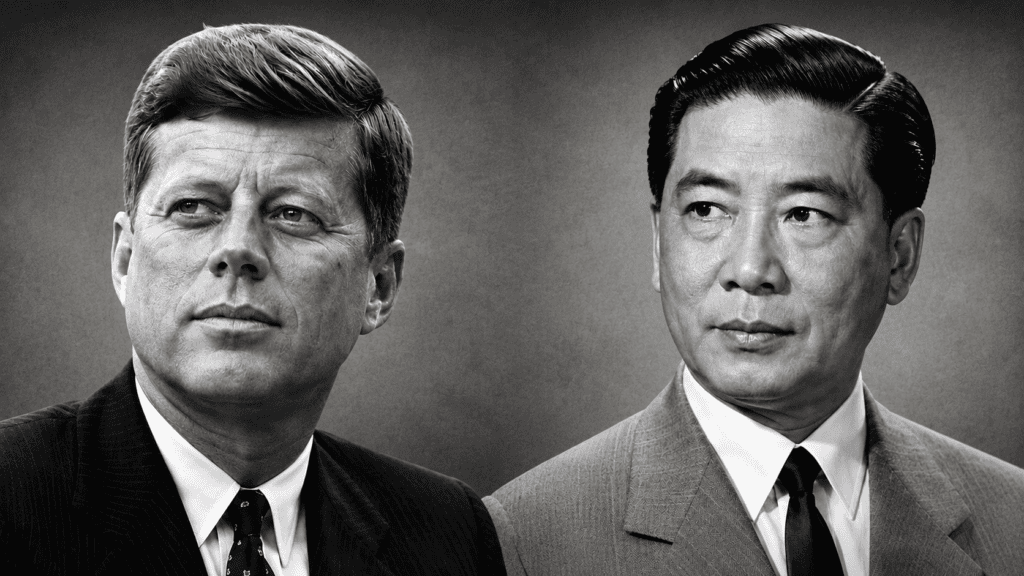
Author Jack Cheevers piqued my curiosity the other week when, on our VBC LIVE, he talked about the infamous “Green Light Cable” sent from President John F. Kennedy’s State Department to the new American ambassador in South Vietnam, Henry Cabot Lodge. The secret message was known as Cable 243, sent on Saturday, August 24, 1963.
It’s not an exaggeration to say that this telegram changed the trajectory of the Vietnam War because it signaled that the Kennedy administration was prepared to support the overthrow of South Vietnamese President Ngo Dinh Diem. Diem was eventually overthrown, and some historians today argue that things might have gone better for the US if he had remained in power.
Jack, author of the new book Kennedy’s Coup: A White House Plot, a Saigon Murder, and America’s Descent into Vietnam, told the cable’s backstory:
President Ngo Dinh Diem had once been something of an American hero. Dwight Eisenhower welcomed him to Washington in 1957. John F. Kennedy had known and admired him before becoming president. Lyndon Johnson famously called Diem the “Churchill of Asia.” State Department officials proudly crowed about “our man in Saigon.”
By August 1963, however, the relationship between Washington and Diem had soured. Diem’s government had become increasingly authoritarian. Diem seemed unwilling or unable to broaden political support beyond his family and a narrow circle of loyalists. Buddhists, Vietnam’s majority religion, protested the regime’s favoritism toward Catholics. Diem responded to the protests with violent repression, rather than reform. Even Diem’s senior South Vietnamese generals grew frustrated by the leader’s religious favoritism.
And they detested Diem’s powerful brother and loose cannon Ngo Dinh Nhu, who controlled the secret police and seemed to be the driving force behind the regime’s repression.
By August, Washington was beginning to wonder whether Diem and Nhu had become liabilities in the war against the Viet Cong rather than reliable partners in it.
Then, on the night of August 20-21, matters came to a head. Forces controlled by Nhu raided Buddhist pagodas across South Vietnam and arrested more than 1,400 monks and nuns. It was a bad look.
Roger Hilsman, the State Department’s assistant secretary for Far Eastern affairs, came into his office that Saturday, August 24, and drafted what became Cable 243. As Jack explained during our program, the message essentially told Lodge to begin looking beyond Diem. He should make contact with political and military figures and make clear that American support for South Vietnam would continue even if Diem were removed.
US government cannot tolerate situation in which power lies in Nhu’s hands. Diem must be given chance to rid himself of Nhu and his coterie and replace them with best military and political personalities available.
If, in spite of all your efforts, Diem remains obdurate and refuses, we must face the possibility that Diem himself cannot be preserved. . . .
Ambassador and country team should urgently examine all possible alternative leadership and make detailed plans as to how we might bring about Diem’s replacement, if this should become necessary . . .
Hilsman didn’t have the authority to send such a consequential cable on his own. He needed higher-ups to approve it. But it was a Saturday in August. Everyone was away from their desks.
Secretary of Defense Robert McNamara was climbing in the Grand Tetons. CIA Director John McCone was yachting in Puget Sound. National Security Adviser McGeorge Bundy was at his home in Massachusetts. Kennedy himself was at Hyannis Port, where he and Jackie were still grieving the death of their newborn son Patrick just two weeks earlier.
The cable bounced through a slipshod approval process. Michael Forrestal of the National Security Council staff called Kennedy directly. Kennedy told him to get a senior administration official to approve it. Hilsman, Forrestal, and Averell Harriman then obtained approvals from senior officials who seemed under the impression that JFK had already approved it. Kennedy, hearing that his advisers had approved it, then gave his own approval.
So, JFK definitely approved the Green Light Cable. But not in the serious deliberative fashion you might imagine. The implications of a coup, you might say, were not thought through.
The cable told Lodge that Diem had to be given a chance to remove Nhu. If Diem refused, Washington would have to face the possibility that Diem himself “cannot be preserved.” Lodge was instructed to consider alternative leadership in case Diem was ousted.
To be clear, the Kennedy administration and the CIA didn’t overthrow Ngo Dinh Diem, as it is sometimes claimed. Rather, they simply gave a green light to South Vietnamese generals who were plotting the overthrow. The wink and nod from Cable 243 was all they needed to proceed.
By Monday, August 26, some of Kennedy’s senior advisers were furious.
McNamara and CIA Director McCone had not been consulted. Neither had Chairman of the Joint Chiefs of Staff General Maxwell Taylor, who later called the way the cable had been approved an “egregious end run.” Kennedy himself recognized realized his error in not giving the cable the scrutiny it deserved.
But at no point did the President withdraw the cable. He let it hang out there without qualifying or negating it.
Jack emphasized this in our conversation. Kennedy gathered his advisers and understood the mistake, but ultimately let the policy stand.
On November 1, South Vietnamese generals finally moved against Diem. Diem and Nhu escaped the presidential palace but were captured the next morning and murdered in the back of an armored personnel carrier.
Kennedy was reportedly shocked when he learned they had been murdered. His administration hadn’t thought much about guaranteeing the brothers’ safety.
And the coup didn’t solve America’s Vietnam problem. In some ways, it made that problem worse.
South Vietnam convulsed with political turmoil following Diem’s death. Six major government changes occurred over the next 19 months, with more coups, countercoups, declarations of martial law, and attempts at establishing civilian rule. All this instability meant that the US had to take on more responsibility in the fight agains the Viet Cong, deepening the American commitment to South Vietnam that directly led to the escalation of the war under President Lyndon Johnson.
And that’s what makes Cable 243 worth remembering on August 24.
Watch our conversation with Jack Cheevers about Kennedy’s Coup and the story behind the “Green Light Cable”: Kennedy’s Coup with Jack Cheevers | Veterans Breakfast Club
