

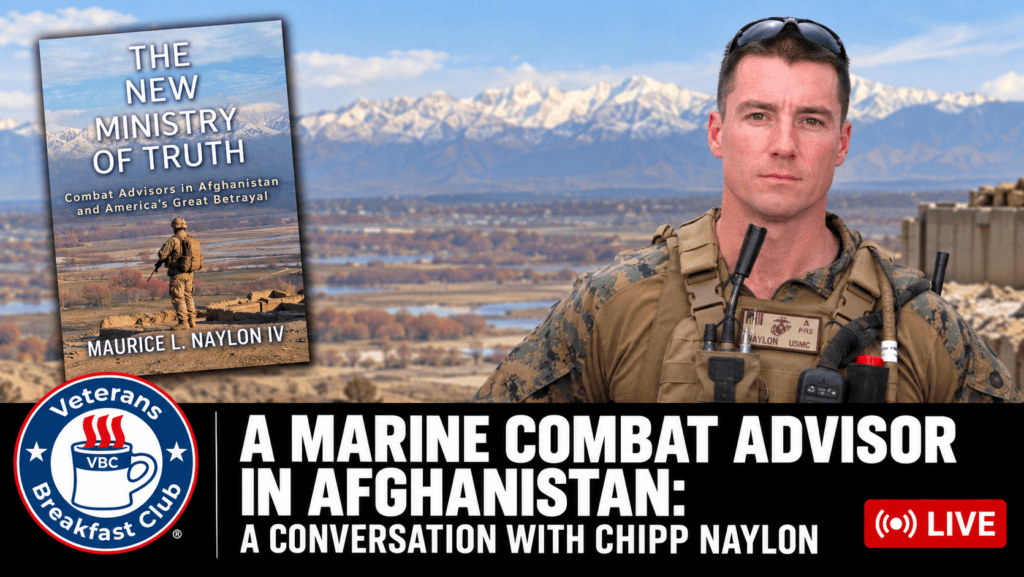
Maurice L. “Chipp” Naylon IV served nine years as a U.S. Marine Corps infantry officer. In 2014–2015, he deployed to Afghanistan as a combat advisor and operations officer working with soldiers from the Republic of Georgia assigned to help defend Bagram Airfield. By then, America had been at war in Afghanistan for more than thirteen years, and Washington was preparing to declare an “end to combat operations.” On the ground, however, Naylon and his Marines were still leaving the wire, hunting for rocket teams and bomb makers, encountering IEDs, and trying to protect one of the largest American bases in the country.
Naylon tells that story in his book The New Ministry of Truth: Combat Advisors in Afghanistan and America’s Great Betrayal. It is less a conventional combat memoir than an account of the widening gap he saw between policy and reality—and of what that gap meant for the servicemembers ordered to carry out the mission.
Naylon’s deployment also offers an unusual window into the complicated coalition war in Afghanistan. His small team of Marines advised a Georgian infantry battalion whose soldiers had their own reasons for being there, while working alongside Afghan National Army forces and operating under an American chain of command. Success depended not simply on firepower but on relationships, trust, cultural understanding, intelligence, and rules of engagement that Naylon increasingly believed prevented his Marines from confronting threats before those threats confronted them.
One phrase captures his larger criticism of the war: “We weren’t in Afghanistan for 20 years. We were in Afghanistan for one year, 20 times.” Units rotated in and out, knowledge disappeared, missions changed, and the people arriving often had to rediscover lessons learned by those who had come before them.
Yet Naylon’s story isn’t simply one of anger or disillusionment. He remains intensely proud of the Marines he served with and of the Georgian soldiers they trained and advised. During seven months in Afghanistan, he watched their combined force develop from struggling with basic patrols into conducting complex nighttime operations with Afghan and American forces. That pride in what servicemembers accomplished at the tactical level exists alongside a much harder question about the larger war: What did those accomplishments ultimately add up to?
Join the Veterans Breakfast Club for a candid conversation with Chipp Naylon about advising foreign troops, defending Bagram, restrictive rules of engagement, leadership and loyalty, the frustrations of coalition warfare, and the strange experience of fighting a war that officials back home were declaring over. We’ll also talk about the fall of Afghanistan in 2021 and the question that runs throughout Naylon’s book and the experiences of so many Afghanistan veterans: What did our service there mean?
