

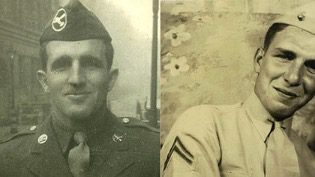
By David Wassel
Several years ago while cleaning out a family house, David Wassel ran across a box containing 170 letters written during World War II. Together, these letters tell the story of the Dininger family of Freeport, Pennsylvania, and walk readers through the adventure, hardship, and heartache of war.
The correspondence revolves around David’s great-uncles, Bob and Harry Dininger, two young men who kept in touch with their mother, Grace, and each other as the war took the brothers to opposite sides of the world.
Bob, eight years older than Harry, entered the Army and volunteered for the paratroopers. He served with the 101st Airborne Division, jumped into Normandy on D-Day, fought his way across Europe, and later served at Bastogne during the Battle of the Bulge. He survived the war and returned home to western Pennsylvania.
Harry enlisted in the Marine Corps in July 1941, before Pearl Harbor. He served with Company C, 1st Battalion, 22nd Marines, fighting through the Pacific, including the Marshall Islands and Guam, where he was badly wounded. He returned to his unit and went with the 6th Marine Division to Okinawa. On May 10, 1945, while leading his platoon in an assault on a Japanese position known as Charlie Hill, 25-year-old Platoon Sergeant Harry Dininger was killed by machine-gun fire.
The letters provide a humble and intimate glimpse into the stresses and strains, as well as the humor and news, of one family at war. Back home, Grace followed the war through newspapers and radio and struggled to glean information about her sons’ whereabouts and well-being from he scant descriptions in the letters.
David has shaped the letters, photographs, newspaper clippings, and his own research into a book-length manuscript titled In the End, Everything Will Be Better, for which he is currently seeking a publisher. He has generously allowed us to share three of the letters here.
The first was written on May 23, 1944, by a British woman whose family had quartered Bob while the 101st Airborne prepared for the invasion of Europe. She wrote Grace Dininger to tell her what a fine young man her son was, unaware that in two weeks Bob would parachute into Normandy.
The second came from Bob himself on August 6, after he had survived D-Day and the fighting in Normandy. Writing to Harry, then serving in the Pacific, Bob described what he had just been through with characteristic understatement: “We had a few trying days but as a whole no complaints.”
The final letter was written from Okinawa on June 11, 1945. Sgt. Major Robert O’Brien, another Freeport Marine and an old friend of Harry’s, wrote Frank and Grace Dininger about their son’s death. His letter is a great expression of a hard-bitten combat veteran about the meaning of Harry’s death and what he knew about his friend’s final days.
This letter, sent to Grace Dininger, was posted by the woman with whose family Bob was quartered in Britain, as he trained and prepared for his part in D Day.
90 Quantock Road
Western-super-Mare
Somerset
May 23rd, 1944
Dear Mrs. Dininger,
You no doubt have already heard from your son Cpl. Robert Dininger that he has been staying with us for just about a month, and I thought you would be pleased to know how very much we all enjoyed having him with us and wished that he could have been here longer. He was kept pretty busy during the day time, but he seemed to be really very interested in his job, and always came in with a smile, in the evening, after having had, as he would say, “a very good day.”
You would have been delighted to see his looking so fit, and when he left us last week, he was as brown as a berry, through being out so much in the sun shine.
We have been so glad to have had this opportunity of getting to know more about you al on the other side of the Atlantic, for it can only be, by having a better understanding of one another in different countries, that we can hope to attain to a better world of Peace, when this war is over.
We considered that we had got the pick of the Regiment, when Cp. Dininger, with his quiet unassuming manner came to us, but after they had gone, and talking to several friends, who had also had Americans with them, I found that they too thought the same about their men, so you see what a good name they left behind them.
You must be having a very anxious time with sons in both war zones, but we trust that they may all come through safely, and before very long may be back with you all again; We have three boys, the eldest being 17 1/2, the second 15, and the baby 10. The eldest will soon be called up now & I don’t expect will have much choice in what he has to do.
Two wars in a life time is a bit hard, don’t you agree. Your son tells us that you had pneumonia in the spring. I hope that you have quite got over it by now, and will keep well in the future.
We shall look forward to meeting your son again sometime & indeed any of you who may pay a visit to this country after the war will always find a welcome at our house.
With kindest regards,
Yours Sincerely,
G.B. Raut
The thoughtfulness of the letter, and the testament to the character of Bob, specifically, and, both to his regiment, and American servicemen stationed overseas, in general, is what really comes through from this letter. The quiet and humble nature portrayed here are very much representative of the man that I knew. It remains one of my favorite letters in the whole batch, and that’s a very, very tall bar. God Bless you, Bob Dininger.
August 6, 1944
Weston-Super-Mare, England
Dear “Hardo”
I feel pretty much like the proverbial tramp in being so lax in keeping up my correspondence with you. I will say this tho — my intentions were good but so damn little to write.
The item of greatest importance, I came thru the first one in good shape. We had a few trying days but as a whole no complaints.
I suppose you receive the news releases regularly so there is no need for me to go into detail as to just what goes on here. It’s suffice to say that we have finally broken thru and are moving at a good pace along the routes to Paris. So you see “kid,” it should not be too long now until the full force of all our men can be turned in your direction.
Don’t get me wrong, I am not trying to insinuate that you need any help but it sure would speed things up. After all, that’s of utmost importance, the day when you and I can get back to the “village.”
Over here they speak of this affair winding up in months and of drastic changes in a matter of days. Maybe a bit optimistic but it is a cinch the “pressure is on.”
At the present I am back in England just recently returned from a leave. I hear from Mom quite regular and things are good at home. Dad is quite busy and spends his spare time in the garden and with the chickens. It seems as tho “Ike” has been assigned to a post in the states, which is as it should be, you know that this is no racket for him.
That’s about all at this sitting kid. Keep your nose clean. Hope to see you soon. So long.
Your Brother
Bob
What really stand out in this letter is Bob characterizing his experiences after jumping out of a plane into the middle of Hitler’s “Fortress Europe” as being “a few trying days.”
Also, after opining that a quick end to the war in Europe, would allow the full force of all our men to be turned to the Pacific, he seems to have almost caught himself as somehow insinuating that Harry needed the help, and clarified that all he meant was that the larger point was getting the whole thing over with so that they could both return home as soon as possible.
Bob Dininger was 32 years old when he entered the Army and, subsequently, volunteered to join the paratroopers, Relatively old for such a position, I would hazard. All this is a very typically humble Bob Dininger.
Grace and Frank Dininger received the following letter from Sgt. Major Robert O’Brien, a Marine from Freeport who had known Harry before the war and who had served with him throughout the Pacific, frequently visiting with him on various islands, and was referenced frequently in Harry’s letters home.
11 June, 1945
Okinawa
Dear Mr. & Mrs. Dininger,
For a long time I’ve dreaded writing this letter because there was little to say. At first I couldn’t write, because I had to wait until the government notified you, and after that I waited simply because I couldn’t, and can’t, find words to describe what I want to say.
It was a great shock to me to hear of Harry’s death, even though we grow rather accustomed to death here. He was a very good friend and we’d spent many hours together on Guadalcanal.
I last saw him on the northern part of the island sometime between April 20 and 25. He came down to see me after his company had moved very close to where I was located. He was very cheerful and looked as fit as I’d ever seen him. All he talked about was going home — in fact that’s all we ever talked about.
Yesterday I called his company and tried to find out the circumstances of his death but because all the old men were no longer there, I could learn nothing other than the date, which you know, and the cause, which you may or may not know. He was hit in the chest by machine gun bullets while leading his platoon up what is now known as “Charlie” hill. According to his first sergeant, death was instantaneous.
I could go on and on but it seems senseless. I still find it hard to believe that he’s gone. I won’t attempt to say that he died for the American way of life, freedom, etc. and these things that are written about by people who don’t do the fighting, and thus don’t know what they’re talking about. What I will say is that he died bravely, and quickly, which is the best way for a soldier to die, if he has to die at all.
You both have my deepest sympathy in this tragic time. If there is anything I can do, whatever it is, just let me know.
He was buried in 6th Marine Division Cemetery No. 1, Plot A, Row 15, Grave #361.
Sincerely,
Your friend,
Bob O’Brien
Sgt Maj. R. B. O’Brien U.S.M.C.
The fact that Bob O’Brien states that he could not find out much about Harry’s death because, “all the old men were no longer there”, gives stark testimony to what had happened to Company C on Okinawa.
