

By Todd DePastino
Today was the first full day of our VBC World War II Tour of Italy, and we made a little history of our own by becoming quite possibly the first American tourist group ever to stop beneath a garbage-strewn bridge to visit an obscure but important World War II battlefield.
Our expert motorcoach driver, Raimondo, pulled off a narrow two-lane road just south of Siracusa, Sicily, and dropped us off for a short walk down the road and then along a little trail to the remains of Ponte Grande. Here, in July 1943, British airborne troops fought a desperate battle to seize a bridge vital to the Allied invasion of Sicily. The operation was something of a disaster, but the British learned lessons that would help make possible one of the great successes of D-Day in Normandy less than a year later.
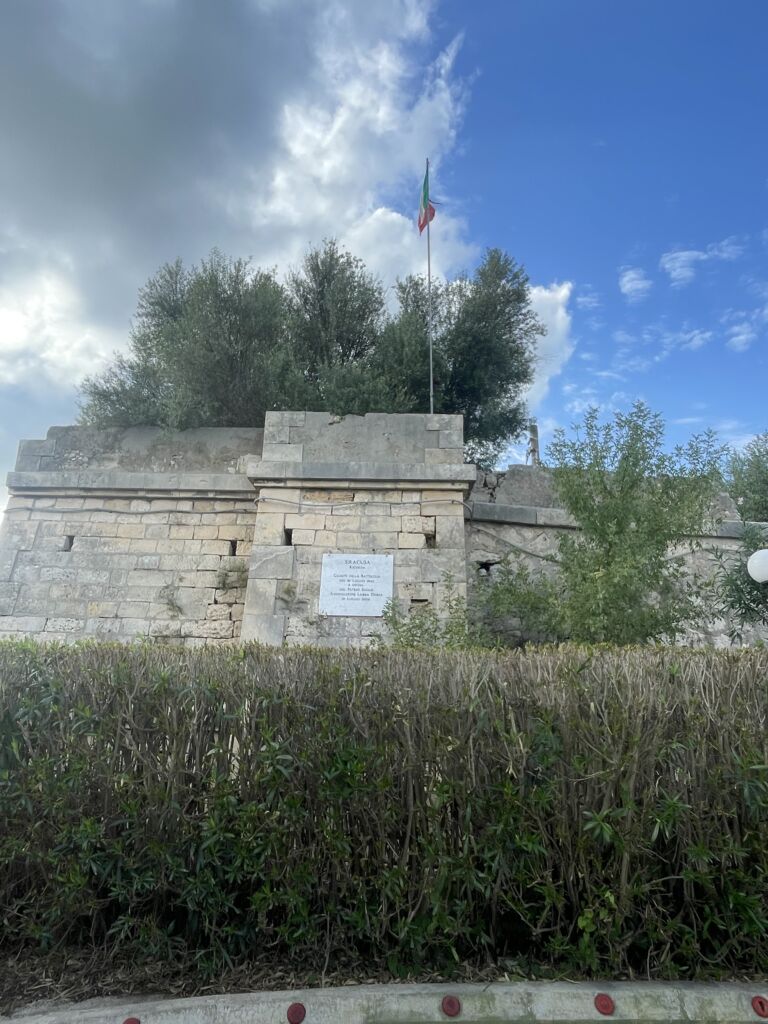
There wasn’t much to see. The old bridge is long gone, replaced by a modern roadway overhead. Below it, the surprisingly clear waters of the little Anapo River flowed past a modest dirt bank. Before us was an old weathered stone abutment that once supported its northern end. An Italian flag fluttered above it, and a modest white marble plaque was fastened to the stonework.
The inscription read:
“Siracusa remembers the fallen of the battle of July 10, 1943, in defense of their native soil.”
The plaque was placed there by a local historical association, Lamba Doria, on July 10, 2008, the battle’s 65th anniversary.
What struck me was that the plaque commemorated the men who had fought against the British. The enemy, in other words, from the perspective of the Allied soldiers whose footsteps we had come to follow.
It was a reminder of just how complicated and agonizing the memory of World War II remains in Italy. In July 1943, Italy was still ruled by Benito Mussolini’s Fascist regime, allied with Nazi Germany. Italian soldiers were fighting to repel an Allied invasion that would ultimately help liberate their country from Fascism. Within weeks, Mussolini would be overthrown. In September, Italy would surrender to the Allies and itself occupied by German forces. and
The Italian experience of World War II was, ultimately, civil war: Fascist against anti-Fascist, neighbor against neighbor. The men commemorated on that little plaque had died defending their homeland and, also, a Fascist state.
Here’s what happened on this spot 83 years ago:
Operation Husky delivered over 150,000 British and American troops to the island of Sicily beginning on July 10, 1943. The first strike on Axis occupied Europe, Husky was staggering, the largest modern amphibious landing in history at the time.
General Bernard Montgomery’s British Eighth Army landed along Sicily’s southeastern coast, and they needed Siracusa, with its great harbor and roads leading north toward Catania and Messina. The Ponte Grande bridge over the Anapo River controlled one of the main approaches to the city. If the Italians blew it up, they could delay the British advance.
So, the job of taking and holding that little bridge got its own name, Operation Ladbroke. The Ladbroke assignment fell to the British 1st Airlanding Brigade, which flew more than 2,000 British paratroopers to Sicily on July 9, the day before the invasion.
But there was a twist. Instead of parachuting into the countryside, the British would arrive in gliders, flimsy engine-less plywood contraptions towed into position by airplanes. The idea was that glider troops would arrive together, with big weapons, even jeeps, instead of scattering across the countryside with light arms only.
Nothing went as planned. Strong winds scattered the formations. The towing aircraft encountered searchlights and Italian antiaircraft fire. Some turned back to North Africa. Others released their gliders too early, far from shore.
Dozens of gliders failed to make it to shore and crashed into the Mediterranean. More than 250 glider troopers drowned.
Of the 144 gliders assigned to the mission, only a dozen or so landed close to their intended zones. And only one glider actually made it to the bridge to accomplish the mission.
That single British Horsa glider carried a platoon of the 2nd Battalion, South Staffordshire Regiment.
Late at night on July 9, the platoon landed and scrambled toward the Ponte Grande. Half the men held the north side, the other half swam across the Anapo River to hold the opposite bank. They then removed the demolition charges the Italians had placed on the bridge to destroy it in case of an Allied landing.
A single platoon accomplished, briefly, what a whole brigade had been sent to do.
Throughout the night, more British glider troops found their way toward the bridge. By early morning of July 10, the defenders numbered about eighty-seven men.
With little ammunition and few heavy weapons, they waited anxiously for the Allied landing to progress and make their way north.
Meanwhile, the stunned Italian enemy came to their senses and regrouped. They understood the critical importance of the bridge and launched a counterattack.
The glider troops fought back from both ends of the crossing, holding on through the morning of July 10 as the invasion unfolded to their south. But the Italians increased in number by the hour, pressing their attack. By the afternoon, the British were exhausted and out of ammunition. Only 15 of the 87 bridge defenders were left active, alive and unwounded. At 3:30pm, they surrendered.
Less than an hour later, British ground troops finally arrived from the landing beaches. They attacked Italians at Ponte Grande and took back the bridge for good. The Allied advance to Siracusa and points north followed.
The British had achieved their objective, but at a terrible cost. Operation Ladbroke exposed weaknesses in the Allies’ airborne doctrine. The British and the Americans briefly considered giving up on future airborne operations. Instead, they wisely decided that more and better training was need, especially for air crews which needed to release paratroopers closer to targets.
That decision paid off eleven months later, during the Normandy invasion of June 6, 1944. In the wee hours of that day, six British Horsa gliders approached two bridges near the Normandy coast. Their mission was to surprise the German defenders, capture the bridges intact, and hold them until reinforcements from the Sword Beach landings arrived.
This time, the operation came off almost precisely as planned. Five of the six gliders landed close to their objectives, one bridge across the Caen Canal, another across the Orne River. The British troops captured both bridges almost immediately. The crossings were later re-christened Pegasus Bridge, after the winged-horse emblem of the British airborne, and Horsa Bridge, after the glider that delivered them.
The success at Normandy was, in part, the result of lessons learned in Sicily.
After our stop at the old Ponte Grande piers, we made our way to the Siracusa British Commonwealth Cemetery, a small burial ground not far from the bridge.
Here lie more than a thousand dead, British soldiers killed during the invasion of Sicily and the fighting that followed. Among them are members of the 2nd Battalion, South Staffordshire Regiment, the airborne who died defending Ponte Grande.
I kept my eyes peeled for markers indicating airborne and took photos of four graves of young men whose lives ended at Ponte Grande at the very beginning of the Allied invasion of Sicily.
In addition to their names (first and middle initials only), service numbers, ages, and units, the headstones record remarkably personal dedications from family members who mourned them.
Here are their details:
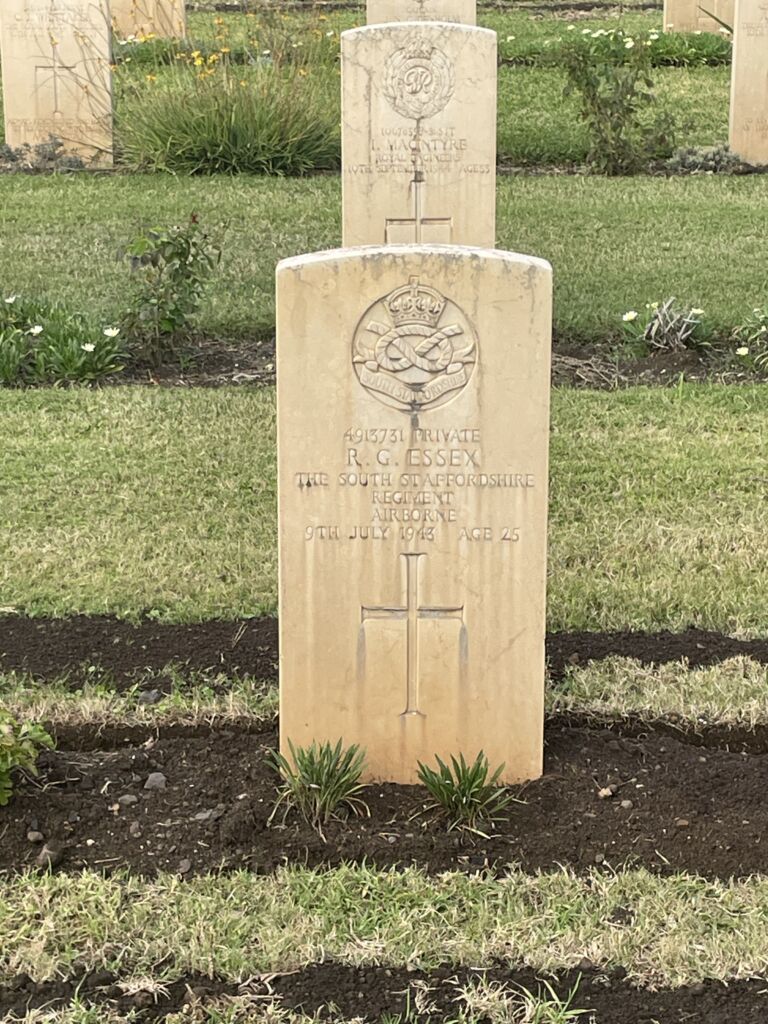
Private Richard George Essex, age 25, served with the 2nd Battalion, South Staffordshire Regiment (Airborne), service number 4913731. He died on July 9, 1943, during the opening phase of Operation Ladbroke. He was the son of Richard G. and Ada Essex of Grimsby, Lincolnshire, and the husband of Patricia Essex. He is buried at Syracuse War Cemetery, Plot II, Row B, Grave 12.
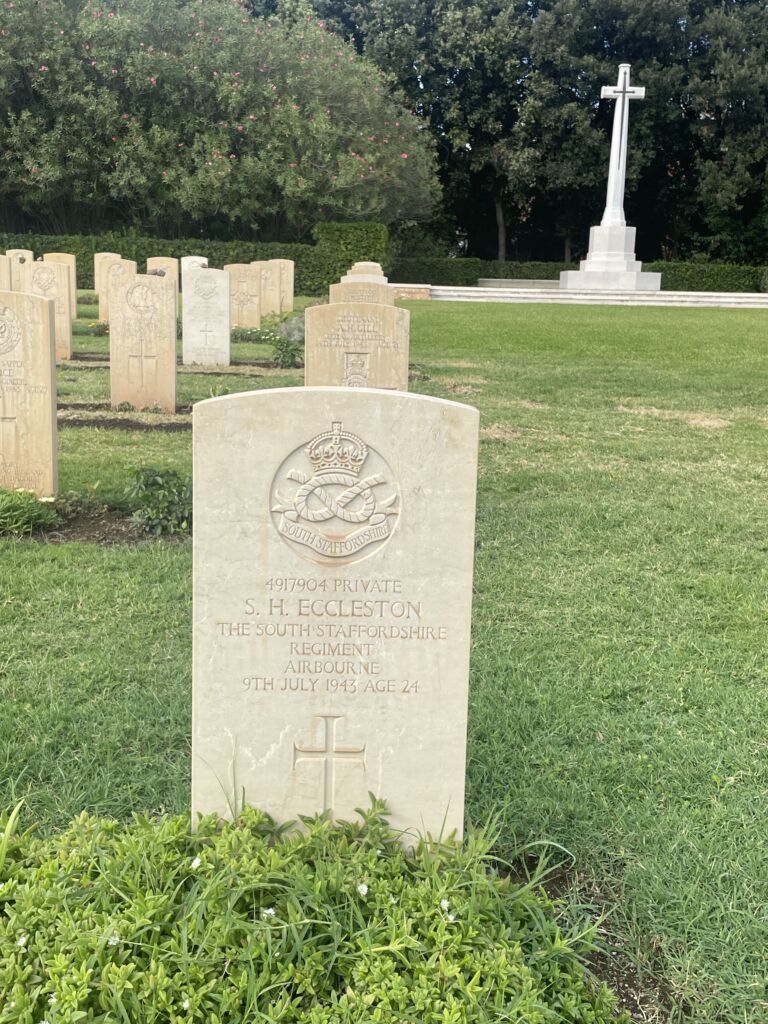
Private Sidney Herbert Eccleston, age 24, served with the 2nd Battalion, South Staffordshire Regiment (Airborne), service number 4917904. He died on July 9, 1943, during Operation Ladbroke. An Ancestry family tree identifies his wife as Irene Dorothy Dyche, born in 1918. He is buried at Syracuse War Cemetery, Plot VI, Row A, Grave 1.
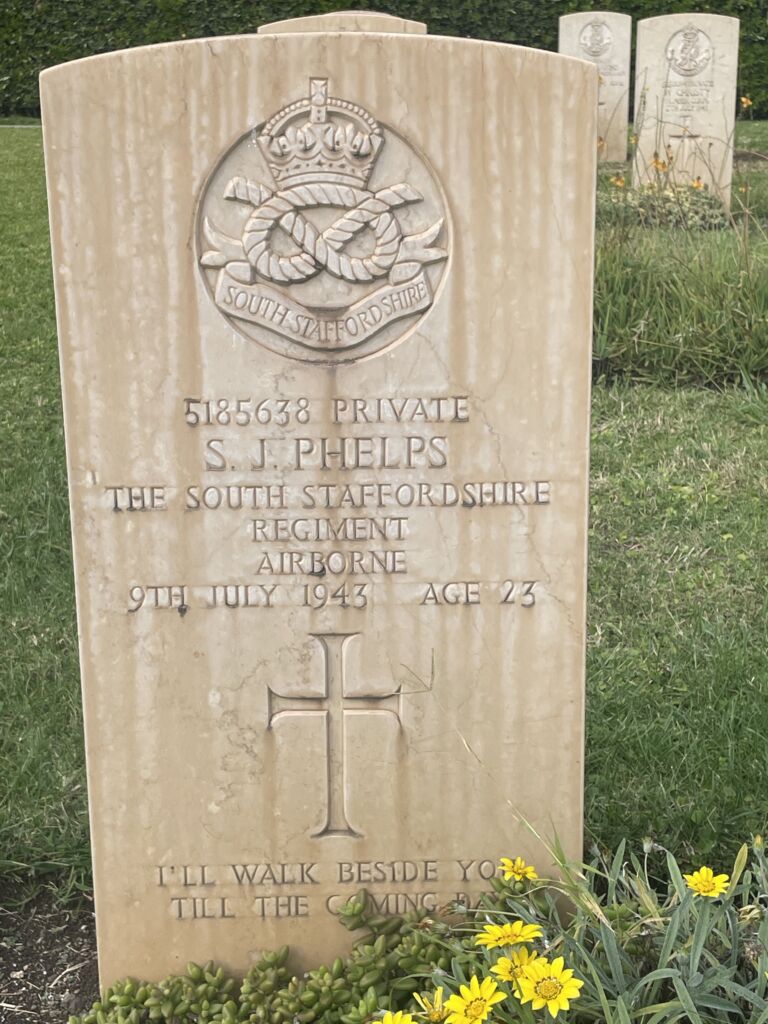
Private Stanley Joseph Phelps, age 23, served with the 2nd Battalion, South Staffordshire Regiment (Airborne), service number 5185638. He died on July 9, 1943, during Operation Ladbroke. His headstone bears the poignant inscription, “I’ll walk beside you till the coming dawn.” He is buried at Syracuse War Cemetery, Plot VIII, Row E, Grave 1.
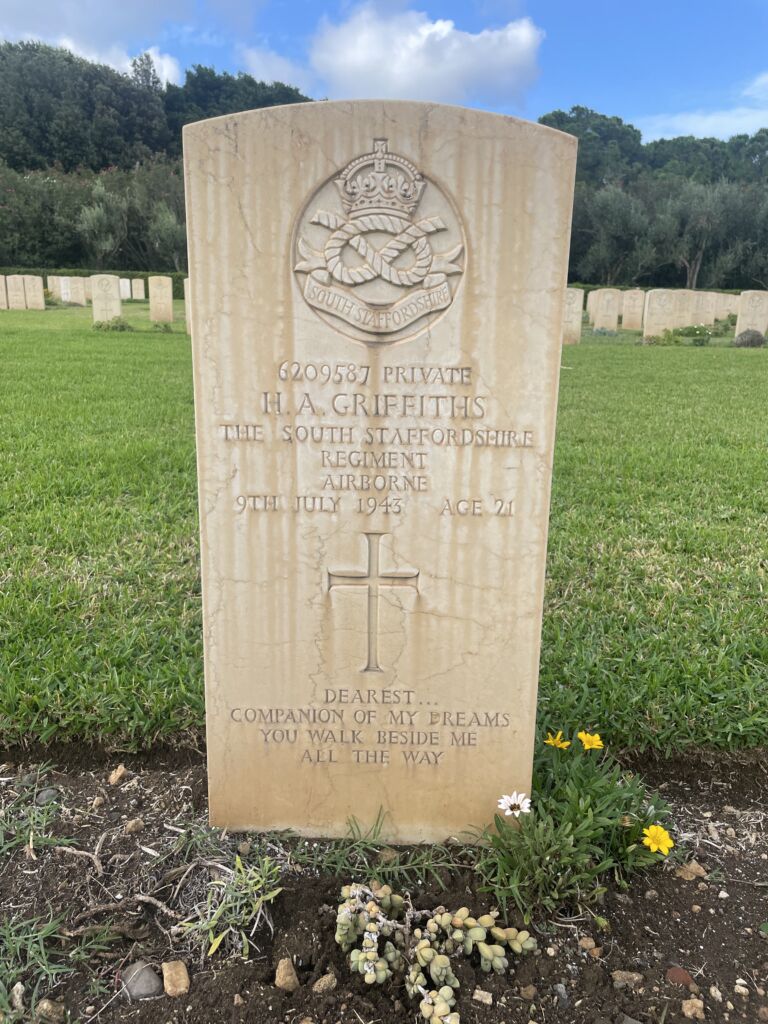
Private Henry Alfred Griffiths, age 21, served with the 2nd Battalion, South Staffordshire Regiment (Airborne), service number 6209587. He died on July 9, 1943, during Operation Ladbroke. His headstone carries a deeply personal inscription, including the words, “Companion of my dreams, you walk beside me all the way.” He is buried at Syracuse War Cemetery, Plot IV, Row H, Grave 4.
So, at Ponte Grande, we saw a brief Italian plaque to the men who died defending the bridge against the British. At Syracuse Commonwealth War Cemetery, we paused before the graves of British soldiers who died fighting the Italians.
In the end, you’re left with an enduring sense of the terrible cost of war, regardless of side.
