

By Todd DePastino
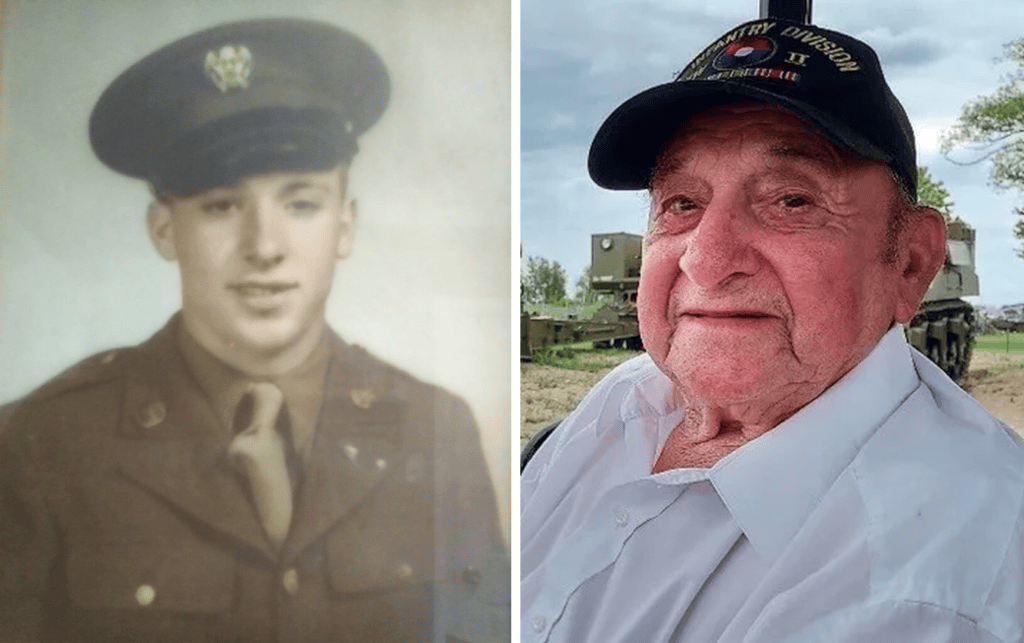
One of our great VBC WWII veterans, George B. Mason, passed away October 25, 2026, at the age of 102.
Those who attended our recent breakfasts in Beaver County may remember George telling stories about the war. One of the most memorable was his certainty that he would never come home. His mother believed he would return, but George wasn’t so sure. It wasn’t until Germany surrendered in May 1945 that he began to believe he might actually survive.
George was born in Hastings, Pennsylvania, on May 2, 1924. He was drafted into the Army in December 1942, during his senior year of high school. By graduation day, he was already overseas, and his brother Robert accepted his diploma for him.
After training at Camp Wheeler, Georgia, George joined Company L, 39th Infantry Regiment, 9th Infantry Division. He served in North Africa, Sicily, Normandy, France, Belgium, and Germany. According to his obituary, his company spent 128 consecutive days on the front lines without relief.
George was a combat infantryman, and his memories included close encounters with German soldiers, artillery fire, and the constant possibility of death.
One of his most extraordinary experiences came on July 25, 1944, during Operation Cobra, the American breakout from Normandy. American bombers accidentally dropped their bombs on friendly troops near Saint-Lô, killing more than 100 Americans, including Lieutenant General Lesley J. McNair.
George was nearby, crouched in a foxhole he had dug himself and covered with branches. A piece of shrapnel tore through his wallet and Army paybook before lodging in his backside. He pulled it out himself. The wound was relatively minor, and George never received a Purple Heart.
He kept the paybook, complete with the hole left by the shrapnel.
George also told the story of how he earned the Bronze Star. His unit had been badly shot up by the Germans, and a telephone line connecting an officer near the front had been severed. Someone needed to venture out under enemy fire to repair it.
“They wanted a volunteer to go fix the line. Nobody volunteered but dummy me,” George recalled.
He went out, repaired the line, and restored communications. He could see German soldiers nearby.
At another point late in the war, George was driving a Jeep to collect water for his company when he encountered a group of young German soldiers. They threw down their rifles and followed him back to the American bivouac area. George estimated there were more than twenty of them. He couldn’t speak German and wasn’t entirely sure what to do, but the young soldiers apparently believed they would be safer with the Americans.
One of George’s most touching stories involved a fellow soldier who had suffered what was then called combat fatigue. The man had an opportunity to return home, but George recalled giving up his own chance to go home so the other soldier could leave. George expected another opportunity would come along soon. It didn’t. He remained overseas until the war ended.
In gratitude, the soldier gave George a wristwatch, which he kept for the rest of his life.
George’s stories were often told matter-of-factly, sometimes with a little humor. But the war had left its mark.
“I didn’t even talk about service for a long time,” he recalled in an interview. “It was years and years that I never even mentioned it because I tried to forget it.”
When George finally returned home, he faced an unexpected problem: he couldn’t find his parents. They had moved while he was overseas, and all he had was a rural delivery address. He hired a taxi and spent more than twenty miles searching for their house.
George eventually married Marcella Hilliard, the young woman his mother had hoped he would meet. They raised two sons, George “Butch” and Donald, and George built a career as a carpenter and construction worker. Marcella passed away in 2025.
In his later years, George began sharing the stories he had kept to himself for so long. We were fortunate to hear some of them at our Veterans Breakfast Club gatherings.
Asked what he wanted future generations to know about the war, George offered a simple answer:
“I just hope they don’t have to go through what I did.”
He also understood what had been at stake. “That was a war we had to win,” he said. But he was quick to minimize his own contribution.
“I was only a small part of the war, small part.”
George Mason was one of millions of young Americans who went off to fight World War II. He was a high school student when he entered the Army and a seasoned combat veteran when he came home. He had expected to die overseas. Instead, he returned, raised a family, worked for decades, and lived to be 102.
And, fortunately for us, he eventually decided to tell his stories.
We extend our condolences to George’s sons, grandchildren, great-grandchildren, and the entire Mason family. We are especially grateful to his family for designating the Veterans Breakfast Club to receive memorial contributions in George’s name. Their generosity will help us continue bringing veterans together and preserving the stories of those who served.
