

By Todd DePastino
Last week, I received an email from Gretchen Ziegler, a Vietnam Donut Dollie and friend of the Veterans Breakfast Club, in response to my article about the history and future of Veterans Day.
Gretchen suggested a topic for one of our Monday night programs: veterans running for and serving in Congress.
Those who know the VBC know that we avoid partisan politics. In fact, we’re allergic to even the hint of it. We’ve spent eighteen years bringing together veterans of different generations, branches of service, backgrounds, and political persuasions. We’ve discovered that there’s plenty to talk about without getting into politics. And there are plenty of places out there for political talk for those who want it.
But Gretchen raises an important question, one that has less to do with Left or Right, Progressive or Conservartive, Democrats and Republicans than with a profound change in American life.
“I have long believed that Vets make good Representatives and Senators,” she wrote, “because they are used to working together to get things done and they have a strong commitment to the USA.”
She’d heard that more than 200 veterans had run for Congress this year and wondered how many had won.
Then she asked a larger question. Could the decline in the number of veterans serving in Congress have something to do with Congress’s diminishing ability to solve problems?
I don’t know the answer to that question. But it got me curious, and I did some digging into the current election cycle and our nation’s political history since World War II.
First, current events: According to Military Times, a record 258 veterans were on the ballot for Congress in the November 3 midterm elections, up from 213 in 2024 and 195 in 2022.
Of this year’s candidates, 115 were Republicans, 80 were Democrats, and 63 were independents or members of third parties. More than 750 veterans had entered congressional races during the primary season.
Yet, despite this surge in veterans seeking office, the number actually serving in Congress is expected to decline.
With Honor Action, an organization that tracks and supports veteran leadership in Congress, reported on November 6 that at least 70 veterans had won election, 40 Republicans and 30 Democrats. They’ll join ten veteran senators whose seats weren’t up for election this year.
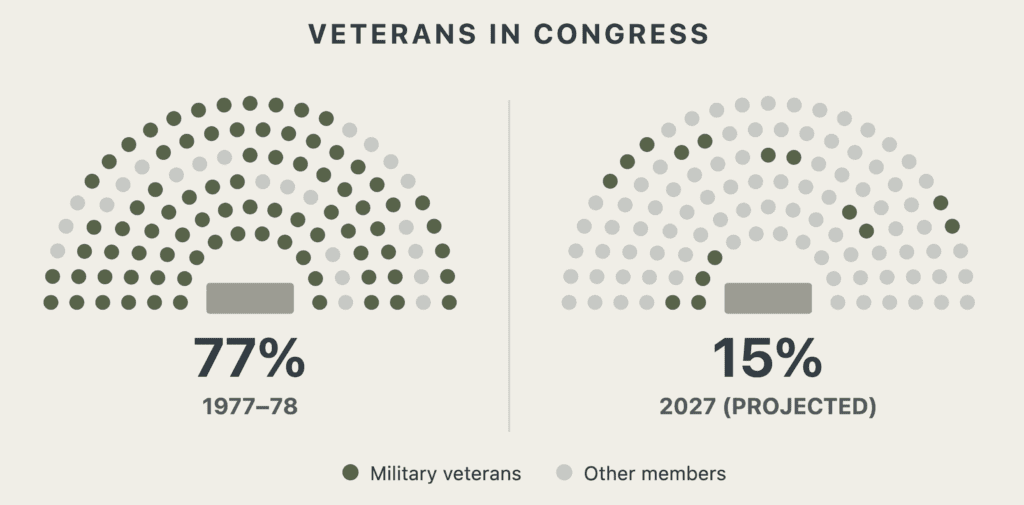
That means at least 80 veterans will serve in the 120th Congress when it convenes on January 3, 2027. That number means that veterans will account for only about 15 percent of the new Congress, down from 19 percent in the outgoing Congress.
But, twelve of these incoming veterans will be women, the largest number ever to serve in Congress.
When I was a kid fifty years ago, military service was a virtual prerequisite for elected office. I looked it up. In 1977–78, according to Pew Research Center, over three-quarters of the members of Congress were veterans. In 1975, an extraordinary 81 of our 100 senators were veterans.
And then, of course, there were our Presidents. Every President from Harry Truman through George H.W. Bush had served in the military. That’s almost fifty years of White House history.
And those who lost Presidential elections were also largely veterans. Eisenhower vs. Stevenson in 1952 and 1956. Kennedy vs. Nixon in 1960. Johnson vs. Goldwater in 1964. Nixon vs. McGovern in 1972. Ford vs. Carter in 1976. Reagan vs. Carter in 1980. Reagan vs. Mondale in 1984. Bush vs. Dukakis in 1988. These were all veteran-on-veteran match-ups.
1992 was a turning point. Non-veteran Bill Clinton defeated incumbent George H.W. Bush.
Four years later, Clinton defeated Bob Dole, whose right arm had been shattered by German machine-gun fire in Italy in April 1945.
Here were two men with extraordinary records of military service who lost presidential elections to a man with none. Something had changed in American politics, reflecting larger changes in American society.
Those changes were demographic. Sixteen million Americans served in the armed forces during World War II. Millions more served during the long Cold War that followed, including Korea and Vietnam.
By the time these men reached their 30s and 40s, when people typically run for Congress, military service was part of most candidates’ backgrounds.
And, at risk of violating my non-political vow, I will suggest that military service is a good thing for potential political candidates. One thing that the military does extraordinarily well is mix Americans of vastly different backgrounds toegther. A farm boy from Iowa has to work with a college graduate from Boston. Someone with a Spanish last name from the borderlands of Texas serves next to a woman from rural Wyoming. They wear the same uniform, eat the same food, and often take the same orders.
It’s not part of the military’s essential mission, but the US Armed Forces does bring together people who otherwise never would have encountered one another. And it did so on a very large scale.
In 1980, about 18 percent of American adults were veterans. By 2021, that figure had fallen to about 6 percent. By 2040, projections are that it will fall to 2 percent.
The end of the draft in 1973, the passing of the massive World War II and early Cold War generations, and the much smaller size of our modern military have all contributed to the decline.
So, while 15% of Congress seems like a small veteran representation, it’s still more than double the percentage of veterans in the nation as a whole. In other words, veterans remain over-represented in the hall of Congress.
Veterans keep running for office. And people keep electing them. But there are far, far fewer veterans than there were decades ago,
What about Gretchen’s question? Does it matter if our Congressmen and Congresswomen, and US Senators are veterans? Do veterans make better elected officials?
The non-profit organization With Honor thinks they do. Founded in 2017 by Marine Corps veteran Rye Barcott and others, With Honor operates on the premise that veterans are well positioned to overcome political polarization.
The organization describes itself as “cross-partisan,” which, notably, is not the same as “non-partisan.”
With Honor doesn’t claim to be apolitical. Its affiliated political action committees support candidates for office, and its public policy arm, With Honor Action, works to advance legislation in Congress.
But it supports both Republicans and Democrats who are willing to make certain commitments about how they’ll conduct themselves in office. The With Honor Pledge asks candidates to commit themselves to integrity, civility, and courage. But more onerous are the specific commitments candidates make to meet one-on-one with a member of the opposing party at least once a month and to collaborate across party lines on significant legislation each year.
The organization, then, supports veteran candidates on the Progressive Left and the Conservative Right. It simply asks that the candidates remain actively bipartisan in their approach to legislation.
It sounds like the assumptions governing With Honor are similar to those expressed by Gretchen in her email: people who have served in the military are unusually good as putting aside personal differences in pursuit of a common objective.
I suspect that’s true, though I’m wary, as a historian, of drawing too straight a line between the decline of veterans in Congress and the rise of our political polarization. After all, those Congresss of the 1960s and 1970s were as fractious as can be, even though they were packed with World War II and Korean War veterans. Anyone who remembers 1968 can attest to the divisions that roiled the country. And veterans were on both sides of every issue tearing the country apart, whether it be war, the economy, or civil rights.
And on the other hand, people with no military service often make excellent politicians. Two of the greatest in our history, Lincoln and Franklin Roosevelt, didn’t have much by way of military background. But they were masters of Washington. And we might be relieved that others, who were superb military leaders, never found their way to high office. President Douglas McArthur or George Patton, Jr., might not have turned out so well.
But I do keep coming back to that unifying experience of military service. The idea that the Army, Navy, Air Force, Marine Corps, and Coast Guard exposes you to fellow Americans you would never have otherwise run across or selected as colleagues and neighbors.
Military camaraderie crosses all kinds of racial, religious, regional, and economic boundaries. One veteran I recently interviewed said, that the most important thing Basic Training taught him were that the assumptions he had about racially different people were wrong.
So, I do think it’s a question worth asking and discussing: what have we lost, if anything, with the decline of veterans serving in Congress?
I hope we’ll have a chance to discuss at a future Veterans Breakfast Club Open Conversation without opening up a partisan can of worms.
