

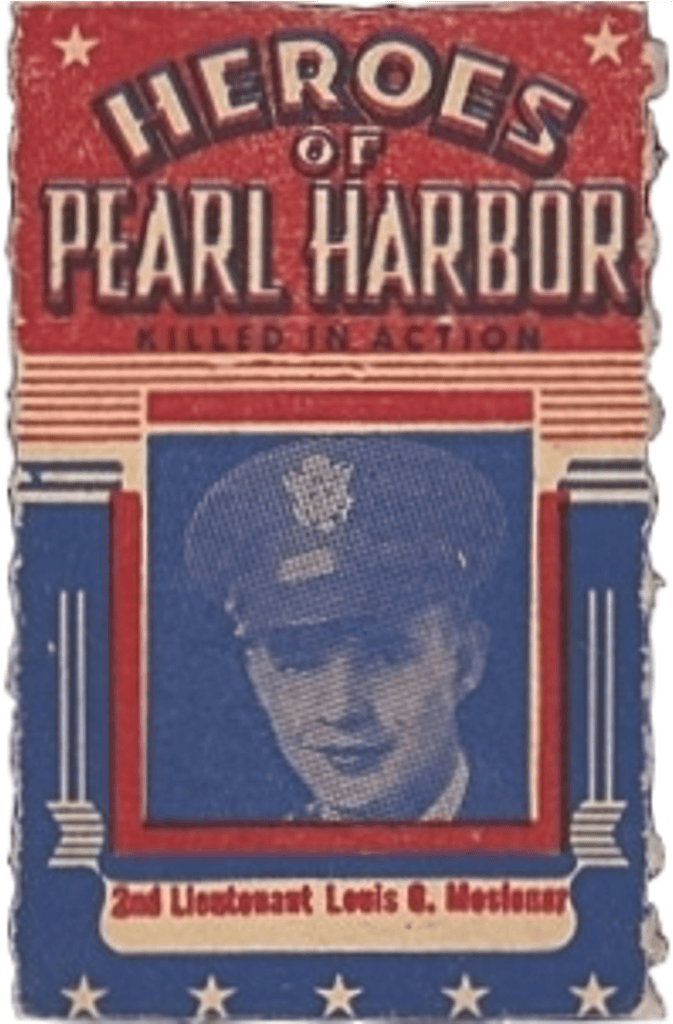
By Todd DePastino
Who was the first American killed in World War II? It’s hard to say, in part, because it depends on when you date the war’s beginning.
The U.S. became a belligerent power on the morning on December 7, 1941, when the Japanese attacked Pearl Harbor. But, by then, the war in Europe had been raging for more than two years. And the war in Asia had been going on since 1937. Americans had gotten caught up in the fighting in both theaters long before Pearl Harbor.
The Naval History and Heritage Command recognizes Navy sailor Freddie Falgout, killed at Shanghai on August 20, 1937, as the first officially designated American military casualty of World War II. An exploding shell killed the 24-year-old Falgout while he was aboard the USS Augusta. No one knows if the shell was Chinese or Japanese.
The U.S. was also fighting an undeclared war with Germany in the North Atlantic in the fall of 1941. American citizens also died aboard passenger ships in the Atlantic torpedoed by German submarines. On October 31, 1941, for example, a German U-boat sunk the USS Reuben James (DD-245), killing 100 crew.
And at least 16,000 American volunteers enlisted in British and Canadian forces before Pearl Harbor, and some of them died in combat in 1940 and early 1941. So, there was plenty of dying even before the U.S. officially entered World War II.
What if we narrow the definition of the “first casualty” to that opening assault in Oahu on December 7? Do we know who died first at Pearl Harbor?
We really don’t since so many were killed simultaneously within moments of the 8:00am attack. There might be hundreds of people whom we could identify as the first.
One of those first Pearl Harbor casualties lies buried near Pittsburgh in Beaver Cemetery. Western Pennsylvania considers him World War II’s First American casualty.
His name was Louis Gustav Moslener Jr., and he was a 23-year-old Army Air Corps navigator who, through an unfortunate turn of events, happened to be at Hickam Field on the morning of December 7, 1941.
Had things gone according to plan, Moslener would have been far out over the Pacific that morning, engaged in a top-secret mission to investigate Japanese military activity in the Pacific.
Moslener was born on August 8, 1918, and grew up in Monaca, a mill town on the Ohio River about 25 miles downstream from Pittsburgh. People in Monaca remembered Louis as a slender, blond-haired boy who played in the high school band and was active in his church. He graduated from Monaca High School in 1935 and went on to study at Carnegie Tech, today’s Carnegie Mellon University.
On May 13, 1940, with war raging in Europe and France about to fall, Moslener left college to join the Army Air Corps.
He became a member of the first class of aerial navigators trained by Pan American Airways in Coral Gables, Florida, as part of the Army’s rapidly expanding aviation program.
The Army needed men who could find their way across thousands of miles of featureless ocean in an age before GPS and reliable long-range electronic navigation aids.
Celestial navigation required a working knowledge of astronomy, mathematics, and geography. A navigator used an octant to measure the position of the sun or stars, performed calculations, and plotted the aircraft’s position on a chart.
It was one thing to do this aboard a ship. It was quite another to do it inside a vibrating airplane traveling at 200 miles per hour, often in darkness and bad weather.
Moslener earned his navigator’s wings and was assigned to Fort Douglas near Salt Lake City, Utah, where he served with the 88th Reconnaissance Squadron.
Then, in November 1941, came a highly classified assignment.
American military leaders knew that Japan had been strengthening its military presence in the western Pacific. What they didn’t know was precisely where the Japanese were concentrating their forces, how large those forces were, or what facilities had been constructed to support them.
Of particular concern were the Marshall and Caroline Islands, sprawling groups of islands and atolls scattered across thousands of miles of the Pacific.
Japan had seized these former German colonial possessions during World War I and subsequently administered them under a League of Nations mandate. The Japanese had been notoriously secretive about what they were doing on the islands and had largely closed them off to foreign observers.
American military planners had little reliable knowledge of the installations Japan had built there.
On November 26, 1941, the Joint Army-Navy Board met in Washington, DC, to discuss the deteriorating situation in the Pacific.
The Navy reported that Japanese aircraft had apparently been conducting photographic reconnaissance of American possessions in the western Pacific. The Americans wanted to do some reconnaissance of their own.
General Henry “Hap” Arnold, chief of the Army Air Forces, offered two long-range aircraft equipped with photographic equipment.
The mission had the approval of Army Chief of Staff General George C. Marshall.
The intelligence gathered would be distributed to General Douglas MacArthur in the Philippines, Admiral Husband Kimmel at Pearl Harbor, Admiral Thomas Hart of the Asiatic Fleet, and military leaders in Washington.
The Americans were particularly interested in the Japanese installations at Truk and Ponape in the Caroline Islands and Jaluit in the Marshall Islands.
Truk would eventually become known as the Gibraltar of the Pacific, an enormous lagoon sheltered by a ring of islands that served as a major anchorage for the Imperial Japanese Navy.
But in November 1941, the Americans had only an imperfect understanding of what was there.
Moslener was assigned as navigator aboard one of the two reconnaissance aircraft, a Consolidated B-24A Liberator piloted by First Lieutenant Ted S. Faulkner.
The B-24 was still a relatively new airplane in 1941. Its exceptional range made it particularly well suited for the assignment.
The mission would ultimately take the crew to the Philippines, with stops at American and Allied airfields across the Pacific.
There was one complicating factor: the United States and Japan were still officially at peace. The Americans wanted intelligence, not an international incident that might precipitate a war.
The crews were instructed to avoid contact with Japanese aircraft but to defend themselves if necessary.
“Pilots should be warned islands strongly fortified and manned,” read the secret War Department instructions of November 26.
The orders also stipulated that the aircraft be “fully equipped with gun ammunition upon departure from Honolulu.”
Those instructions would have tragic consequences for Louis Moslener.
His crew left Hamilton Field in California on December 4, 1941, for the 2,400-mile flight across the Pacific to Hawaii.
For Moslener, it was his first long-distance flight over the ocean.
They arrived safely at Hickam Field on December 5. The second B-24, piloted by Lieutenant Harvey J. Watkins, had developed mechanical problems and was forced to return to California.
An inspection of Faulkner’s aircraft revealed that it lacked essential armament for the reconnaissance mission.
Arrangements were made to correct the deficiencies before the crew continued across the Pacific.
The delay proved fatal.
On December 7, Moslener was still at Hickam Field with the other members of Faulkner’s crew when the Japanese attacked Pearl Harbor.
Moslener and Private Daniel J. Powloski, a 36-year-old crew member from Rochester, New York, were killed. Several other members of the crew were wounded, and their Liberator was destroyed.
The secret reconnaissance mission never took place.
There’s a terrible irony in the story. American military leaders had dispatched Moslener and his crew to find out where the Japanese were preparing for war. They were looking thousands of miles to the west.
War found them instead.
Back in Monaca, Moslener’s parents had received a letter from their son just two days before his death. Unable to disclose the nature of his assignment, he told them simply that he was going on a long journey.
His commanding officer, Major Richard H. Carmichael, subsequently wrote to the family to explain what had happened.
“He was killed instantly by the first bomb dropped by the Japanese in this war,” Carmichael wrote.
Whether Louis Moslener was literally the first serviceman killed at Pearl Harbor is impossible to establish with certainty. He was, without question, among the earliest American casualties that Sunday.
Moslener was initially buried in Hawaii. On October 25, 1947, his remains were laid to rest in Beaver Cemetery, just across the Ohio River from the town where he’d grown up.
His grave has become a gathering place for Beaver County veterans on December 7.
In 2021, on the 80th anniversary of the attack, Beaver County veteran Jerry Fisher organized a group of 34 people to travel to Pearl Harbor. Members of the group wore caps commemorating Moslener.
Others gathered at his grave in Beaver to lay a wreath and read the names of local veterans who had been at Pearl Harbor.
Tomorrow marks the 85th anniversary of Moslener’s death.
His grave remains a quiet reminder of how suddenly World War II came home to American communities, including a little town on the Ohio River where a young man who was good at mathematics had left college to learn how to navigate by the stars.
