

By Todd DePastino
We’ve been talking a lot about helicopters lately at the Veterans Breakfast Club, especially with Vietnam veterans who flew them (see our August 10, 2026 VBC LIVE and our September 14, 2026 VBC LIVE conversations). During these conversations, I keep asking pilots to explain how helicopters actually fly and, more particularly, how flying one differs from flying an airplane. They patiently talk about collective and cyclic pitch, torque, advancing and retreating blades, translational lift and autorotation. I usually pretend I understand what they’re talking about.
These conversations are probably why I noticed an obscure anniversary in military history I otherwise would have passed right over.
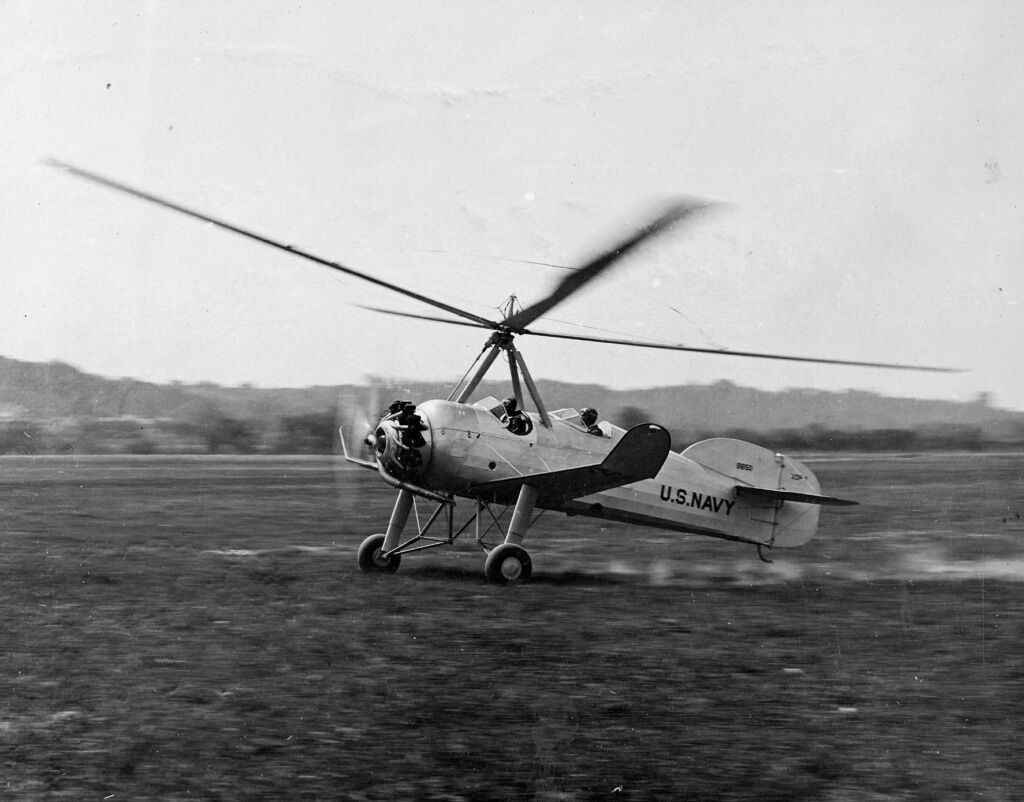
On September 23, 1931, Navy Lt. Alfred M. Pride landed a very peculiar-looking aircraft on USS Langley, America’s first aircraft carrier. The machine had an airplane fuselage and propeller, but above the cockpit was an enormous rotor. Pride landed and took off three times, completing what the Navy considers its first shipboard rotary-wing operations.
The machine was called an autogiro, and I’ve come to think of it as a kind of missing link between the airplane and helicopter.
Before going further, watch this wonderful 1931 newsreel explaining the Autogiro. Seeing the thing fly is half the fun.
The big difference between this autogiro and a helicopter is that the autogiro’s rotor isn’t turned by an engine. A motor doesn’t power the rotor. Instead, the engine turns an ordinary propeller that pulls the aircraft forward, while the rotor overhead spins freely. As the aircraft moves, air flows upward through the rotor disc, causing the blades to turn through a process called autorotation. Those spinning blades then generate the lift that keeps the machine aloft.
So, if I’m understanding my helicopter pilots correctly: a
Airplane: moves its wings through the air.
Helicopter: spins overhead wings directly with a motor.
Autogiro: moves forward while the air spins its overhead wings.
The autogiro was developed in the 1920s by Spanish engineer Juan de la Cierva, who encountered a problem that later helicopter designers would also have to solve. In forward flight, a rotor blade moving into the oncoming air travels faster through the air than the blade retreating on the opposite side, creating unequal lift. Cierva’s ingenious solution was to hinge the blades so they could flap independently, helping equalize the lift across the rotor. The Smithsonian calls this breakthrough essential not only to the autogiro but to development of the practical helicopter.
In 1931, the autogiro looked like the future. Amelia Earhart flew one to 18,415 feet that year. Two weeks later, an autogiro landed on the White House lawn.
Autogiros had a lot going for them: they could fly slowly, land in short distances, and make nearly vertical descents. Some would even be able to make “jump” takeoffs.
But the one thing an autogiro couldn’t do is hover.
Because its rotor wasn’t powered in flight, an autogiro needed to keep moving forward to stay aloft. Helicopters, with their powered rotors, would arrive in the 1940s, be able to hover and take off straight upwards and therefore eclipsed the soon-to-be-forgotten autogiro.
That said, plenty of our helicopter pilots in the VBC have flown the autogiro. They all practice what to do if motor stops working. Power is disengaged and upward airflow through the rotor keeps the blades turning allowing the aircraft to land safely.
So, all you helicopter pilots out there, please give a nod to the lost-to-history autogiro, whose principle of flight lives in when helicopter engines fail.
