

By Jack Cheevers
Jack Cheevers is the author of Act of War: Lyndon Johnson, North Korea, and the Capture of the Spy Ship Pueblo, winner of the 2014 Samuel Eliot Morison Award for Naval Literature. He worked as a newspaper reporter and editor for twenty-seven years, including stints at the Los Angeles Times, The Oakland Tribune, and the Associated Press and United Press International bureaus in San Francisco. A Massachusetts native, he is a proud graduate of the University of California at Berkeley. He lives on a pond in New Hampshire.
The following is excerpted from Jack Cheever’s book Kennedy’s Coup which vividly recreates the Kennedy Administration’s secret encouragement of the fatal 1963 military coup against South Vietnam’s defiant president. A preface and closing has been provided by the author to give the excerpt context.
Kennedy’s Coup (Simon & Schuster) was released in February 2026 and is available through bookshop.org.
Preface
In the summer of 1963, the Kennedy administration faced a worrisome political backlash over its strong support of South Vietnam’s tough, authoritarian president, Ngo Dinh Diem.
Diem had asked, two years earlier, for American help in battling an increasingly dangerous insurgency by communist-led Viet Cong guerillas. JFK responded with Operation Beef-Up, a massive infusion of helicopters, tanks, artillery, armored personnel carriers, fixed-wing aircraft, small arms, napalm and well-trained American combat advisers. Millions of dollars in economic aid began flowing to South Vietnam as well.
As he struggled to put down the Viet Cong, Diem confronted a second crisis: a widening protest movement by Buddhists, who constituted about 70 percent of South Vietnam’s population.
Buddhists claimed that Diem, an ardent Catholic, and his government were persecuting them by restricting their purchases of land for schools and pagodas and otherwise suppressing their belief system. They further alleged that they faced discrimination in hiring and promotions in the military and civil service, and that local government officials were killing some Buddhists and forcing others to convert to Catholicism. Though the persecution allegation was false, according to a subsequent UN investigation, and other charges sometimes exaggerated or baseless, they were picked up by the American press and widely publicized in the United States.
The protest campaign picked up momentum when Diem’s security forces killed eight people during a chaotic demonstration outside a government radio station in Hue in May 1963. The following month, a Buddhist monk set himself on fire in a Saigon intersection, and photographs of his horrifying death appeared in newspapers and magazines throughout the United States.
JFK found himself on the defensive as members of Congress and editorial writers bashed him for backing a supposed religious bigot and demanded cuts, and even cancellation of U.S. aid to South Vietnam. So vociferous was the criticism that Kennedy began to think Diem, a longtime U.S. ally, might have to be ousted. “The time may come when we’re gonna have to try to do something about Diem, and I think that’s going to be an awfully critical period,” Kennedy told his new ambassador to South Vietnam, Henry Cabot Lodge, shortly before he flew to Saigon. “I don’t know how well you’re prepared for that out there, or who we would sort of support. . . . I think that’s going to be one of your key problems this year.”
Any residual White House sympathy for Diem evaporated in late August when South Vietnamese police and soldiers raided Buddhist pagodas in several cities and arrested 1,400 monks and nuns in an effort to decapitate the protest movement. Diem and his brother and right-hand man, Nhu, were delighted, but the rest of the world was outraged, along with many Americans.
JFK’s advisers split into two bitterly antagonistic camps: those who wanted Diem gone, and those who wanted him left in place. Diem’s opponents–chiefly Lodge, Under Secretary of State for Political Affairs Averell Harriman, Assistant Secretary of State for Far Eastern Affairs Roger Hilsman, and Michael Forrestal, the Vietnam specialist on Kennedy’s National Security Council–felt he was too repressive and unpopular to ever win the war against the Viet Cong. Defense Secretary Robert McNamara, CIA director John McCone, and Frederick Nolting, Lodge’s predecessor as ambassador, still backed Diem as an experienced and competent leader who could eventually defeat the communists. Kennedy’s military commander in South Vietnam, General Paul Harkins, agreed.
But it wasn’t clear who ordered the pagoda raids or even who carried them out. Hilsman believed that Nhu, who headed South Vietnam’s special forces and secret police, was the culprit. A former World War II guerilla leader in Burma who held a Yale PhD in international relations, Hilsman was convinced that Nhu and his notorious wife, Madame Nhu–aka the “Dragon Lady”–had become intolerable embarrassments to the Kennedy administration and needed to be removed.
He decided to take action.
(Note: Also referred to below are Marine general Victor Krulak, the counterinsurgency specialist for the Joint Chiefs of Staff, and George Ball, JFK’s under secretary of state for economic affairs.)
Excerpted from Kennedy’s Coup by Jack Cheever
On Saturday, August 24, in his office at the State Department, Hilsman drafted one of the most fateful directives of the Vietnam War, a message to Lodge that came to be know as “the green light cable.”
“US government cannot tolerate situation in which power lies in Nhu’s hands,” Hilsman wrote. “Diem must be given chance to rid himself of Nhu and his coterie and replace them with best military and political personalities available.” The embassy was to inform South Vietnamese military and civilian leaders that if Nhu and his wife weren’t axed, Washington “would find it impossible” to extend further military and economic support to South Vietnam.
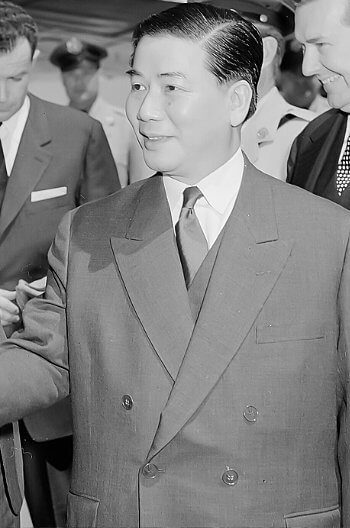
President Ngo Dinh Diem, May 1957. (Public Domain)
Diem should be given a reasonable opportunity to remove Nhus,” Hilsman went on, but if he refused, “we are prepared to accept the obvious implication that we can no longer support Diem.” The cable also instructed Lodge to tell Diem’s generals that Washington would give them “direct support in any interim period of breakdown” of Diem’s government.
The new ambassador—in Saigon barely two days—was further told to “urgently examine all possible alternative leadership and make detailed plans as to how we might bring about Diem’s replacement if this should become necessary.” Lodge should work with Harkins to protect American citizens during “this operation.” Hilsman closed by assuring Lodge that “we will back you to the hilt on actions you take to achieve our objectives.”
Thus, with a single telegram, Hilsman laid the groundwork for a complete reversal of nearly a decade of American policy toward Vietnam. On the strength of no authority but his own, he moved to pull the rug out from under a longtime anti-communist ally during wartime.
Worse, he did so in pursuit of a chimera. U.S. diplomats had been telling Washington for years that as corrosive as Nhu’s presence was, he and his brother were Siamese twins who could never be separated. Nolting’s predecessor, Elbridge Durbrow, urged Diem in 1960 to appoint Nhu as an ambassador and send him into comfortable, semipermanent exile abroad. Diem ignored him. He and his brother were bonded not only by blood, but by past triumphs and a shared vision for the future of their country.
Nhu was Diem’s right-hand man, the cutthroat executor of his policies. He headed the crucial strategic hamlet program, ran the secret police, and oversaw the Republican Youth, all key pillars of strength for the regime. Nhu functioned as his brother’s big thinker, writing his speeches and coming up with personalism as the regime’s official ideology.
To Diem, resisting foreign pressure was an art form. Getting him to ship his indispensable brother out of South Vietnam had as much chance of success as persuading JFK to send his brother and right-hand man, Robert, to the moon. (Recognizing this sibling parallel, some Americans call Nhu “Bobby Nhu.”)
The green light cable didn’t directly order Lodge to foment a coup. But by imposing an unattainable condition on Diem, and encouraging his generals to turn against him when he failed to meet it, Hilsman’s instruction set in motion a series of events that culminated in the president’s overthrow and brutal murder nine weeks later.
As soon as the green light cable was drafted, Hilsman and his bureaucratic allies set out to ram it through the government’s interdepartmental clearance process without nearly as much top-level scrutiny as it needed.
On that late-summer weekend, much of official Washington was on vacation or otherwise out of town. Kennedy was with his family in Hyannis Port, mourning his prematurely born son Patrick, who’d died at a Boston hospital on August 9, after less than two days of life. Secretary of Defense Robert McNamara was climbing the Grand Teton mountains in Wyoming. Secretary of State Dean Rusk was in New York meeting with UN officials and taking in a Yankees game. CIA director John McCone was yachting in Puget Sound. McGeorge Bundy, JFK’s national security assistant, was at his vacation home in Manchester-by-the-Sea, Massachusetts.
Hilsman took the draft telegram to Harriman, his immediate superior, for approval, and they brought it to Forrestal. Forrestal telephoned George Ball, the acting secretary of state in Rusk’s absence, and relayed the message to him. Then Forrestal sent a copy over the secure White House communications system to JFK in Hyannis Port.
In a memo earlier that day, Forrestal told the president “it is now quite certain” that Nhu is “calling the shots – even though the CIA was reporting that it was unclear who was in charge in Saigon. Forrestal added: Averell and Roger now agree that we must move before the situation in Saigon freezes.” When Forrestal later sent Kennedy the text of the green light cable, he again nudged the president to act quickly, writing in a cover memo: “Since the situation in Saigon may not remain fluid for long, [the State] Department believes desirable transmit this message tonight.”
Forrestal next called Roswell Gilpatric, McNamara’s second-in-command, at his farm on Maryland’s Eastern Shore. Immediately suspicious of how the cable was being handled, Gilpatric had Forrestal read it to him twice. He realized the message was “highly controversial” and figured the anti-Diem clique was trying to rush it through at a time when top officials who might object were gone.
“I frankly thought it was an end run,” Gilpatric recalled. “I didn’t see why it had to be done Saturday night with the president away, with Rusk away, with McNamara away, Bundy away.” But Gilpatric raised no showstopper objections to the cable, seeing it as a political matter more in the State Department’s bailiwick than the Pentagon’s.
Forrestal then turned to Krulak, who was in Forrestal’s White House office as he made the clearance calls. Forrestal asked him to deliver a copy of the cable to General Maxwell Taylor, who JFK had made chairman of the Joint Chiefs of Staff in October 1962. Krulak hurried away.
Kennedy called Forrestal, saying, “I want to talk to George Ball and Harriman about this telegram. Where are they?” Forrestal said he’d find them. Ball, it turned out, was playing golf in Potomac, Maryland. As he finished up the ninth hole, Harriman and Hilsman “appeared in a great sweat” and drove Ball to his home, where he got on the phone with the president to go over the cable.
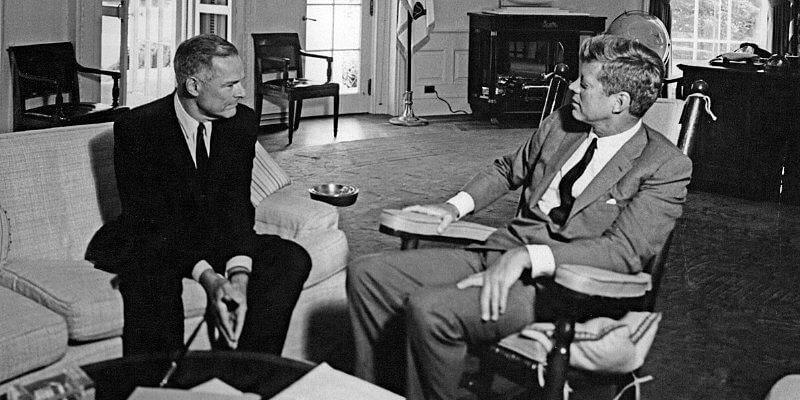
President Kennedy and Ambassador Henry Cabot Lodge discussing President Diem and South Vietnam in the Oval Office on August 15, 1963. (The Kennedy Library)
“He asked me what I really thought,” Ball remembered. “I had told him that Averell and Hilsman very much wanted to do this. I had made some changes in the telegram; I had watered it down myself, actually, over their earlier version. I read him the critical paragraphs. I told him that this would certainly be taken as encouragement by the generals to [mount] a coup. But I said I thought that, in my judgment, the situation with Diem was becoming an enormous humiliation to the United States, that we were supporting a regime which was behaving in the most unconscionable and cruel, uncivilized way toward a significant minority of the population. Madame Nhu was making the most outrageous statements, and Nhu was a very devious and unreliable fellow. I thought to send this telegram to Lodge, who’d just arrived there, was probably all right. So [Kennedy] approved it.”
At about 7 p.m., Forrestal got in touch again with Krulak, asking him if he’d shown the cable to Taylor. Forrestal recalled Krulak replying that Taylor had reviewed the text and “it’s all right with him if everybody else is in agreement.” Forrestal checked again with Kennedy, who gave his final sign-off.
The cable was transmitted to Saigon at 8:11 p.m.
But Krulak gave a different account, saying he wasn’t able to show the message to Taylor until about 9:45 p.m., after it had already been sent to Lodge. Taylor, who opposed ousting Diem, read the text and commented to Krulak that it reflected “the well-known compulsion of Hilsman and Forrestal to depose Diem.”
Taylor added that he was glad he wasn’t on the receiving end of the instruction, since it was so vague, and more thought should have been put into drafting it. He later complained that Hilsman, Harriman, and Forrestal had executed “an egregious end run” around the usual vetting process.
Hilsman subsequently insisted that the green light cable was properly cleared with Kennedy and other Washington principals. But some top officials said they’d been hustled rather than consulted. After Hilsman asserted that he’d discussed the message with Marshall Carter, the CIA’s acting director in McCone’s absence, Carter “took angry exception,” saying he never saw the text before it was sent to Saigon. In a 1967 memorandum, Carter branded the message “ill-conceived, ill-timed, and inadequately coordinated.”
Nevertheless, in a matter of hours, the Kennedy administration had made a decision, after years of full-throated U.S. support for Diem, that could trigger a revolt against him. Kennedy and his men had given little if any consideration to important questions raised by the green light cable. If Diem were deposed, who or what would replace him? Would the new government be an improvement over the present one? Would it have the support of the people and the ability to prosecute the war any more effectively?
Closing
With the Kennedy administration’s covert encouragement, troops under the command of rebel generals swept into Saigon on Nov. 1, 1963 and laid siege to Diem’s palace. Despite heavy shelling and aerial bombing, Diem and Nhu escaped that night but surrendered at a Catholic church the next day. Insurgent soldiers placed the brothers inside an armored personnel carrier, tied their hands, and brutally murdered them.
The generals, who had promised to turn power over to civilians, instead formed a junta and tried to govern the country themselves. They proved to be inept and, three months later, were overthrown by another general.
South Vietnam spiraled into political disarray sometimes bordering on chaos. Over the next 18 months, seven different governments rose and fell. Buddhists and Catholics fought each other in bloody street battles in August 1964.
Three weeks after Diem’s killing, JFK was assassinated and Lyndon Johnson took over. He tried to keep the war on the back burner as he campaigned for president in 1964. But the Pentagon, warning that the war was being lost, urged Johnson to dispatch American combat troops to South Vietnam and begin heavy bombing of North Vietnam.
By March 1965, LBJ had lost patience with the chronic political infighting and turmoil in South Vietnam. He ordered the first Marine units to South Vietnam and launched Operation Rolling Thunder, a strategic bombing campaign that went on until Halloween 1968.
At the time of JFK’s death, there were about 16,000 U.S. military personnel in South Vietnam, serving in advisory roles. Five years later, under Johnson, more than 500,000 American troops were engaged in the war.
