


By Ken Kaszak
I recently took a private tour of the Korean Demilitarized Zone, the DMZ, one of the strangest places on earth. It’s tourist destination, a wildlife refuge, a frozen-in-time relic of the Cold War, and, oh, yeah, the place where the next nuclear war could break out.
My hotel was in Seoul’s Gangnam District, the same Gangnam made famous by K-pop culture and the song “Gangnam Style.” From there, it was about a 75-minute drive north toward the border with North Korea.
One thing I didn’t realize before the trip: the actual Military Demarcation Line (MDL) sits about 2.4 miles beyond the start of the DMZ itself. In other words, the “Demilitarized Zone” is a buffer before you even reach the real dividing line between North and South.
Every morning, buses packed with tourists head north toward the staging areas near the border. The experience has a surprising “touristry” feel to it. There’s a small amusement park, gift shops, food stands, and even a gondola ride that glides over part of the DMZ. The gondola never gets close to the actual border, but how odd that it carries tourists over one of the most militarized regions in the world.
The staging area itself contains several memorials and exhibits: a train riddled with more than a thousand bullet holes sitting on severed track, a small Buddhist temple devoted to peace, a memorial to Korean WWII “Comfort Women,” and an unusual monument displaying rocks collected from battlefields around the world.
There was also excellent food. A South Korean burger chain called Frank Burger had a stand there. Excellent burgers.
So little human activity occurs at the DMZ that nature has reclaimed much of it. Birders flock to see the birds that lives and pass through it.
The highlight of the tour was the Third Tunnel of Aggression.
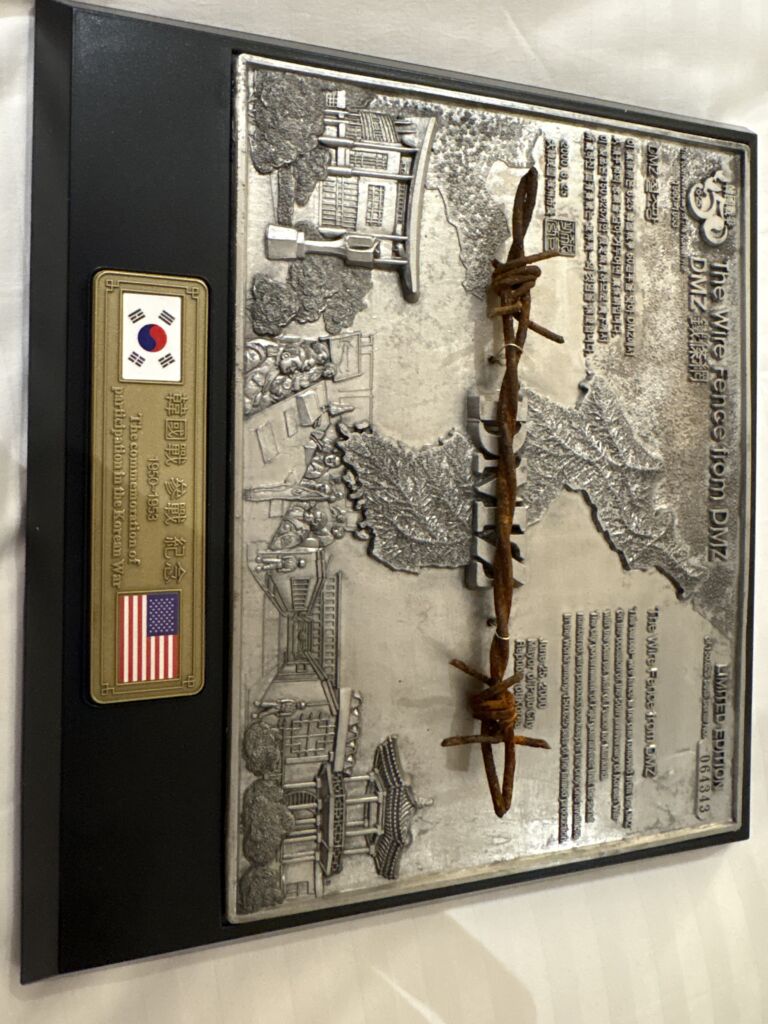
I had vaguely known that North Korea had dug tunnels beneath the border, but I didn’t realize the scale of it. Four infiltration tunnels have been discovered so far, though South Koreans suspect there may be more.
The Third Tunnel is open to visitors. South Korean authorities estimated that North Korea could have moved as many as 30,000 troops through it in a single hour.
Visitors are issued hard hats before descending a long sloping passage underground. The deeper you go, the narrower and stranger the tunnel becomes. Pipes and support beams overhead force you into a permanent crouch, like Chuck Berry’s duck walk.
Along the tunnel walls are displays showing how North Korean soldiers supposedly excavated the passage using picks, shovels, and wheelbarrows. At the end, a South Korean soldier informs visitors that North Korea is only about 200 yards away.
Outside the tunnel entrance sits the colorful “DMZ” sign familiar from so many photographs: the “D” painted red, the “M” yellow, the “Z” blue.
Another stop was Unification Village, a small farming community inside the civilian control zone near the DMZ. The area is famous for its soybeans and ginseng. My guide insisted I try soybean ice cream. It may have been the best ice cream I’ve ever had.
The final stop was Dora Observatory, where visitors peer into North Korea through powerful binoculars. Photography is prohibited there.
One thing you can see from the observatory are the two flagpoles, one for each nation. Over the years, North and South Korea competed to erect taller and taller flagpoles near the border. On the day I visited, North Korea appeared to be winning.
For reasons I still can’t explain, one of the things hanging inside the observatory was a reproduction of Gustav Klimt’s Woman in Gold. I have no idea why it’s there.
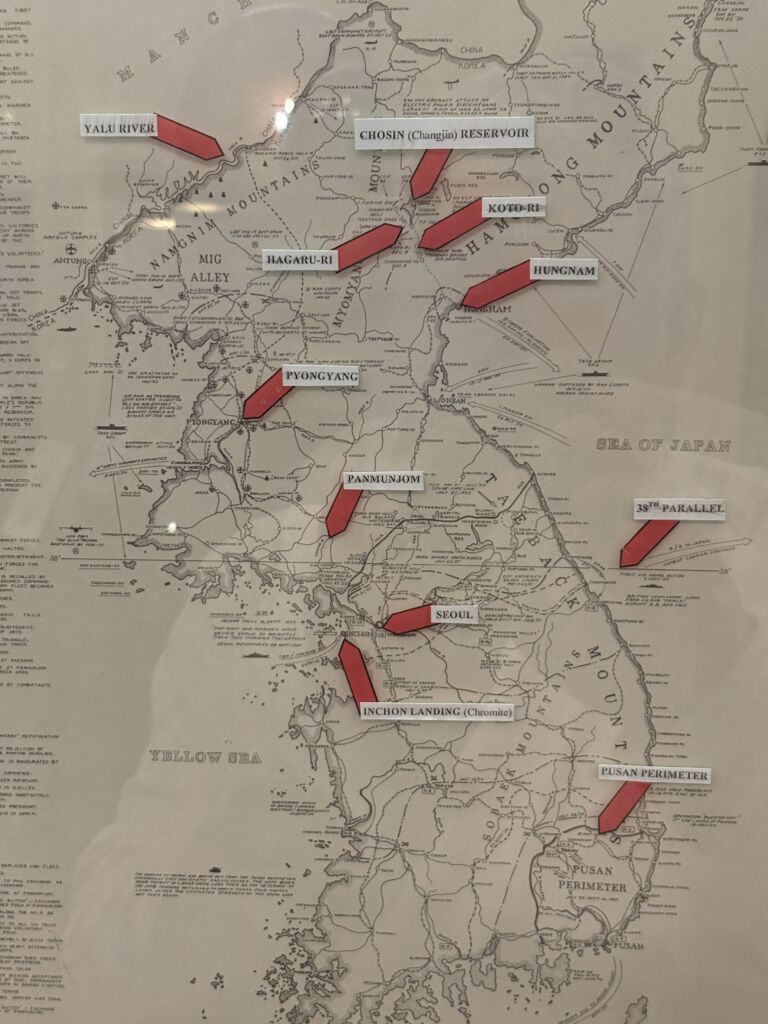
The area visitors most associate with the DMZ is the Joint Security Area at Panmunjom. That’s the section directly on the Military Demarcation Line itself. It’s currently closed to tourists.
That’s because tours were halted after US Army Private Travis King sprinted across the border into North Korea in July 2023. The United States eventually secured his release through Swedish diplomatic channels.
Long before that incident, the Joint Security Area was the site of one of the Cold War’s most dangerous confrontations: the 1976 “Axe Murder Incident.”
Two U.S. Army officers, Captain Arthur Bonifas and First Lieutenant Mark Barrett, were killed by North Korean soldiers during what began as a routine tree-trimming operation near the border. In response, the United States launched Operation Paul Bunyan, an overwhelming military show of force with heavily armed troops returning to finish cutting down the tree.
The confrontation brought the two sides dangerously close to war.
That tension still hangs over the DMZ. After all, the Korean War never officially ended. Only an unsteady ceasefire was reached on July 27, 1953.
