

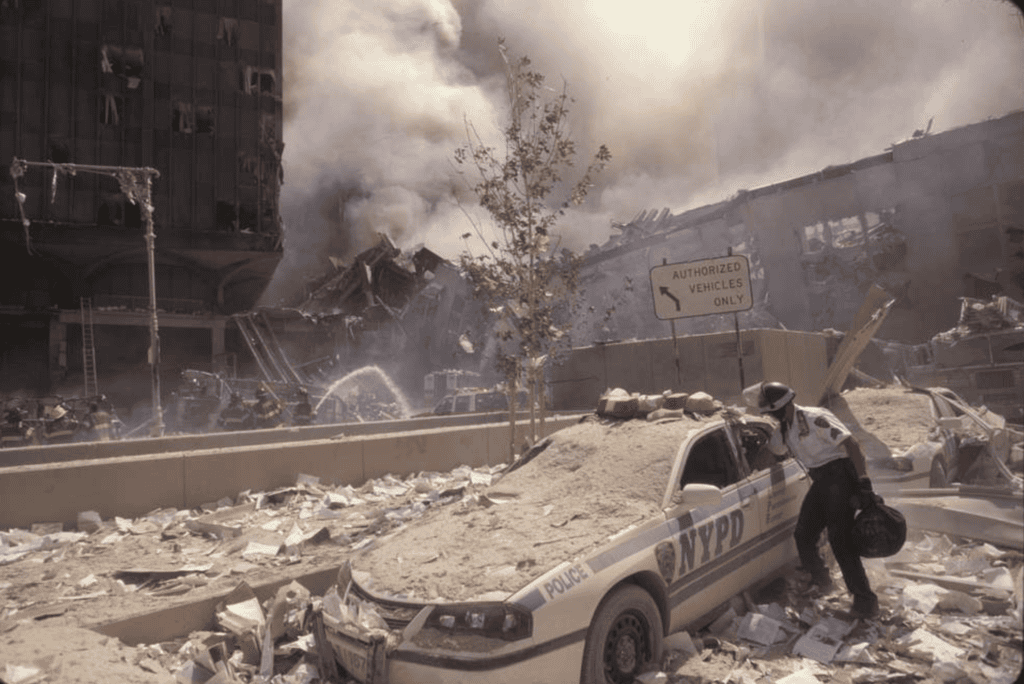
by Bob Oles
Robert J. Oles joined the New York City Police Department in 1996 after eight years in the U.S. Marine Corps, including service in Operations Desert Shield and Desert Storm. On September 11, 2001, Bob was attending an intelligence course in Virginia when word came that planes had struck the World Trade Center. He returned home immediately and would spend much of the next week working at Ground Zero.
With his Marine Corps background and his experience of the attacks in New York, he felt called back to military service. In 2002, unable to return to the Marine Corps after his long break in service, he joined the Army Reserve. He eventually deployed to Iraq, where he served in Baghdad in 2004. He remained in the Army Reserve until completing 20 years of service.
When Oles later joined us on a Veterans Breakfast Club livestream, he spoke candidly about the strange workings of memory. Some memories and emotions lay buried, only to surface years later. That awareness of the trickiness of memory informs the account below. Some moments remain extraordinarily vivid. Others are harder to place. Bob distinguishes between the two and avoids embellishment.
Some things Bob witnessed at Ground Zero remain too disturbing to recount. What follows is one man’s recollection of September 11 and its immediate aftermath, working amid the ruins of the World Trade Center.
On the morning of September 11, 2001, I was in Virginia attending an intelligence course when we were informed that aircraft had struck the World Trade Center. As an NYPD officer on military leave, I immediately advised the instructor of my situation and departed for New York City.
I traveled north on I-95 toward New York. The highway was virtually empty, which was itself eerie. As I crossed the Potomac River, I could see off to my left, heavy smoke billowing from the Pentagon. Seeing that smoke made the magnitude of the attack unmistakably real. I was no longer simply traveling home, I was returning to a city that had just experienced an unprecedented attack.
I arrived in New York during the afternoon. After checking on my family, I immediately reported to my command, the 78th Precinct in Brooklyn. Although I was officially on military leave and the command was not expecting me, I went to the locker room, geared up, and prepared for whatever assignment awaited me.
At the time, I was the day-tour lieutenant’s driver. Lieutenant James Fitzpatrick, a 35 year veteran of the NYPD and former Marine, told me to get the van and, in words I will never forget, said, “Let’s see what these bastards did to our city.”
We drove toward lower Manhattan, crossing the Brooklyn Bridge. As we approached Ground Zero, the scene was unlike anything I had ever witnessed. Thick smoke filled the area, fires were still burning, and the air was acrid and heavy, permeating my nostrils and leaving a taste in my mouth.
Approaching from the east, I saw through the smoke what remained of the World Trade Center. The towers that had dominated the Manhattan skyline were gone. What remained was a devastated landscape of smoke, fire, debris, and portions of the towers’ exterior structures. The absence of the buildings themselves was almost as difficult to comprehend as the destruction surrounding them.
What followed was not simply a single evening at Ground Zero. I spent the entire first week there, returning day after day as the rescue operation developed. During those first days, I brought supplies into the area, worked along the perimeter of the rubble, and assisted wherever I could.
As the operation continued, I worked on the pile itself. One of the most physically demanding aspects was what became known as the “bucket brigade.” Responders formed human chains and passed debris from one person to another, hauling the rubble out by hand, piece by piece. Much of the work early on, had to be accomplished through human effort, as heavy machinery could not yet gain access to the rubble. Working on the pile was physically exhausting and emotionally difficult. I recall the eerie sensation of complete silence as we handled one bucket after another, it’s hard for me to think that was indeed the case, or perhaps this was some sort of reactive emotional or sensory episode in response to our very grim surroundings. We were surrounded by the remnants of the World Trade Center and by the knowledge that beneath the debris, were people who had been working and living their lives only days earlier. Every piece of debris carried with it the possibility that something, or someone might be found and this was an awesome responsibility that I believe all of us took very seriously.
In the days immediately following September 11th, the stench of decay from the deceased began to permeate our clothing and seemed to remain in our nostrils for weeks, along with the acrid smell of smoke and burning steel, it was an odor that was impossible to escape. The odor became part of the environment in which we worked, and one of the sensory memories that remains most vivid to me from that period.
There was virtually no place to rest. Across from the pile stood what remained of the American Express building, which had been demolished in the collapse. A temporary morgue had been established there, and it became one of the few places where we could briefly sit down and recover from the physical exhaustion of the work. We would spend hours working on the pile, carrying debris and assisting with the recovery effort, and then cross the street to a makeshift morgue to rest. We were operating in what seemed to be a hellish scene of epic proportions. There was little separation between the work of searching and recovering and the stark reality of what we were ultimately there to find.
Each day brought more work, more exhaustion, and a deeper understanding of the magnitude of what had happened. Yet we continued to return without complaint, we were all in a state of shock, but we were also running on adrenaline. We were not simply performing an assignment. We were working with our fellow officers, firefighters, emergency medical personnel, all of us attempting to recover those who had been lost, and perhaps provide something to the families who were waiting for them.
Those first seven days at Ground Zero remain among the most physically and emotionally demanding experiences of my life. The images, smells, sounds, and physical sensations of that period remain vivid even after all these years.
I had left Virginia that morning simply trying to get home and report for duty. By the end of that first week, I had spent days working alongside my fellow officers and other responders in the charred ruins of the World Trade Center.
I had come home because I was a New York City police officer. I went to Ground Zero because that was where my city, and my duty required me to be. What I witnessed and experienced during those first seven days would remain with me for the rest of my life.
