
By Todd DePastino
Our Italian tour manager, Riccardo, smiled and shook his head “no” when I asked him if any tour groups ever requested a trip to crumbling ruins of an abandoned tobacco processing plant outside Salerno.
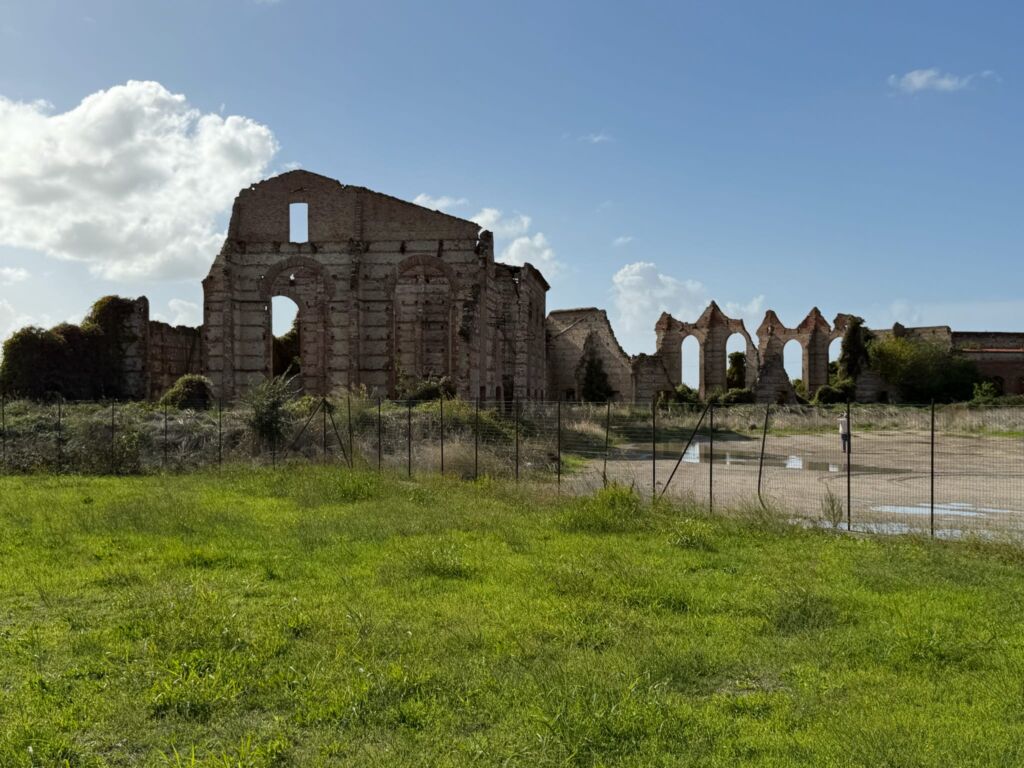
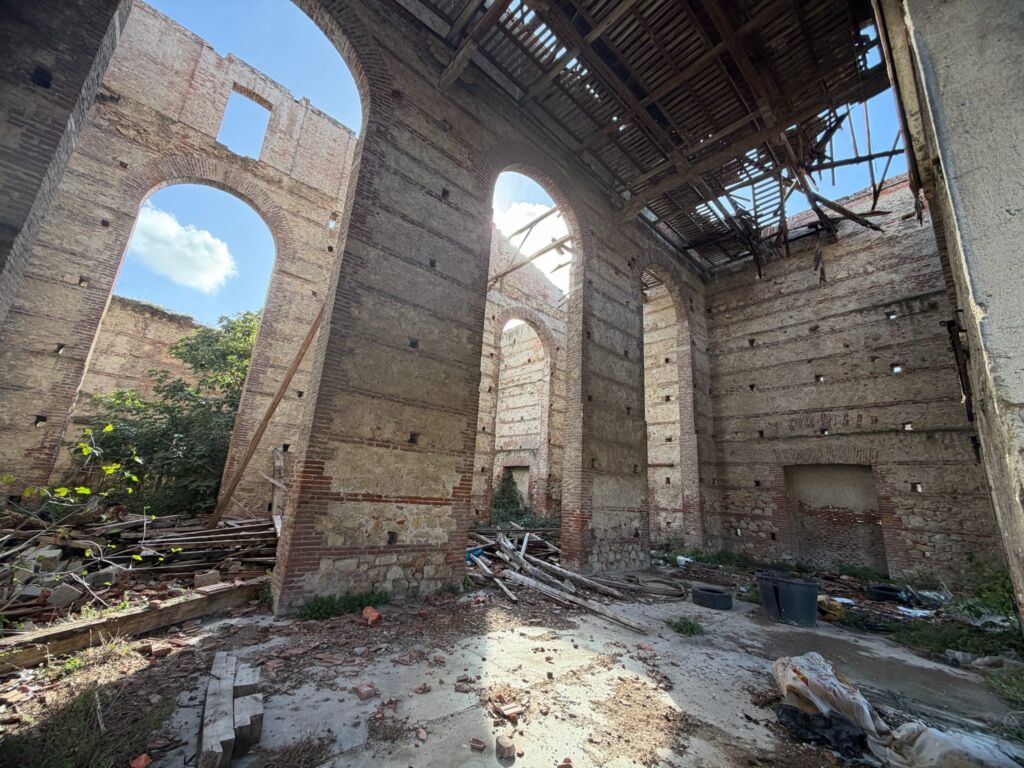
The old Tobacco Factory, near the tiny town of Eboli, is not exactly a tourist attraction. There are no ticket booths, souvenir shops, or, until last month, even a sign indicating what happened here 83 years ago. Instead, just a dirt and gravel road, weeds growing through the rubble, and a couple vagrant dogs quietly observing our arrival.
From September 11-18, 1943, these haunting brick and concrete buildings were the scene of some of the fiercest fighting of the Allied invasion of mainland Italy.
The factory, known in Italian as the Tabacchificio Fiocche, stood near the Sele River, ten miles inland from the beaches where American and British troops landed on September 9 in Operation Avalanche. The Allies’ goal was to surprise the Germans and seize the port of Naples. That would begin a quick campaign to liberate all of the Italian mainland.
But the Germans weren’t surprised. They were ready and well-equipped to throw the invasion force back into the sea.
The 16th Panzer Division met the invasion, and five other enemy divisions, and part of a sixth, rushed to Salerno Bay to launch counterattacks that exploited a seven-mile gap between the British 10th Corps on the left and the American 6th Corps, made up of the 36th Infantry Division and the 45th Infantry Division, on the right.
The 36th Division, a Texas National Guard unit that hadn’t seen combat, took the initial brunt of the German firepower. The 45th “Thunderbird” Infantry Division, another National Guard unit from Oklahoma, Colorado, Arizona, and New Mexico, was quickly sent in from its floating reserve in the bay to assist the Texans.
Two of the 45th’s regiments, the 157th and 179th Infantry, rushed inland to plug the dangerous gap between the British and the Americans.
The Tobacco Factory was key to sealing the breach. The mass of buildings, arranged in a circle, stood like a fortress on a slight rise overlooking roads and river crossings. Whoever held the factory could observe and fire upon troops moving through the surrounding countryside.
On September 11, the 157th Infantry, supported by tanks of the 191st Tank Battalion, advanced toward the factory. The 16th Panzer Division was waiting. When the American tanks got close, concealed German guns opened fire, knocking out seven of them. Machine-gun fire from the factory complex drove back the American infantry.
The Americans tried again the next morning. The men of the 157th Infantry managed to capture the buildings. But they couldn’t hold them. A couple hours later, the Germans came roaring back and drove the Americans out.
The factory would change hands amid repeated attacks and counterattacks with the Germans maintaining the dominant position there during the critical days of the battle.
On September 13, with their reinforcements in place, including the 29th Panzergrenadier Division and the 26th Panzer Division from Calabria, and the Hermann Göring Panzer Division from Naples, the Germans launched their most dangerous offensive against the American beachhead. The Americans pulled back and shrank their perimeter as German armor pushed toward the coast. Commanding General of the 5th Army, Mark Clark, ordered preparations for an evacuation of the beach.
But then, just in time, devastating naval gunfire from the USS Philadelphia (CL-41) and other American cruisers, destroyers, and British warships helped to halt the German advance. The Philadelphia especially trained its sights on the roads around the Tobacco Factory.
Also arriving in the nick of time were the 158th and 189th Field Artillery Battalions of the 45th Infantry Division. Their 105mm and 155mm guns were set up on a slope overlooking the Sele River and the path of the German Panzers. They directed their fire in such a way that the Germans could not counter. This fire gave the Americans time to reorganize their defenses, receive reinforcements, and begin a counterattack of their own.
The Germans finally withdrew from the area on September 18. The 157th Infantry occupied the Tobacco Factory later that day.
It had been a desperate and costly fight. Like so many other battles to come in Italy, the battle for Salerno was an Allied victory, but a much closer one than planners had anticipated.
Today, the old tobacco factory is a ruin. Much of the damage was caused by the fighting, some of it by a 1980 earthquake.
But, until last month, there was no memorial or acknowledgement of the role these buildings played in World War II.
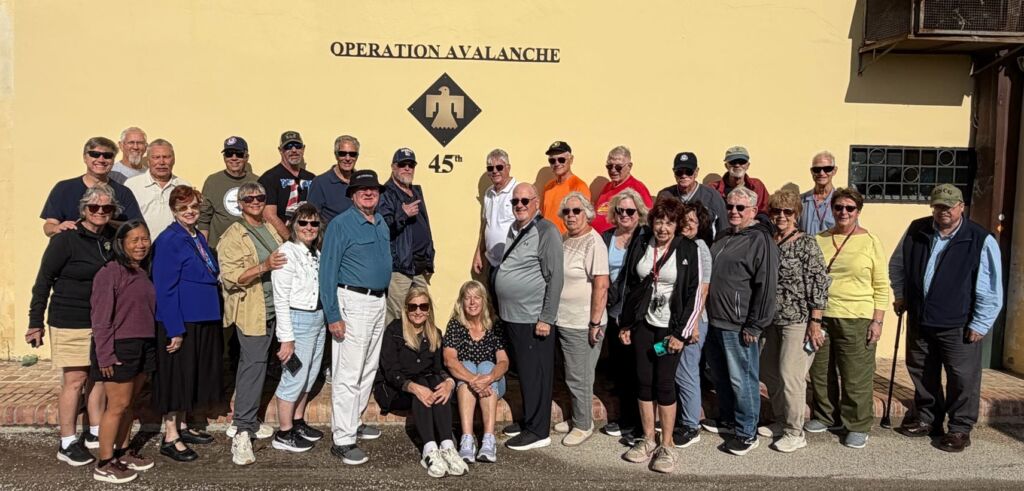
On September 9, 2026, the 83rd anniversary of the Salerno landings, a new plaque honoring the 45th Infantry Division was dedicated at the factory. The ceremony was part of a larger effort by the Oklahoma National Guard and its partners to commemorate the Thunderbirds’ World War II service in Italy.
Our friend, historian David D’Andrea, accompanied the Oklahoma delegation for the dedication. Dave has worked closely with Italian historians and communities to recover and preserve the history of the American campaign here. He sent us a photograph from the ceremony. A little over a month later, our tour group assembled around the same Thunderbird insignia.
History, of course, is always disappearing from our landscape, as it vanishes from living memory. But, if you look hard and study the past, you can uncover the stories contained in places like this, wrecked buildings hiding tales of drama, terror, courage, confusion, and loss.