

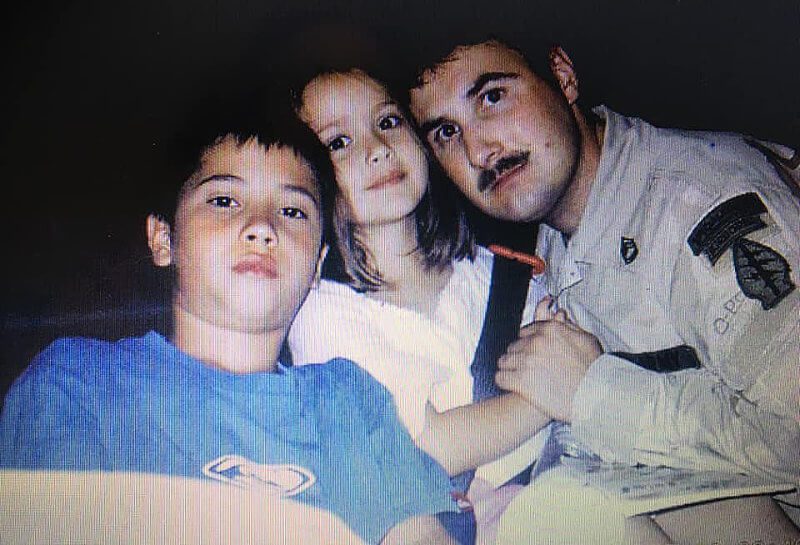
Andrew McCaffrey with two of his children. (The McCaffrey Family)
By Matt Cahill
Matt Cahill is the Founder and Executive Chair of Green Star Families. A retired U.S. Army Sergeant First Class and medic, he served with the 101st Airborne Division and later in the Pennsylvania Army National Guard. He holds a Master of Social Work and is a PATH Intl. Equine Specialist in Mental Health and Learning. His work focuses on supporting veterans and advocating for recognition of families impacted by veteran suicide.
Six years ago, my friend and fellow veteran, Andy McCaffrey took his life.
Four years earlier, standing in my kitchen late at night, we had made a promise to each other. It was not a dramatic conversation, and it wasn’t something either of us spent much time dwelling on afterward. We had both lived enough life to understand that there are places the mind can go when the weight becomes too much. Before the night ended, we agreed that if either of us ever found ourselves there again, feeling like we couldn’t take another step or make it through another day, we would call the other first before making a decision that couldn’t be taken back.
Andy never made that call.
I have thought about that fact more times than I can count. Over the years, I have replayed that conversation in my mind and asked myself the same questions again and again. Why then? What was weighing on him that day? What happened between the promise we made and the decision he ultimately made? Most of all, why didn’t he call? Like so many families and friends left behind after a suicide, I have learned that some questions will always remain unanswered.
One fact I do know the answer to is who Andy was.
I met him in 1995 at Fort Campbell, Kentucky, when we were both serving with the 101st Airborne Division. The pace was relentless, training schedules were endless, sleep in short supply, and everyone was expected to perform regardless of what hell their personal lives were in. It was the kind of environment where people revealed who they really were because there was very little energy left for pretending.
One afternoon, Andy came walking toward me with his hand held out and said, “Doc, I need stitches.”
At first, I thought he was joking. Then I looked down and saw he had managed to split his hand open trying to tear into an MRE with a bayonet. The cut was deep enough that it clearly needed attention.
That was my job, but there was one problem. I had never actually performed sutures on my own before. I had trained for it, done it under supervision, and been cleared to do it independently. What I had never done was sit in the dirt, surrounded by Soldiers, and be entirely responsible for the outcome.
I told him I didn’t have anything to numb the pain. He looked at me and, in true Andy fashion, said, “You got this, Doc.”
I became hyper-focused. The noise around us faded away, and it became just another task that needed to be done. Andy sat there while I stitched his hand back together without saying a word about the pain. More importantly, he never gave me a reason to doubt myself.
Looking back, I realize that moment was about more than his cut hand. Andy was helping me, a young medic, find confidence in my abilities before I had fully learned to trust myself.
That was Andy. There was never any façade with him. He was direct, honest, and comfortable in his own skin. You always knew where you stood because he didn’t mince words, and if he respected you, it was because you had earned it.
Over the years, our lives took different directions, but our friendship remained. Sometimes months would pass without us talking, and then one phone call would put us right back where we left off. The military has a way of creating friendships that endure. Time passes, people move, careers change, families grow, but some bonds never seem to fade.
I eventually left active duty and returned home to Pennsylvania while Andy continued serving and eventually found his way into Special Forces, deploying multiple times to Afghanistan. During one of those deployments, he was wounded in an explosion that took part of his arm. Most people would have looked at that injury and accepted that their military career was over. Andy looked at it as his next challenge.
That grit carried him through recovery and rehabilitation, and eventually he became the first amputee from Afghanistan to return to combat as a Green Beret. It was an extraordinary accomplishment, but if you knew Andy like I did, that probably wouldn’t surprise you. What mattered to him wasn’t making history. What mattered to him was getting back to his team and continuing to serve.
As time marched on and we got older, our conversations changed. We went from talking about adventure, chasing adrenaline, and figuring out what challenge we wanted to tackle next to talking about injuries, surgeries, recovery, and the things that stay with people long after military service ends. Like most veterans know all too well, we talked about pain, both visible and invisible.
The promise Andy and I made that night happened during a visit in 2016 when he and his wife came to stay with us. It was late, everyone else had gone to bed, and Andy and I were standing in my kitchen talking. The conversation wandered through old memories before eventually landing on subjects most veterans rarely discuss out loud, and almost never with anyone else.
By that point, I had my own experiences with dark places. Years earlier, I had contemplated ending my own life and came far closer than I care to admit. So when Andy and I started talking about those dark places, I knew exactly what he meant. I understood how convincing those thoughts can feel when you’re in the middle of them and how difficult it can be to see a way through.
We understood each other without having to explain every detail because some experiences create their own language, even in silence. Before the night ended, we made a promise. If things ever got bad enough, call first.
He never made that call.
In August of 2020, Andy ended his life.
The following year, after pandemic restrictions eased, Andy’s former First Sergeant and close friends held a Viking funeral, just as Andy had requested. I attended and spent time with his daughter, Izabel, who was trying to make sense of a loss that would never fully make sense.
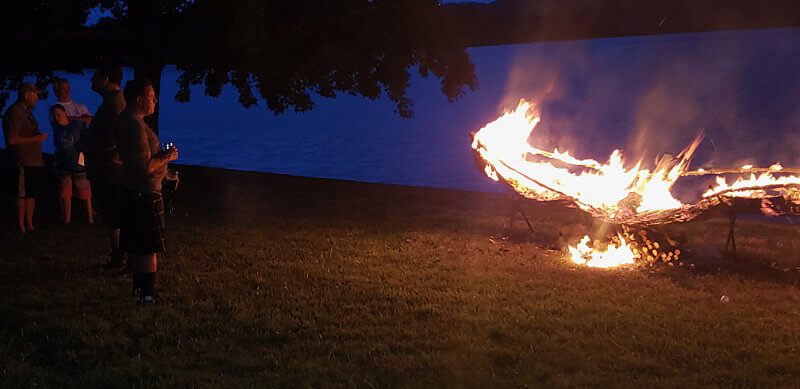
Andrew McCaffrey’s Viking Funeral, 2021. (The McCaffrey Family)
During our conversation, she told me about something that happened while she was traveling to the funeral. She had a layover along the way, and at some point the weight of everything caught up with her. Overwhelmed with grief and exhausted from the journey, she went to the airport USO facility looking for a quiet place to sit, collect herself, and find refuge in an area she felt comfortable in.
At first, she was turned away and found herself having to explain who her father was, his military service, and why she belonged there before she was eventually allowed inside.
Eventually, the situation was resolved, and she was able to get the rest she needed, but that wasn’t what stayed with me.
What stayed with me was the thought of a young woman traveling to her father’s funeral, carrying a grief most people will never understand, and finding there was no place for her to go. She was hurting, she was alone, and she was trying to make sense of losing her father. I couldn’t stop thinking about that.
The more I thought about that conversation, the more it bothered me. I wanted to know if Izabel’s experience was unusual, and what I discovered was that it wasn’t.
After the funeral, I found myself talking with surviving spouses, parents, children, and siblings from across the country. Their stories were different, how it happened was different, but I kept hearing the same things. They felt invisible after the suicide. They were grieving while also trying to figure out where they fit and whether anyone understood what they were carrying.
Andy’s family was not the exception. There were thousands of families across this country trying to make sense of a loss that would never make sense. They were looking for community and for recognition. They just wanted reassurance that they had not been forgotten.
That is when Green Star Families was born.
It was born from the belief that Izabel should never have felt alone while traveling to her father’s funeral, or been made to feel like she didn’t belong. It was born from conversations with families who felt invisible after losing someone they loved. Most of all, it was born from the belief that these families have nothing to be ashamed of, that they matter, and that they deserve to know they have not been forgotten.
I know that nothing will change what happened to Andy. Nothing will answer every question his family still carries, and nothing will erase the loss felt by those who loved him. What we can do is make sure families facing similar losses know they are not alone.
When people ask why Green Star Families exists, my answer is simple. It exists because behind every veteran suicide is a family whose life changes forever.
Andy never made that call, and his daughter should never have had to feel alone and wonder where she belonged.
These families deserve to be seen. They deserve to be supported and honored. They deserve meaningful recognition, not to be treated as an afterthought. Most of all, they deserve to know they have not been forgotten.
 Legislative Update
Green Star recognition continues to gain momentum across the country.
At the federal level, the Sgt. Walter F. Hartnett IV Green Star Veterans Service Act (H.R. 6022) remains under consideration in Congress and has gained additional bipartisan co-sponsors.
At the state level, California became the first state to formally recognize Green Star Families when SCR 154 was adopted on May 29, 2026.
Pennsylvania followed with House Bill 2449, which passed the Pennsylvania House with bipartisan support and now moves to the Senate.
While there is still work ahead, these milestones represent meaningful progress toward ensuring families impacted by veteran suicide are seen, recognized, and no longer feel invisible.
For updates and information, visit GreenStarFamilies.org.
