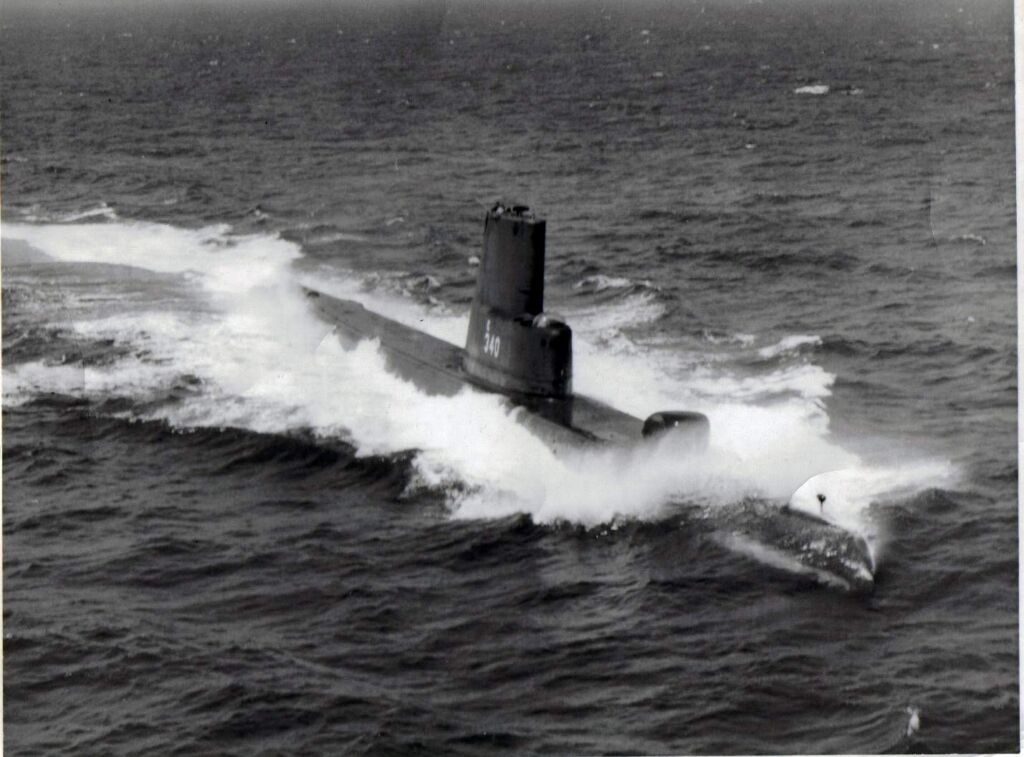
Navy Cold War submarine veteran Gene Rutter recently shared this story, which was published in The Silent Service Remembers, Volume 3 by Charles and Frank Hood. Gene shared this story in response to a recent VBC Bulletin, which included a story about the USS Nautilus sailing under the North Pole on August 3, 1958, a first for a submarine. Gene at that time was aboard the USS Entemedor (SS-340), in the midst of the Lebanon Crisis, with only noodles to eat.
All hands aboard the USS Entemedor (SS-340), that is to say, all my shipmates and I, were looking forward to port of Copenhagen, Denmark in the summer of 1958. At the time, I was an ET3(SS)—electronics technician with qualification in submarines, for those not familiar with the syntax. Our skipper was Lieutenant Commander W. E. Nicklas, Jr.
I had been on board the Entemedor for more than two years, having completed several Med cruises and local anti-submarine warfare (ASW) operations near our home port of State Pier in New London, CT. The boat had only very recently completed a major overhaul at the Philadelphia Naval Shipyard. As we passed The Little Mermaid, the iconic bronze statue along the promenade that welcomed sea visitors to the harbor, we could not wait to see the many attractions of Copenhagen.
At the top of the wish list was the Tivoli Gardens amusement park, the Scandinavian predecessor of Disneyland that featured rides, games, and other diversions. (Fun fact: Four years before Disneyland opened in Anaheim, CA, Walt Disney and his friend Art Linkletter visited Copenhagen in the summer of 1951. Disney was so enthralled by the beauty of Tivoli Gardens that he drew much of his inspiration for Disneyland from his observations during that trip.)
Once we were tied up at the pier, the liberty call was given, and all hands (except for the skeleton crew standing watch) left the boat to see the sights of Copenhagen. It was a perfect destination for a group of guys eager to set foot on dry land and enjoy some well-deserved downtime. We were supposed to be there for about a week as I recall, and the first two days passed with little or no major incidents.
However, on the third day, we were ordered back on board for an on-deck muster. This came as a total surprise, The Captain said that we would be leaving as soon as possible, which caused some concern, especially to some of more seasoned crew members. Why did we have to suddenly leave Copenhagen so quickly?
A crisis had developed in Lebanon (also known as the Lebanese Civil War of 1958) that had demanded a US military intervention. As a result, there was concern that our Cold War adversaries, the Soviets, might try doing something from their ports in the Barents Sea. We were needed at sea to monitor such activities.
Let me explain a bit more about the misleadingly named Lebanese Civil War of 1958. Egypt was at the real heart of the conflict. It began when the charismatic young leader Gamal Nasser, an ardent Arab nationalist, won the presidency of Egypt in 1956. Nasser’s socialistic government aligned itself with Soviet interests and incited a similar Arab-minority backlash in nearby Lebanon.
President Eisenhower had established a doctrine recognizing the strategic value of the Middle East for western Allies and establishing the need to intervene to protect regimes considered threatened by the advance of Soviet communism.
Because of the growing threat of rebellion in Lebanon by the Muslim population, Eisenhower sent US Marines to Beirut to help bolster the Lebanese government. In one of the first instances of US military invasion upon foreign soil since World War II, thousands of US troops stormed the beach during “Operation Blue Bat” just south of Beirut and seized control of Beirut’s main seaport and airport.
The brewing international crisis was resolved by the installation of a moderate Christian as the new president of Lebanon, which led to a quelling of the Muslim unrest. Of course, the vast majority of the submarine crew had no idea of these events as we were enjoying our R&R in Copenhagen.
It was during the final preparatory phase of Operation Blue Bat that the Entemedor had been hastily called back into action to provide sea support if needed.
With little advance notice, we did manage to get underway, but not without causing a major problem: we were short on food supplies (stores). Normally when a Navy ship heads into port, the first order of business is to replenish the depleted stores—just in case circumstances warranted a quick turnaround, as in our case.
Unfortunately, that did not happen on the Entemedor during our visit to Copenhagen. Why the stores loading had not promptly occurred wasn’t clear at the time that we hurriedly shoved off.
During a typical stores-loading party, every available space—and then some—was filled as tightly as possible with as much food as we could carry. The Navy knew how important good food was to the morale of every ship, especially those of us in the Submarine Force.
With no loading of fresh fruits, vegetables, eggs and dairy products, and no restocking of frozen meats and canned goods, we were very limited in the available dietary choices for the duration of our mission. What were the commissarymen (essentially cooks, now called “culinary specialists”) going to do under such circumstances?
A quick check of our depleted food inventory revealed many unused boxes of…noodles. Yes, we had plenty of noodles shoved into nooks and crannies all over the boat, but otherwise there was nothing substantial to eat.
So, for the next 30-40 days on mission, our cooks found some very creative ways to prepare noodles…although there were only so many ways to prepare them. The cooks tried steaming them, baking them, and even frying them, scrounging whatever little else was available to accompany them.
Nevertheless, no matter how they tried to vary our meals, noodles remained the primary culinary offering. To their credit, they tried to vary the preparations from one meal to the next, but the bottom line was that every meal served was primarily noodle-based.
The crew grumbled about the monotony of eating noodles and more noodles, but they lay most of their frustration at the feet of the head cook. It had been his responsibility to get the stores loaded, they assumed, and he failed to do so.
As you might imagine, the head cook became the butt of some nasty pranks. These included wrapping a chain around his bunk to keep him from getting comfortable in bed and then loudly waking him up only a few minutes after he had managed to fall asleep.
Needless to say, there were some very hard feelings. I should hasten to add, however, that despite being the target of several pranks, the head cook never got upset or even mentioned the reason that the stores had not been promptly loaded on board in Copenhagen.
I saw that as a remarkable display of allegiance and a fine credit to his character and his service to the Navy. Personally, I lost about 30 pounds during the “Noodle Patrol”. I got so sick of eating noodles that I vowed never to eat them again. This aversion to noodles persisted with me for over 40 years.
As they say, time is the ultimate healer, and that’s how long it took for me to even consider trying them again. I started off with chicken noodle soup and expanded from there, but even now, I prefer other foods.
Many years later, after I joined the Tarheel Base of the USSVI, I happened to learn a little more about why the head cook had seemingly dropped the ball by not getting our food stores on board. During a meeting in Elizabeth City, I described the noodle incident to a fellow shipmate.
He was quite familiar with the story, as it turned out—and he informed me that the lapse in loading stores had NOT been the head cook’s fault.
Someone higher in the chain of command, he insisted, had ordered the head cook to hold off on the evolution until a scheduled shipment of hot dogs had arrived at the pier. As a result, no stores had been loaded when the Lebanon situation suddenly escalated, and we departed on such short notice.
That’s why the Noodle Patrol happened. At least my sad sea story had a happy ending. When we finally returned to the States and transited up the Thames River to the State Pier across from Electric Boat, we spied two large containers waiting for us on the dock.
Imagine our surprise when we opened the containers: each one was loaded with a hundred pounds of fresh live lobster! After weeks of noodles, we were in food heaven. Personally, I consumed eight lobsters, cleaning every bit of meat possible from the body and claws.
My reward? A full stomach, but a big case of indigestion.