
Pittsburghers on the road delight is discovering hometown connections thousands of miles away. On one of our final days in Italy, we stumbled across a great Pittsburgh WWII story in the sprawling Piana delle Orme Museum near the Anzio beachhead south of Rome.
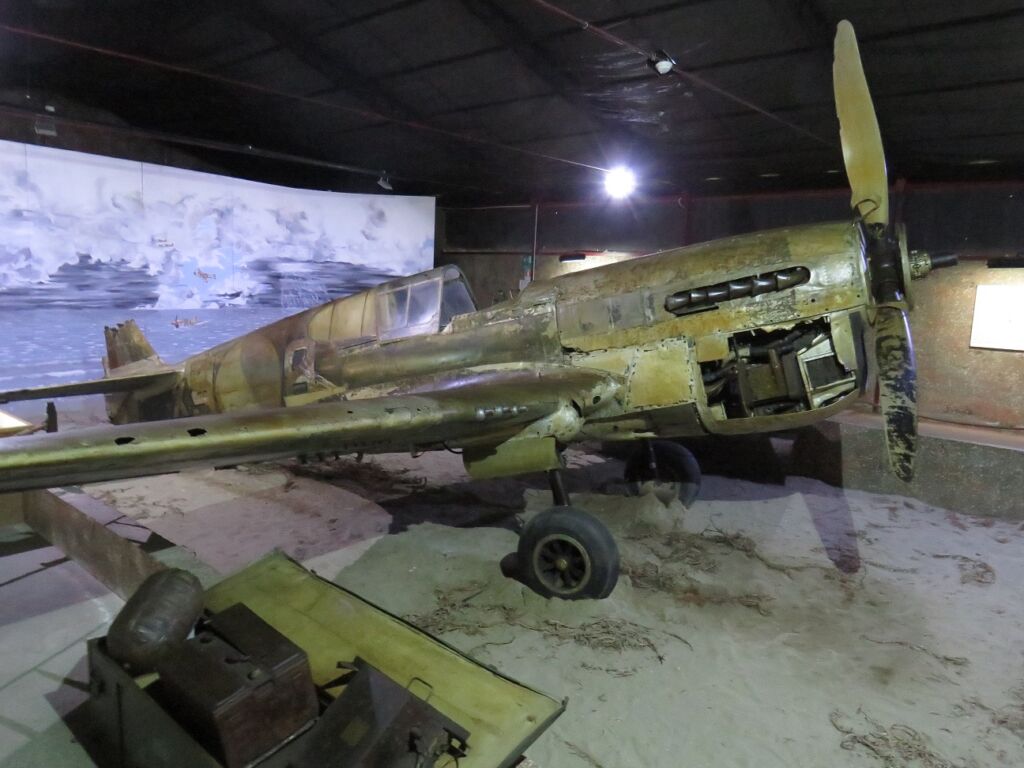
Our Italian guide, Annarita, was leading us through the museum’s World War II exhibits when we came upon the battered remains of an American Curtiss P-40L Warhawk, one of the workhorse fight aircraft for the Allies in World War II. This Warhawk had spent 54 years at the bottom of the Mediterranean before being recovered in 1998.
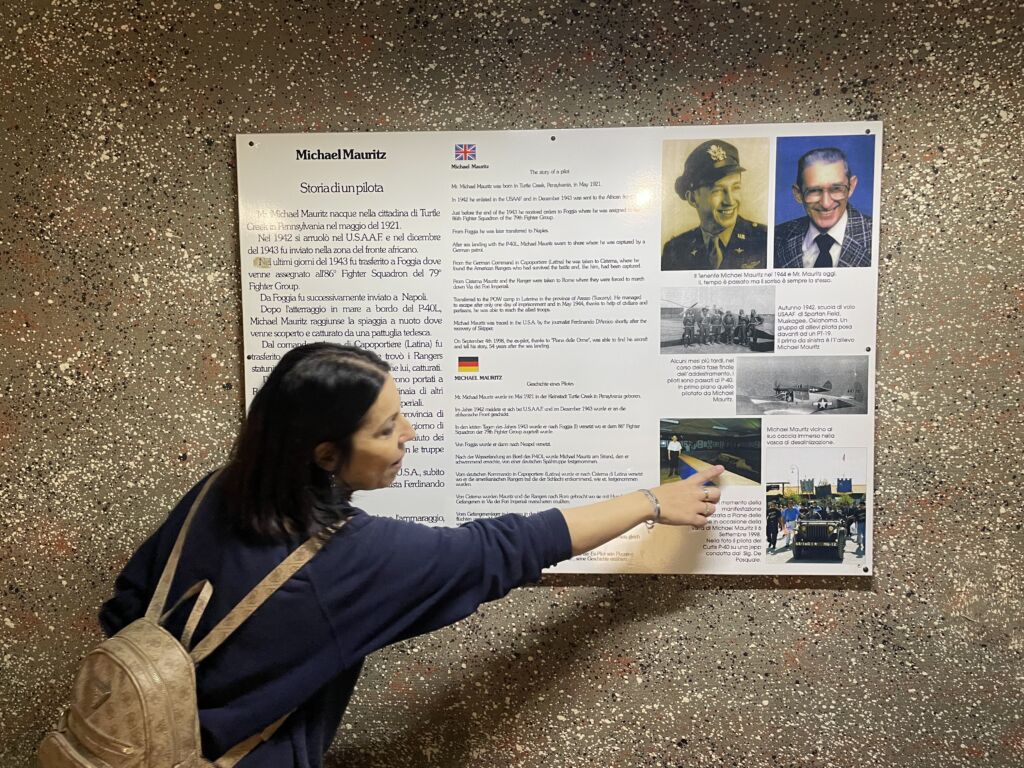
And the pilot who had landed it in the water on January 31, 1944? Second Lieutenant Michael Mauritz of Turtle Creek, Pennsylvania.
“Turtle Creek!” we exclaimed at once.
Annarita was astonished to discover visitors who’d actually had heard of Turtle Creek and knew exactly where the old Westinghouse manufacturing town was.
In an instant, this old World War II airplane became imbued with almost personal significance for all of us.
Michael Mauritz was born in Turtle Creek in May 1921. He joined the U.S. Army Air Forces in 1942 and was assigned to the 86th Fighter Squadron of the 79th Fighter Group, flying missions in the Mediterranean theater.
On the morning of January 31, 1944, nine days after the Allied invasion of Anzio, Mauritz was assigned a low-flying reconnaissance mission the beach. His plane for that day was nicknamed Skipper, serial number 42-10857.
The P-40 was one of America’s most important fighters at the beginning of World War II, but it was soon outshone at high altitudes by more advanced fighters like the P-47 Thunderbolt and P-51 Mustang. Most of the 14,000 Warhawks produced during the war disappeared soon after, scrapped as obsolete. Unlike the P-51 Mustang, the P-40 had relatively little value once newer fighters became available.
Thus, the Skipper is one of the few P-40s left around and the only surviving example of lightweight “L” variant.
One of the charms of this museum piece is that it hasn’t been restored to gleaming perfection. It’s still a battered aircraft as it emerged from the sea, with its faded camouflage and missing parts.
Mauritz was flying Skipper with a squadron of twelve other P-40s at 800 feet, watching for German aircraft. He noticed his engine temperature climbing dangerously. The coolant gauge reached 150 degrees Celsius. Whether the trouble resulted from mechanical failure or enemy ground fire was uncertain, but the engine was overheating, and Mauritz knew he couldn’t keep flying.
He broke formation, jettisoned his external fuel tank, and brought the P-40 down on the unusually calm Mediterranean about 300 feet offshore, a perfect emergency landing.
Mauritz escaped from the sinking aircraft and made his way to the beach and took refuge in some bushes. But the enemy was all around him and within minutes three German soldiers took him prisoner.
From there, after being paraded in Rome with other POWs, Mauritz was taken to a prison camp at Laterina in Tuscany. As it happened, Mauritz arrived with about 700 members of Darby’s Rangers, who’d been captured at the disastrous Battle of Cisterna a day or two ater Mauritz’s emergency landing.
Rangers being as they are, they determined to escape captivity, and Mauritz joined them, partnering with a Ranger captain. He spent the next five months behind enemy lines, using shoeshine to dye his light hair dark to blend in with Italian locals.
The Italian people were unfailingly supportive in his efforts to evade capture, risking their own lives to hide Mauritz in stables and even their own homes.
In June 1944, the pilot made it to the 15th Air Force base at Foggia and was repatriated back to the United States. After the war, he went to work and retired from US Steel in 1985.
Meanwhile, Skipper collected barnacles in the shallow waters in the Gulf of Gaeta, where it had come to rest in January 1944.
That’s where the Skipper came to the attention of an Italian businessman named Mariano De Pasquale, who possessed an extraordinary passion for collecting 20th century artifacts of his beloved Anzio region.
De Pasquale had born in Sicily in 1938, moved to the Italian mainland south of Rome as a teenager and made a fortune as a flower exporter. The swamplands that became his flower beds had been reclaimed during Mussolini’s era, turning marshes into rich farmland. As De Pasquale aged, he began collecting farm equipment and machinery. That collection expanded to include military vehicles and other artifacts from World War II.
In 1997, he opened Piana delle Orme, a massive open-air museum with a dozen large pavilions covering over 300,000 square feet devoted to preserving the history of the region and its people.
When De Pasquale heard that local divers had discovered Mauritz’s P-40 lying about 30 feet underwater, he determined to recover it for his museum.
In January 1998, the Skipper came to the surface in remarkably complete condition after 54 years underwater. Italian aviation historian Ferdinando D’Amico helped trace the aircraft to Michael Mauritz, still living in Turtle Creek. De Pasquale invited Mauritz and his family to Italy as his guests that September, arranging a celebration at the museum and even an audience with Pope John Paul II.
De Pasquale also invited Romano Mussolini, the jazz pianist and son of Italian dictator Benito Mussolini, to perform at the ceremony welcoming the American pilot.
Mauritz was overwhelmed by the attention. “It’s like a dream,” he said.
Three years before his death in 2005, Mauritz published a book about his adventures, The Secret of Anzio Bay: A True Story of an American Fighter Pilot in World War II Italy.
Outside Italy, Mariano De Pasquale’s Piana delle Orme Museum remains relatively obscure. It lacks the international reputation of the Imperial War Museum in London, the National WWII Museum in New Orleans, or the museums of Normandy.
But if you want a good look at a P-40L and hear a great WWII story with a Pittsburgh connection, it’s the only place to go.
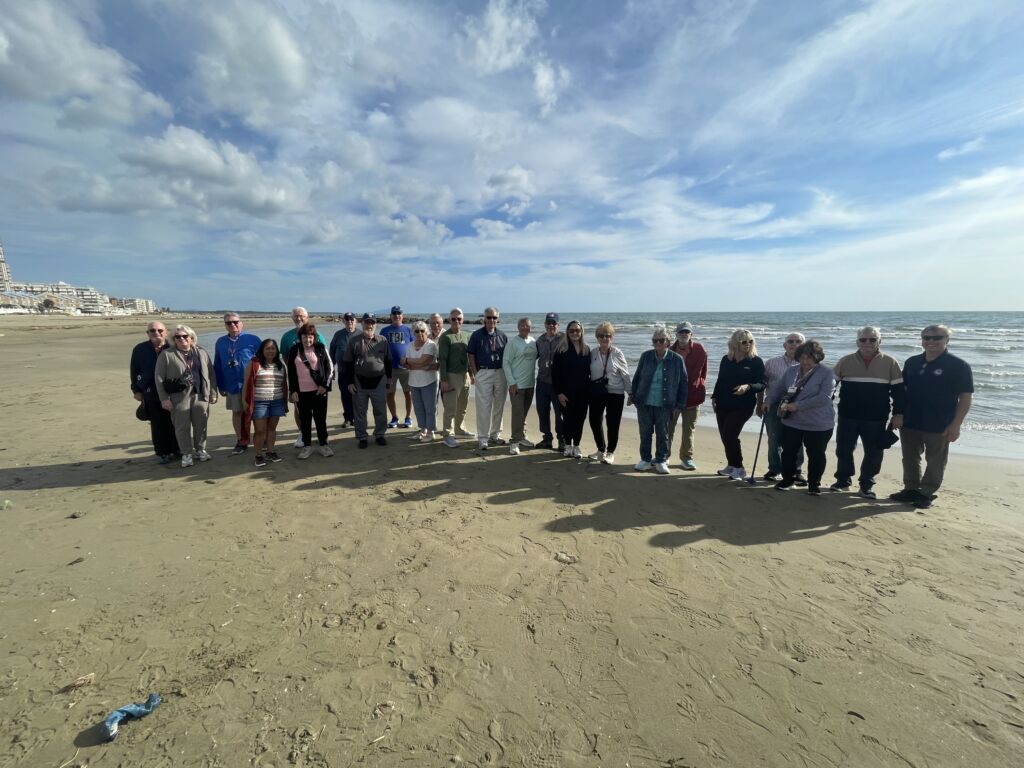
Later that afternoon, we gathered on the beach near Nettuno where the Allis landed on January 22, 1944.