

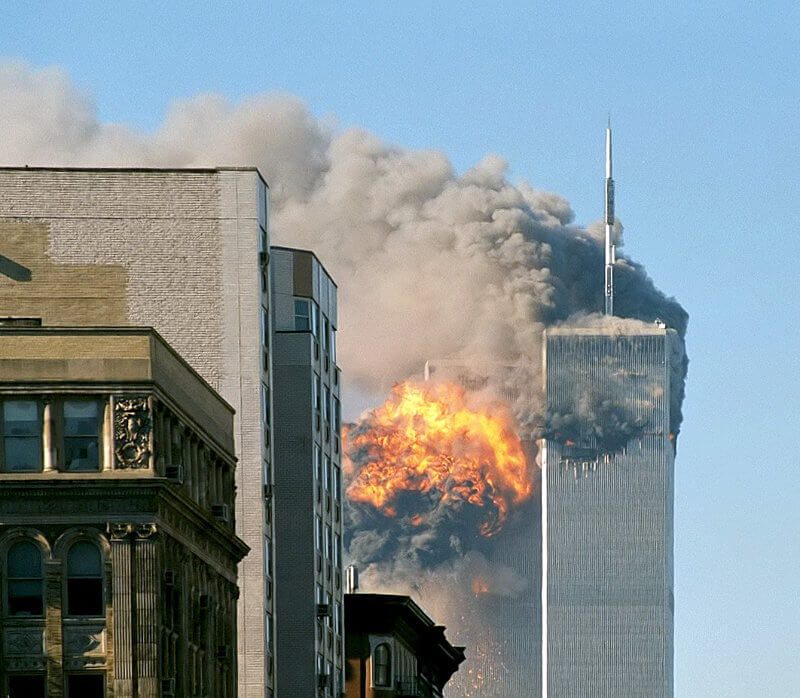
United Airlines Flight 175 hits the World Trade Center’s south tower, September 11, 2001. (Public domain)
By Todd DePastino
On September 11, 2001, nineteen young men boarded four commercial airliners and changed the course of American life—or so it seemed.
Most of us who were alive that day remember exactly where we were when we saw images of smoke pouring from the North Tower of the World Trade Center. We remember the second plane striking the South Tower live on television. And then, 56 minutes later, that same tower collapsed, followed by its North twin at 10:28am. Meanwhile, another hijacked airplane hit the Pentagon, and reports came in of a fourth crashing into a Pennsylvania field after passengers fought back.
Just writing this brief account makes my stomach flip as it did that morning, as my shock and confusion gave way to a profound sense of doom. Out of the clear blue, everything had suddenly changed.
Now, twenty-five years later, the attacks of September 11 have crossed a threshold. They are no longer merely memories. They belong to history, which, theoretically means they can be examined at a critical distance without one’s stomach flipping.
A generation of Americans has grown up with no personal recollection of that day. More than a third of Americans today are thirty years old or younger. For them, 9/11 belongs to the same category as the fall of the Berlin Wall, the assassination of John F. Kennedy, or the moon landing: events they know through photographs, documentaries, and the memories of older people.
That passage from memory into history raises a question historians ask about any major event: What did it mean?
The answers are rarely simple and not always even obvious.
Some events that seem earthshaking at the time fade into obscurity. Others grow larger with the passing years. Sometimes an event’s significance turns out to be entirely different from what contemporaries imagined.
Consider the Black Tom Island attack of July 30, 1916. In the middle of the night, German agents detonated a massive munitions depot on a small island in New York Harbor. The resulting blasts, one of the largest non-nuclear explosions in history, shattered windows across Manhattan, damaged the Statue of Liberty, and registered as a small earthquake. Newspapers treated it as a national crisis. Americans wondered whether the nation was under attack.
Today, almost nobody remembers it.
Or consider the Whiskey Rebellion of 1794. Armed resistance to federal authority spread across the trans-Appalachian West. President George Washington personally led troops west to suppress the uprising in Western Pennsylvania. Many Americans feared the young republic might collapse before the Constitution had even taken root.
Today, outside the Pittsburgh region and a handful of history classrooms, the Whiskey Rebellion is little more than a footnote.
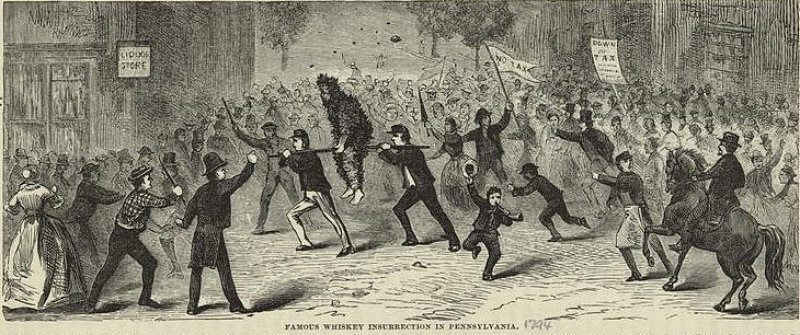
The Whiskey Rebellion, 1794. Illustration from R.M. Devens’ 1882 book, Our First Century. (Public domain)
Other events remain permanently etched in our national memory. Pearl Harbor is one example. Nearly every American knows the date: December 7, 1941. Yet historians point out that the deeper forces drawing the United States into World War II were already in motion. Pearl Harbor accelerated decisions, unified public opinion, and provided a dramatic turning point, but it did not create the global conflict that followed.
Twenty-five years later, historians are beginning to ask whether 9/11 may ultimately occupy a similar place in history.
The attacks themselves were extraordinary. Nearly 3,000 people were killed. The World Trade Center was destroyed and the Pentagon damaged. These mighty symbols of American economic, military, and political power came under direct assault. The result was an enduring spectacle of horror that we’ll never forget.
But the attacks of 9/11 weren’t just spectacle. They were also strategy. The nineteen hijackers who carried them out were not attempting merely to destroy buildings. They were after something bigger.
The men came primarily from Saudi Arabia, along with Egypt, the United Arab Emirates, and Lebanon. Many had spent years preparing under the direction of Osama bin Laden and al-Qaeda. Their goal was not simply to kill Americans but to provoke a larger conflict, to draw the United States into a prolonged struggle across the Islamic world that would exhaust American power and inflame anti-American sentiment. Then, US-backed “apostate” regimes in the Middle East, such as Egypt, Jordan, and Saudi Arabia would be overthrown and replaced by a single transnational caliphate ruled by Sharia law.
The attackers failed to achieve their strategic goals. Al-Qaeda never sparked a global Islamic uprising. It never drove the United States from the world stage. The apostate states are still around, and there is no caliphate. The spectacle of 9/11 endures in our memory. But the strategy behind it is dead and forgotten.
On the American side, most of us woke up on September 12 believing that terrorism would now be an omnipresent threat and the dominant form of warfare in the twenty-first century. But large-scale terrorist attacks inside the United States and Europe after 9/11 proved remarkably rare. The homeland remained far more secure than we had first feared.
One thing Al-Qaeda did successfully trigger was a far-reaching American military response, though not the one bin Laden had imagined.
The years immediately following 9/11 produced a sweeping reorientation of American foreign and domestic policy. President George W. Bush adopted what he called the Freedom Agenda, an ambitious strategy rooted in the belief that terrorism flourished in societies marked by dictatorship, repression, and corruption. If democracy could be spread across the Middle East, the theory held, the conditions that produced terrorism would disappear.
It was, perhaps, the most ambitious American foreign-policy project since Woodrow Wilson’s attempt to re-draw the map of Europe and re-write the rules of international order at the end of World War I.
The United States invaded Afghanistan in October 2001 to destroy al-Qaeda and remove the Taliban regime that had sheltered it. Initial military operations succeeded quickly. Al-Qaeda’s training camps were destroyed, and the Taliban collapsed . . . but the war in Afghanistan continued.
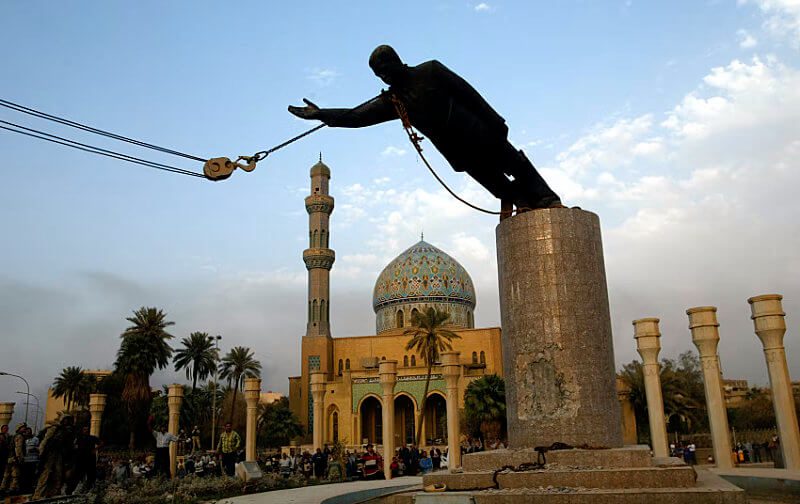
Statue of Saddam Hussein being toppled in Bahgdad’s Firdos Square after the US invasion, April 9, 2023. (DoD)
In 2003, the United States invaded Iraq. Although Saddam Hussein’s regime had no operational role in the September 11 attacks, administration officials argued that the risks posed by hostile regimes in the post-9/11 world were too great to ignore.
Saddam Hussein was overthrown in weeks. There, too, however, the war continued.
What followed were two decades of counterinsurgency, nation-building, military deployments, and strategic frustration.
Today, Afghanistan is once again governed by the Taliban. After twenty years of war, the last American troops departed in August 2021, and the government the United States spent two decades supporting collapsed in a matter of days.
Iraq presents a more complicated picture. Saddam Hussein’s brutal dictatorship is gone, and Iraqis enjoy civil society, even elections, to an extent unknown before Saddam’s ouster. Yet years of insurgency, sectarian violence, and chaos have left Iraq fragile and under the thumb of neighboring Iran. Hundreds of thousands of Iraqis died in the turmoil that followed the invasion. The survivors live in a country far removed from the democratic model envisioned by advocates of the Freedom Agenda.
Whether Iraq is better off than it was in 2001 remains fiercely debated. What is less disputed is that the Freedom Agenda failed to achieve its grandest objectives.
The United States emerged from the experience more cautious about large-scale nation-building efforts than at any time since Vietnam.
Perhaps the greatest historical consequence of 9/11 lies in the opportunities and priorities it displaced.
When the Twin Towers fell, the United States was without peer, standing at the height of its global power and prestige. Historians call it the “unipolar moment” after the Soviet Union had collapsed and the Cold War ended. No other country could challenge American preeminence. Globalization appeared unstoppable. And, extrapolating from what was happening in Eastern Europe, some policymakers believed that expanding democracy would make great-power war obsolete. Future conflicts would be limited, short, and decisive.
The military itself reflected those assumptions. It was shrinking after the Cold War and focusing on rapid, high-technology conventional warfare, the kind of fighting exhibited in Operation Desert Storm in 1991.
Then came 9/11. It was almost as if, in the vacuum created by the collapse of a rival superpower, a small but deadly network had grown, committed not to national ideals or interests, but to terrorizing the American people.
Homeland security suddenly became a military concern. Counterterrorism became a national obsession and counterinsurgency the central military mission.
For twenty years, the United States focused attention, resources, and strategic energy on wars in Afghanistan, Iraq, and related operations around the globe.
Meanwhile, another historical development continued largely in the background: the rise of China.
China’s economy skyrocketed in growth. Its military modernized by leaps and bounds, and its influence spread across Asia, Africa, Latin America, and the Pacific. By the time American leaders fully shifted their attention from Afghanistan and Iraq, China had become a great power. The vacuum left by the Soviet Union was filled not with scattered Islamic terrorists, but with a formidable strategic rival accounting for 20% of the world’s population.
Historians and strategists today ask themselves if China’s rise would have happened the way it did without 9/11. The consensus seems to be that, yes, China was destined to become a great power. But, if the US had never launched its Global War on Terror, that rise would have been slower and more tentative, hemmed in by American diplomatic, commercial, and military countermeasures in the Pacific. Those countermeasures came too late, after the wars in Iraq and Afghanistan had wound down. 9/11, says one Asia expert, “was a geopolitical gift to China.” China got a free hand to expand its power while the US was distracted by wars in the Middle East.
Today, twenty-five years after 9/11, Great Power Competition seems to be the big story of the twenty-first century, not terrorism. From this perspective, 9/11 seems less like the opening act of a new era than the closing act of one that began with the Iranian Revolution of 1979 or the Beirut Barracks Bombing of 1983.
In this sense, perhaps 9/11 accelerated trends already underway by intensifying the US war on Islamic terrorism that had begun in the 1980s. The most important legacy of 9/11 may not be the attacks themselves but the choices that were made later in response.
That’s usually how history works. Events that capture our attention are not always the events that shape the future. Sometimes the true significance of a moment lies not in what happened on a single day, but in how nations respond afterward.
September 11 will remain unforgettable. But the story historians will continue debating is not what happened that morning. It is what happened next.
