
By Todd DePastino
I thought I knew most of the little books, pamphlets, newspapers, and guides the U.S. Army produced for its troops during World War II. But Navy Corpsman veteran Michelle Wilcox gave me one I’d never seen before.
Michelle recently discovered it among the belongings of her late father, a World War II veteran who served in the Mediterranean Theater.
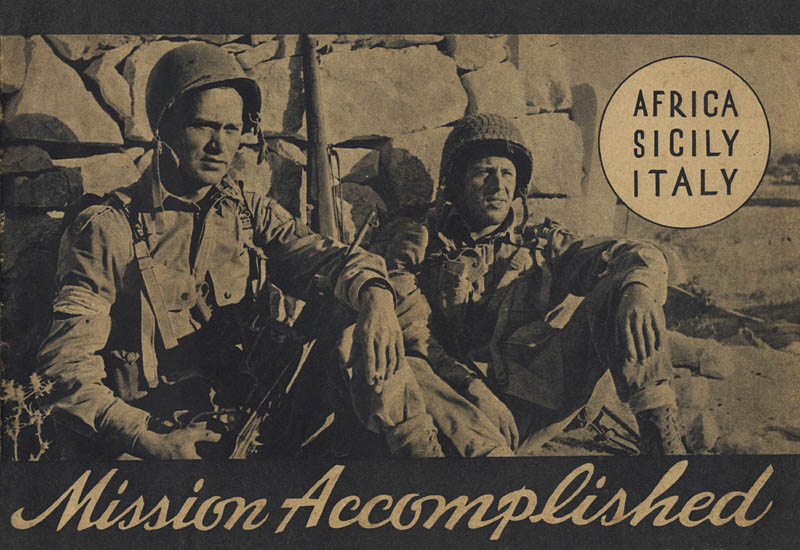
The cover caught my attention immediately: Mission Accomplished: Africa, Sicily, Italy. Inside are 24 newsprint pages (10.5″X by 7.25″), bound with staples, and packed with photographs, maps, headlines, and a well-written account of the war American troops had just finished fighting.
Mission Accomplished was published in 1945 by the Information and Education Section, Mediterranean Theater of Operations, United States Army—MTOUSA. It was published as a souvenir of service and didn’t circulate widely outside the ranks of Mediterranean Theater veterans.
The Army’s Information and Education program grew out of a peculiarly American problem: how do you turn millions of independent-minded civilians proud of their rights of citizenship into effective and obedient soldiers?
The Army believed these citizen-soldiers ought to understand why the orders they were to follow mattered. Ands why this new thing, an enormous Army of draftees and volunteers, was necessary. The goal wasn’t blind but informed obedience. The Army wanted soldiers to understand who they were fighting and how their own miserable little piece sof the war related to the larger global cause.
So the Army got into the media business in a big way. Frank Capra’s Why We Fight films, Stars and Stripes newspapers, and Yank magazine were all part of the effort. Soldiers were inundated with maps, pamphlets, and news summaries and were even supposed to sit through an hour-a-week lecture on the world situation and current events. The Army even surveyed hundreds of thousands of GIs to find out what they thought about everything from their officers and training to the enemy and the purpose of the war.
Normally, in an Army, information travels in one direction: downhill. But in WWII, the US Army made it a point to direct information uphill, from the ranks to the brass, in order to understand the American Soldier.
The idealistic assumption behind all this was that free men would fight better if they understood what they were fighting for. The concern, in other words, was morale.
Of course, the distinction between “information” and “propaganda” (a discredited term from World War I) was thin. The Army wasn’t entertaining a free debate about how big a threat Nazi Germany was to the United States or whether the war was good idea. The Information and Education Section’s job as to persuade men that their cause was just and their sacrifices necessary. But it had to be done with a light hand. No exaggerated stories of atrocities or vilification of a demonized “Hun,” as in World War I. You don’t lie to free citizens in a democracy to motivate them. You give them the facts, explain the stakes, and they will understand their role in the war.
So, Mission Accomplished isn’t an official or objective history. It wasn’t written primarily for the general public. It was produced for the people who had actually fought the war and reinforced the lessons and information they had received along the way.
GIs who came through North Africa and Sicily had slept in mud, eaten rotten rations, gone weeks without bathing, witnessed the darkest humanity has to offer, and seen friends killed and wounded. They’d marched through blasted rubble that were once towns with names they never knew and couldn’t pronounce if they had. Now, Germany had surrendered, and they were wondering when they could go home
The Army now handed them a fun little booklet that explained “WHAT IT WAS ALL ABOUT.”
The story starts in North Africa, where the U.S. Army first went up against the Germans in force, then moves to Sicily and finally Italy. The headlines give you the flavor: “OUR FIRST D-DAY.” “PROGRESS BY YARDS.” “THEY STOPPED US AT CASSINO.” “MUD, MULES, MOUNTAINS, MINES, MEN.” “IT TOOK GUTS TO STAY AT ANZIO.” “ATTACK! BREAKTHROUGH! ROME!”
Mission Accomplished trumpets Victory. But it never pretends it was easy or without gruesome sacrifice. The book gives you a story of sheer misery: wet mountains and roaring rivers, demolished bridges and mined roads, German defensive lines across the most difficult terrain imaginable.
It puts in words what the great Bill Mauldin offered in pictures: a story of exhausted, dirty, cold, and moralized soldiers who somehow endured the unendurable.
Mission Accomplished doesn’t have Mauldin’s skepticism or his wonderfully subversive sense of humor. It is, after all, an official Army publication. But the world pictured in its pages is recognizably Willie and Joe’s world.
Today, our popular memory of the American war in Europe is dominated by Normandy. The landing at Omaha Beach, the battle of the hedgerows, the Battle of the Bulge, and the final drive into Germany. The Mediterranean war often gets treated as a sideshow, a place where lessons were learned but the war bogged down.
Mission Accomplished explains to soldiers what their sacrifice had accomplished. It doesn’t question Allied strategy or ask if the Italian campaign was worth the cost. Command controversies aren’t addressed. Civilians are simply part of the landscape through which the 5th Army moved.
The book tells us, in a sense, less about the Mediterranean Theater of Operations and more about how the Army wanted its soldiers to remember their war. And when, down the road, your young daughter, perhaps named Michelle, asked, “Dad, what did you do in the war?”,you could hand her Mission Accomplished. This is where I was. This is what I did.
This October, Michelle is joining us on the Veterans Breakfast Club WWII Italian Campaign Tour, where we’ll travel from Sicily to Rome, following much of the same route described in Mission Accomplished. We begin around the Operation Husky landing grounds in Sicily, cross to the mainland, and continue through the Salerno sector, the Winter Line and Monte Cassino, Anzio, and finally Rome.
We advertised the tour as a chance to “travel in the footsteps of Bill Mauldin and Audie Murphy.”
For Michelle, however, she’ll be tracing the footsteps of her father.
Many thanks to Michelle Wilcox for preserving her father’s copy of Mission Accomplished and allowing the Veterans Breakfast Club to digitize it and make it available to everyone.
You can read the complete 1945 publication below.
